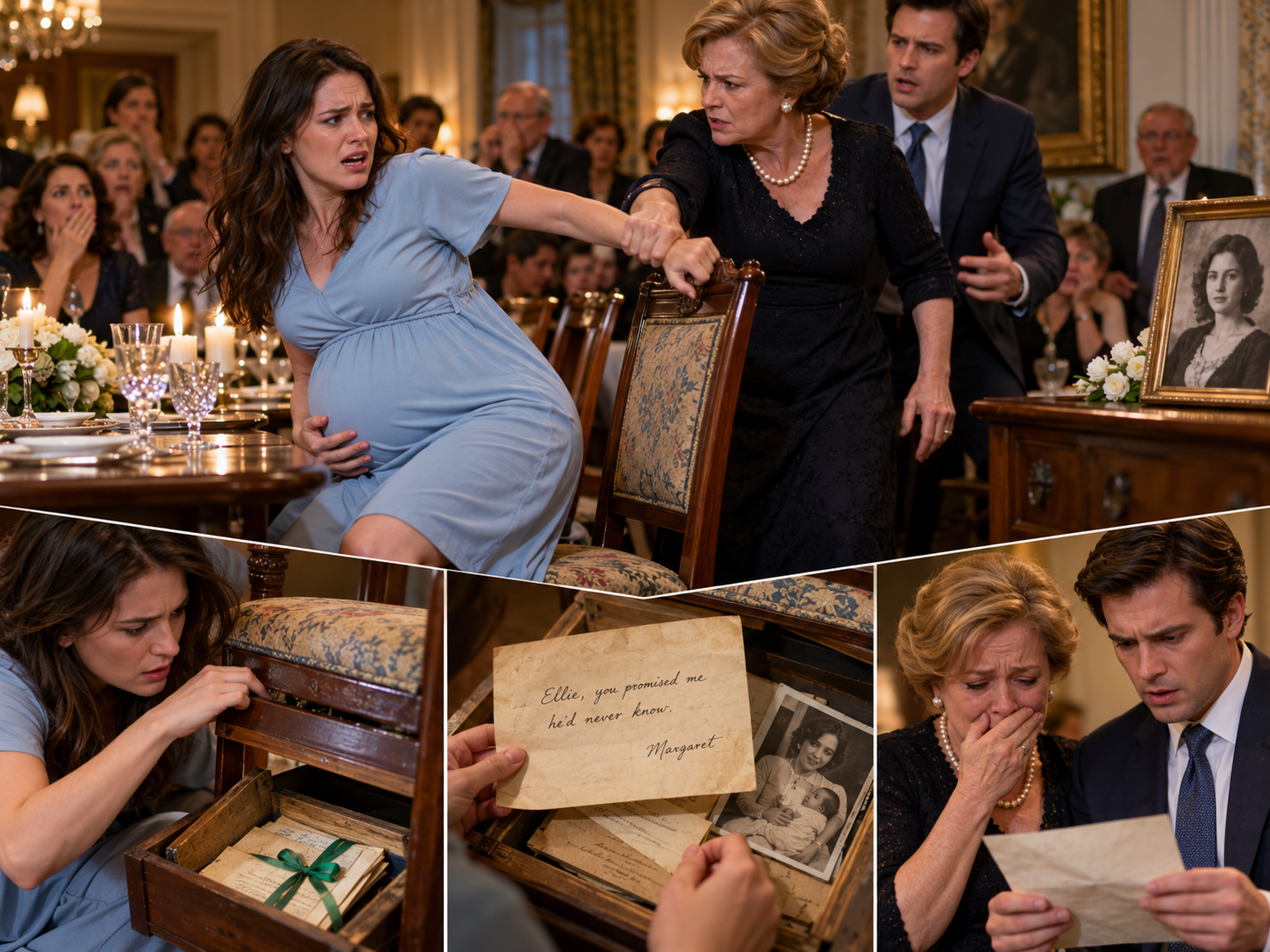
Daniel and I drove home Sunday morning mostly in silence.
The letters were in a document box on the back seat.
Eleanor had wanted to keep them.
Daniel had wanted copies.
Robert had finally suggested we take the originals temporarily so they could be scanned and preserved.
Eleanor agreed.
Reluctantly.
I kept looking back at the box.
Forty-six years of someone’s life reduced to paper.
At a red light, Daniel said, “I should have defended you.”
I looked out the window.
“Yes.”
His hands tightened on the steering wheel.
“I knew that chair was sensitive.”
“That isn’t the problem.”
“I know.”
“Do you?”
He took a breath.
“I should have stopped Mom the second she touched you.”
“Yes.”
“I should not have told you she was just emotional.”
“No.”
“I made you responsible for making her behavior comfortable for everyone else.”
I turned toward him.
That sentence mattered.
He had finally found the shape of what hurt.
“When you said that,” I told him, “I felt like I disappeared.”
His face tightened.
“I’m sorry.”
“I was standing there with my wrist burning and my side hurting, and you were worried about explaining your mother.”
“I know.”
“No.”
I shook my head.
“Don’t say you know unless you’re willing to understand why it happened.”
He glanced at me.
“What do you mean?”
“You've spent your whole life adapting to her.”
He didn't answer.
“You knew the chair mattered. You didn't know why, but you knew no one challenged her about it.”
“That’s true.”
“And when she crossed a line, your first instinct was not to confront her. It was to make the line disappear.”
He looked ahead.
The light turned green.
We drove.
After a while, he said, “You sound like Margaret.”
I stared at him.
He immediately winced.
“I didn't mean—”
“No.”
I looked at the box behind us.
“Maybe that’s exactly the problem.”
He waited.
I said, “Your family learned how to survive by not saying things.”
He nodded slowly.
“My mother learned that from her parents.”
“And you learned it from her.”
His eyes flicked toward my stomach.
“And I was about to teach it to our kid.”
The sentence settled between us.
There it was.
The real inheritance.
Not a chair.
Not letters.
Silence.
Daniel reached across the console.
This time, I let him take my hand.
Over the next week, the letters took over our kitchen.
We scanned every page.
We arranged them by date.
Daniel created a timeline.
I read them again, more slowly.
Now that the initial shock had passed, I noticed details I had missed.
Margaret was funny.
Even when terrified.
She teased Eleanor about her terrible coffee.
She drew tiny flowers beside angry sentences.
She complained about swollen ankles.
That detail made me cry.
I sat at our kitchen table, twenty-two weeks pregnant, reading the words of another pregnant woman from nearly half a century earlier.
The baby kicked so hard tonight that I laughed, and then I cried because there was nobody I could tell.
I placed my palm over my stomach.
For the first time, Margaret stopped being the tragic dead aunt in Daniel’s family stories.
She became a woman.
A frightened twenty-six-year-old woman trying to make decisions while everyone around her told her what those decisions would cost.
I began to understand why she kept the letters.
Proof.
Proof that she had loved Samuel.
Proof that she had regretted losing him.
Proof that she had tried.
And perhaps proof against Eleanor.
Not because she hated her sister.
Because she knew Eleanor was capable of turning pain into silence.
There were tender letters too.
That surprised me.
Margaret thanked Eleanor for bringing her food when she could not leave the apartment.
For holding her hand during an appointment.
For sitting with her the night before Samuel was born.
For being the only family member who knew.
One letter ended:
I know you love me. I just wish love didn’t scare you so much.
I cried after reading that.
Because it explained Eleanor better than all the angry letters.
Love frightened her.
Love created things she could lose.
So she tried to control them.
People.
Memories.
Stories.
Chairs.
Daniel sat across from me.
“What?”
I handed him the letter.
He read it.
Then leaned back.
“That's Mom.”
“Yes.”
He looked at the stack.
“I don't know whether to hate her or feel sorry for her.”
“Maybe neither has to cancel the other.”
He nodded.
We had spoken with Robert twice.
He had begun contacting the adoption agency named in Margaret’s letters.
The original organization no longer operated under the same name, but records had apparently been transferred.
No one promised anything.
Privacy laws mattered.
Samuel, if alive, had the right not to be found.
We agreed on one rule.
We would not hunt him like an object.
We would make Margaret’s information available through the proper channels and allow him to choose.
That mattered to me.
Margaret had lost so many choices.
Samuel deserved his.
Eleanor did not participate at first.
Then, one evening, she called me.
Not Daniel.
Me.
I almost did not answer.
“Hello?”
“Jennifer.”
Her voice sounded smaller over the phone.
“Yes?”
“I found something.”
I sat straighter.
“What?”
“A photograph.”
My stomach tightened.
“Of Samuel?”
“No.”
She paused.
“Of Margaret when she was pregnant.”
I closed my eyes.
“Where?”
“In an old sewing box.”
“Did you know you had it?”
“No.”
I wasn't sure I believed that.
Maybe she heard my silence.
“I truly didn't.”
“What does it show?”
“Margaret standing by Aunt Rose’s porch. She must have been seven months.”