The first thing I heard was the glass breaking.
Not Kimberly shouting.
Not my son telling her to stop.
Glass.
A sharp, violent crack that cut through the house I had lived in for thirty-eight years.
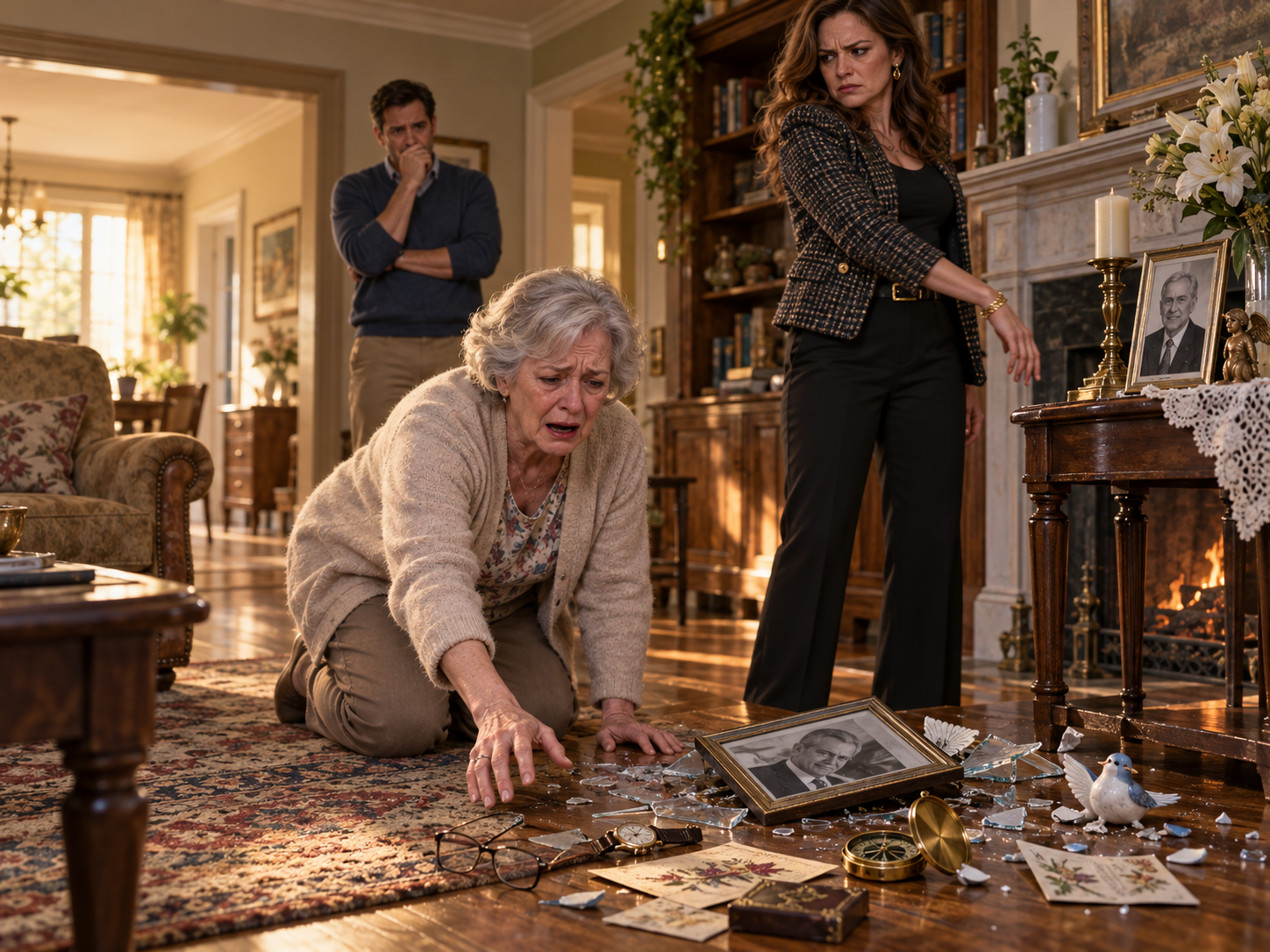
I was standing in the hallway when the framed photograph of my husband hit the hardwood floor face-first.
For one second, I couldn't move.
Robert had been dead for four years, but in that photograph he was fifty-nine again, standing beside the lake in his old green jacket, laughing because I had complained about the wind.
Then Kimberly swept her arm across the small wooden table beneath the photograph.
Everything went down.
Robert's watch.
His reading glasses.
The brass compass our son had given him for Father's Day when he was twelve.
Three anniversary cards I had kept tied together with a faded blue ribbon.
And the little ceramic bird Robert bought me in Vermont because he said it looked "too stubborn to fall over."
It shattered into three pieces.
"Kimberly!"
My own voice frightened me.
I rushed forward.
She spun around, face flushed.
"This is ridiculous, Helen!"
"Don't touch those!"
"It's a room! It's not a mausoleum!"
I dropped to my knees beside the broken frames.
My hands shook so badly I couldn't decide what to pick up first.
Robert's face lay beneath fractured glass.
Kimberly had been arguing with me for twenty minutes about turning the room into a home office.
It wasn't even really a room dedicated to Robert.
The desk was still there. The bookshelf was still there. I kept the curtains open. Sometimes I sat by the window with tea.
But the corner beside the fireplace was his.
That was all.
One corner.
"He has been dead for four years," Kimberly said.
I stared up at her.
There are sentences that hurt because they're cruel.
Then there are sentences that hurt because they're true in a way the speaker has no right to use against you.
Behind her stood my son, Daniel.
Forty-one years old.
My only child.
His hands were shoved into the pockets of his jeans.
He looked at the floor.
"Daniel," I said.
He didn't answer.
"Tell her."
His eyes lifted briefly.
"Mom, maybe we should all calm down."
I almost laughed.
Calm down.
My husband's photograph was lying under broken glass.
His wife had thrown it there.
And my son wanted everyone to calm down.
Kimberly pointed toward the wall.
"I have client calls every day. The kitchen table doesn't work. This room is sitting here doing nothing."
"It is my house."
She stared at me.
Something changed in her face.
A small thing.
A tightening around the mouth.
Then she said, "You don't need all this space anyway."
I felt the words before I understood them.
"What?"
Daniel stepped forward.
"Kim."
"No, Daniel. We keep pretending this situation makes sense."
"This situation?"
"You live alone in a four-bedroom house."
"I didn't ask you to move in."
That silenced the room.
Three months earlier, Daniel had told me their apartment lease had ended unexpectedly.
They needed somewhere to stay.
"Four or five weeks," he'd said.
I had opened my door without hesitation.