Stories worth slowing down for — new every evening
SHE THREW MY HUSBAND’S MEMORY TO THE FLOOR.

Part 2: THE NUMBER ON THE PAPER

THE NUMBER ON THE PAPER

I didn't sleep.

Every sound in the house became suspicious.

Pipes cooling.

Floorboards settling.

The refrigerator compressor turning on downstairs.

Around two in the morning, I heard Daniel walk past my bedroom.

He paused outside my door.

I waited for him to knock.

He didn't.

By breakfast, Kimberly was behaving as though nothing had happened.

She stood in my kitchen wearing a cream blouse and drinking coffee from Robert's old mug.

I took it from her hand.

She stared at me.

"Use another one."

"Seriously?"

"Yes."

Daniel sat at the table staring at his phone.

I waited for him to speak.

When he didn't, I said, "Are you planning to sell my house?"

His head snapped up.

Kimberly answered first.

"Nobody said that."

"I heard you last night."

Daniel's face changed.

That was my answer.

I looked at him.

"Daniel."

He rubbed both hands over his face.

"Mom, we're trying to figure things out."

"What things?"

"Our future."

Kimberly pulled out a chair.

"You have a lot of equity sitting here doing nothing."

I almost admired the sentence.

My home had become equity.

My marriage had become square footage.

Thirty-eight Christmas mornings, two kitchen renovations, Robert teaching Daniel to ride a bicycle in the driveway, the pencil marks measuring our son's height inside the pantry door—

All of it was "sitting here doing nothing."

"This house is not yours," I said.

Kimberly sighed.

"No one is trying to steal your house."

"Then why are you discussing selling it?"

"We're discussing options."

"For my property?"

Daniel finally spoke.

"Mom, just hear us out."

"No."

His jaw tightened.

"We're struggling."

That stopped me.

Daniel had always been proud.

Even as a child, he hated admitting he needed help.

"What happened?"

He glanced at Kimberly.

"We have debt."

"How much?"

Kimberly said, "That's private."

I looked at her.

"Then my house is private too."

I left them there.

Later that morning, they went out together.

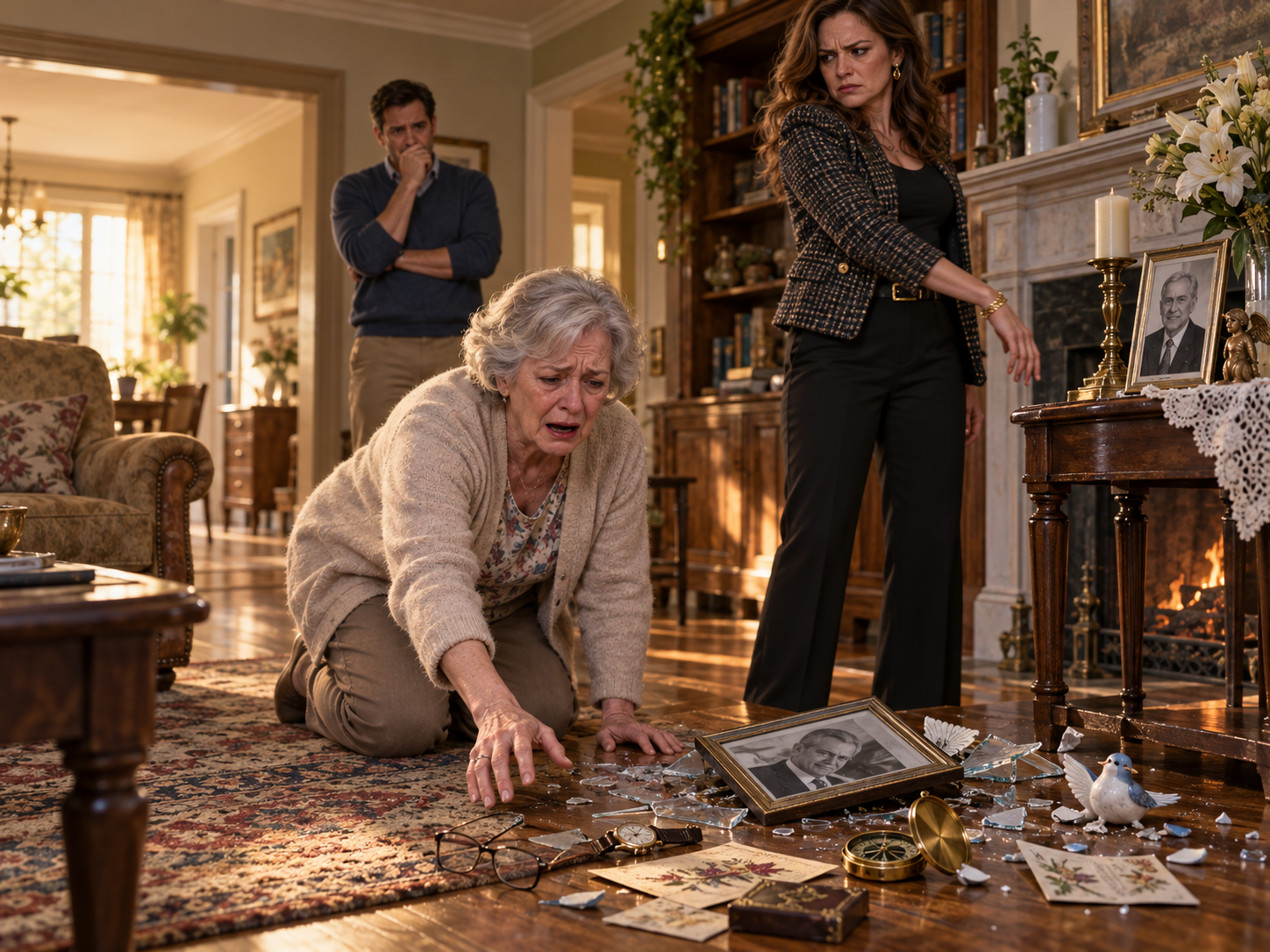
I cleaned Robert's damaged things.

His watch had survived.

The photograph hadn't.

I carefully removed the picture from the broken frame and placed it inside a drawer until I could buy a new one.

When I carried the wastebasket from the room, a folded piece of paper caught beneath the leg of the desk.

I thought it was garbage from Kimberly's work.

I nearly threw it away.

Then I saw my address.

Printed at the top.

Below it was a number.

$642,000.

Underneath:

Estimated Market Range.

I read the page twice.

There were notes written in Kimberly's handwriting.

Renovated kitchen.

Original wood floors.

Large backyard.

Possible quick sale?

My fingers went cold.

She had already researched the value.

At the bottom of the page was the name of a real estate agency.

And a phone number.

I folded the paper and slipped it into my cardigan pocket.
When Daniel came home, I found him alone in the garage.

He was pretending to reorganize a box of old tools.

I stood in the doorway.

"How much money does Kimberly want?"

His shoulders stiffened.

"Mom."

"Tell me."

He wouldn't look at me.

Finally, he said, "It's not just Kimberly."

I waited.

"There's an investment opportunity."

"What kind?"

"A development project."

"Whose?"

"A friend of hers knows someone involved."

I closed my eyes.

Robert would have asked twelve questions before Daniel finished that sentence.

Robert trusted people.

But he never trusted vague sentences involving money.

"How much do you need?"

Daniel hesitated.

"Two hundred fifty thousand."

I laughed once.

Not because it was funny.

Because it was too large to enter my mind gracefully.

"And you decided my house would provide it?"

"No."

"Daniel."

"We thought maybe you'd sell, downsize, keep what you need, and help us invest the rest."

"Thought?"

I pulled the valuation sheet from my pocket.

His face went white.

"Did you know about this?"

"Mom—"

"Did you?"

He looked away.

That hurt worse than a yes.

I folded the sheet again.

"You have until Sunday."

His head jerked toward me.

"What?"

"You and Kimberly need to find somewhere else to live."

"Mom, come on."

"No."

"Where are we supposed to go?"

"I don't know."

"You're kicking out your own son?"

I looked at him.

"No, Daniel."

My voice shook.

"I'm asking the man who watched his wife throw his father's photograph on the floor to leave my house."

He flinched.

For a moment, I saw my little boy again.

Then the garage door opened.

Kimberly walked in.

She looked from Daniel to me.

"What happened?"

I held up the valuation sheet.

Her face barely changed.

That frightened me most.

She wasn't ashamed.

She was calculating.

"You went through my things?"

"It was under my desk."

"It's not your desk. You never use it."

I stared at her.

"Sunday."

"What?"

"You heard me."

She gave a short smile.

Not amusement.

Challenge.

"You might want to think carefully before making decisions you can't undo."

Then she walked past me into the house.

Daniel followed.

I remained in the garage, holding the paper.

Robert's old workbench stood against the wall.

Above it hung a small wooden plaque he had carved years before.

Measure twice. Cut once.

I stared at those words.

That night, I decided I would stop reacting.

I would start measuring.

And for the first time since Kimberly entered my house, I began to wonder what else she had already done without telling me.