The next morning, I called my bank.
Not because I thought Kimberly could sell my house with a smile and a valuation sheet.
I wasn't completely naïve.
I knew deeds required signatures.
I knew property transfers required paperwork.
But I also knew something else.
People rarely begin with the act they intend to commit.
They begin by testing boundaries.
A drawer opened without permission.
A bill redirected.
A password requested "for convenience."
A room renamed.
A house called an asset.
A mother called unreasonable.
By the time the final boundary disappears, everyone pretends it had never really existed.
I changed my online banking password.
Then my email password.
Then I checked the drawer where I kept the deed, insurance papers and Robert's estate documents.
Everything appeared to be there.
I sat at the dining room table with the folder in front of me.
Robert had organized paperwork with the same maddening precision he brought to loading a dishwasher.
Labels.
Dates.
Colored tabs.
I used to tease him about it.
"One day," he'd say, "you'll be glad I know where everything is."
I ran my thumb along the edge of a folder marked PROPERTY.
"You always had to be right," I whispered.
The deed listed both our names originally.
After his death, the attorney handling the estate had explained the transfer arrangements.
I remembered signing papers.
I remembered crying halfway through.
I remembered hearing words like trust, beneficiary and survivorship without absorbing much of them.
Grief does that.
People explain your future while you're still trying to understand why the second coffee cup will never be used again.
I found a document titled MARITAL PROPERTY TRUST.
I frowned.
The words looked familiar.
I had seen them four years earlier.
But I couldn't remember the details.
I began reading.
Before I got far, Kimberly walked into the dining room.
I closed the folder.
Her eyes went to it immediately.
"What are you doing?"
"Reading."
"Reading what?"
"My documents."
She gave me a strange smile.
"You're acting like we're criminals."
"Are you?"
Her smile disappeared.
"Daniel told me you're making us leave."
"Yes."
"You know he lost his job, right?"
I stared at her.
"What?"
She froze.
Only for a fraction of a second.
But I saw it.
"When?"
She looked toward the kitchen.
"You should ask him."
"Kimberly."
"Six weeks ago."
Six weeks.
They had moved into my house three months earlier.
For half that time my son had been unemployed.
Every morning he left at eight.
Every afternoon he returned around five.
Briefcase.
Coffee.
Complaints about traffic.
All theater.
"Where does he go?"
"I don't know."
"You don't know?"
"Coffee shops. The library. Interviews."
"And you both decided lying to me was easier?"
"He was embarrassed."
"You weren't embarrassed to ask for my house."
She crossed her arms.
"There you go again."
"Again?"
"Making this emotional."
I actually laughed.
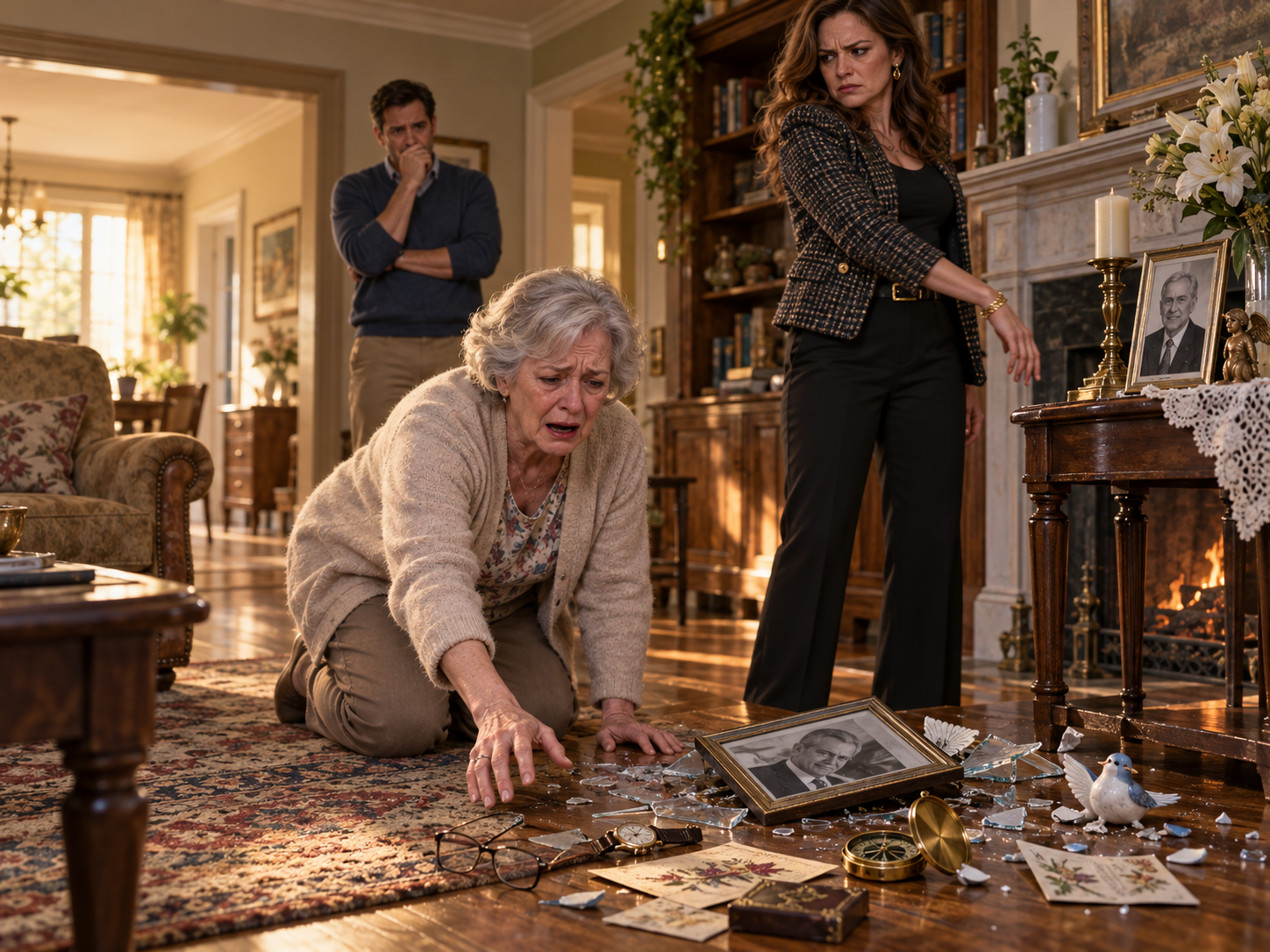
"You broke my husband's photograph and shoved me into a chair. Forgive me for bringing emotion into the situation."
"I apologized."
"No, you didn't."
She opened her mouth.
Closed it.
Because she knew I was right.
Not once had she apologized.
Not for the photograph.
Not for pushing me.
Not for planning around my property.
She leaned toward the table.
"Daniel has spent his entire life trying to make you and Robert proud."
There was venom in the way she said my husband's name.
"His father expected him to be perfect. You may not realize what that did to him."
"Don't use my dead husband to excuse what you're doing."
"I'm explaining why Daniel deserves a chance."
"With my money?"
"With family money."
There it was.
I looked at her carefully.
"Family money."
"Robert built this house with Daniel in mind too."
"You never knew Robert."
"I know what Daniel told me."
"Then Daniel didn't tell you enough."
She glanced toward the folder again.
"What does that mean?"
"Nothing."
It was the first lie I told her.
I didn't yet know what the trust document meant.
But her attention to it told me I should find out.
That afternoon, after Kimberly left to meet a client, I drove to a copy shop.
I copied every page.
Then I took the originals to a safe-deposit box at my bank.
I felt foolish doing it.
Dramatic.
Suspicious.
I imagined Robert laughing gently.
You've been watching too many crime shows, Helen.
But another part of me heard what he used to say whenever I hesitated over something important.