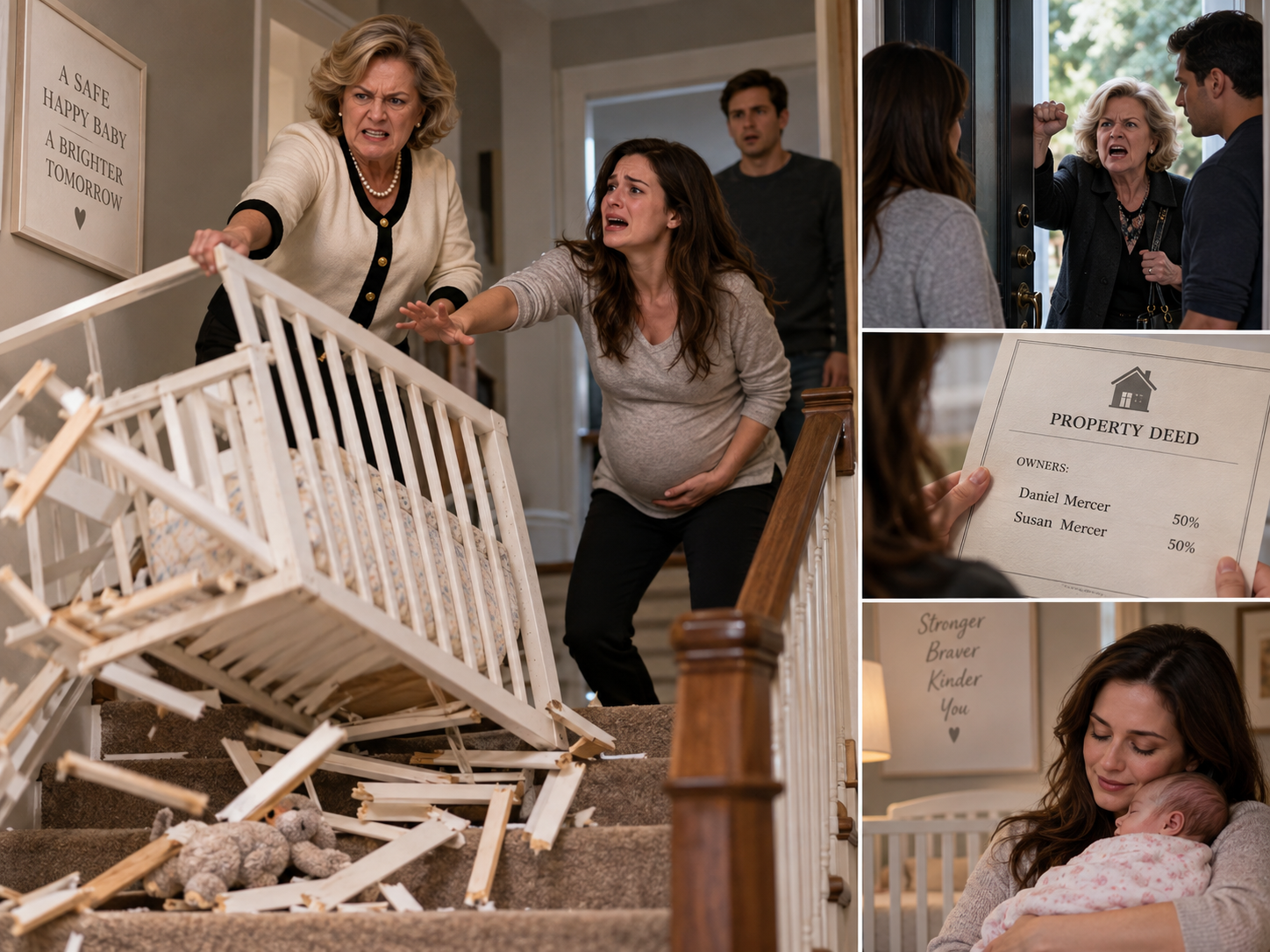
The sound of my baby’s crib breaking at the bottom of the stairs was the moment I understood that my mother-in-law had never been arguing about furniture.
She was arguing about ownership.
Mine.
My baby’s.
My marriage.
Maybe even my home.
I was seven months pregnant when Susan wrapped both hands around the white wooden rail of the crib I had bought and dragged it through the nursery doorway.
“Susan, stop.”
She didn’t.
The legs scraped across the hardwood floor.
I stepped in front of her.
“Put it back.”
Her mouth tightened.
Behind her, the nursery looked suddenly wrong without it. Pale green walls. A shelf of folded blankets. Tiny clothes hanging in the closet. A stuffed rabbit Daniel had bought after our twenty-week ultrasound.
Everything waiting for a child who had not yet arrived.
Except the one thing my mother-in-law had decided I wasn’t allowed to choose.
“You had no right to get rid of the family crib,” Susan said.
“I didn’t get rid of it.”
“You refused it.”
“It’s almost forty years old.”
“It raised three babies.”
“It doesn’t meet current safety standards.”
She gave a sharp, humorless laugh.
“There it is again.”
“What?”
“That tone.”
I stared at her.
“My tone?”
“You always have a reason why your way is smarter. Safer. Better.”
My heart was beating faster than it should have been.
I put one hand under my stomach.
The baby shifted.
“Susan, this isn’t about you.”
“That is exactly what you don’t understand.”
She pulled the crib harder.
I caught the opposite rail.
For a few seconds we stood there, a pregnant woman and a sixty-two-year-old woman fighting over a piece of nursery furniture.
It would have been ridiculous if I hadn’t been afraid.
“Susan.”
My voice lowered.
“Let go.”
Her eyes changed.
I had seen Susan irritated before. Disapproving. Offended. Cold.
I had never seen that expression.
It was fury stripped of manners.
“This house has traditions,” she said.
“This is my baby.”
“And Daniel is my son.”
“That doesn’t make you the mother of my child.”
The silence after I said it felt dangerous.
Then Susan jerked the crib out of my hands.
One wheel struck the hallway table.
A framed wedding photograph fell face down.
I reached for the crib again.
She shoved my arm away.
“Don’t touch me.”
“You’re the one dragging my furniture through my house!”
Her head snapped toward me.