Stories worth slowing down for — new every evening
SHE THREW HOT SOUP AT OUR HOUSEKEEPER—AND MY MOTHER DEFENDED HER

Part 1: THE SCREAM UPSTAIRS

THE SCREAM UPSTAIRS

The first thing I heard when I opened the front door was my mother screaming.

Not calling my name.

Not asking for help.

Screaming.

It was the kind of sound that erased thought.

My handbag slipped from my shoulder and hit the marble floor as I ran.

“Mom?”

No answer.

Then something crashed upstairs.

I took the steps two at a time.

My mother, Eleanor Bennett, was seventy-one years old and twenty-three days out from open-heart surgery. Her cardiologist had warned me about everything—stairs, stress, sudden exertion, infection, blood-pressure spikes.

He had not prepared me for the sight waiting in her bedroom.

Grace was on her knees beside the bed.

A shattered soup bowl lay near her.

Cream-colored broth spread across the hardwood floor.

Grace's right forearm was bright red from wrist to elbow. Blisters were already beginning to rise along the skin.

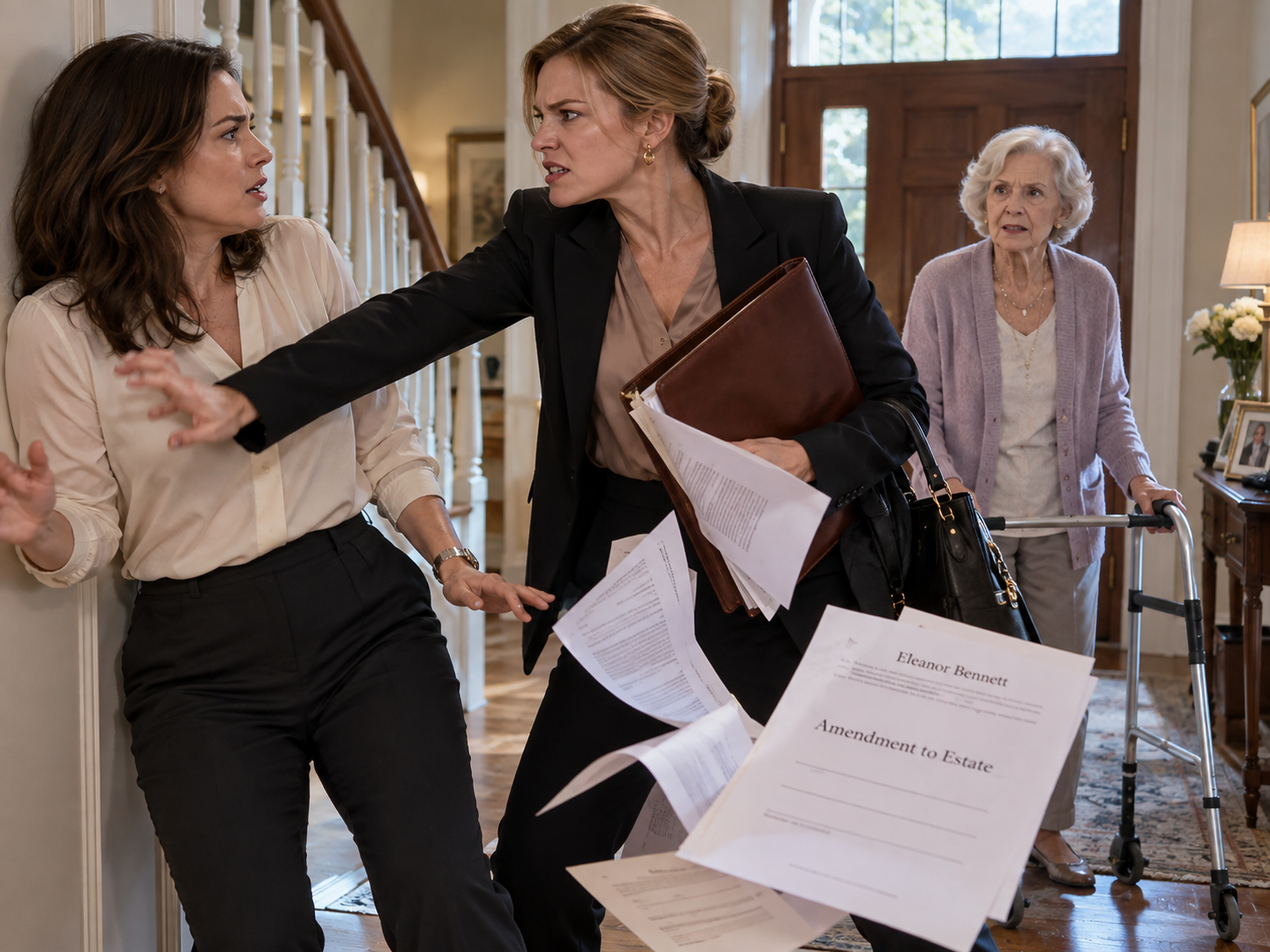
My fiancée, Vanessa, stood several feet away, one hand pressed dramatically against her collarbone.

And my mother was propped against her pillows, pale and trembling.

For one awful second, nobody spoke.

Then Vanessa pointed at Grace.

“She pushed me.”

Grace's head snapped up.

“What?”

Vanessa looked at me.

“Adrienne, thank God.”

I crossed the room toward my mother.

“Mom, are you hurt?”

Eleanor shook her head faintly.

Her gray hair had been brushed neatly that morning, but now several strands clung to her forehead. Her chest rose in quick, shallow movements beneath her robe.

“Mom, look at me.”

Her eyes found mine.

I touched her cheek.

“Did the soup hit you?”

Another small shake of her head.

Behind me, Grace stood unsteadily.

“Ms. Adrienne, please listen to me.”

Vanessa cut her off.

“She lost her temper.”

Grace stared at her.

“You threw it at me.”

“What?”

“You threw the tray.”

Vanessa gave a disbelieving laugh.

“That is insane.”

“I brought Mrs. Bennett's lunch. You came in. You started arguing with me. You grabbed the tray.”

“You dropped it.”

“You slapped it from my hands.”

“You shoved me first.”

“I never touched you.”

Their voices rose over each other.

“Stop.”

Neither heard me.

“Stop!”

The room went quiet.

I turned first to Grace.

She had worked for my mother for almost six years.

Not as a live-in maid, exactly. Grace came five days a week, cleaned, cooked, ran errands when needed, and during my mother's recovery she had agreed to stay longer hours so I could continue working.

She had been there when I brought Eleanor home from the hospital.

She knew every medication.

She knew which foods my mother tolerated.

She knew that the smallest coughing spell frightened her after surgery.

Grace was fifty-four, soft-spoken, intensely private, and so controlled that I had once watched her calmly handle a flooded laundry room while my mother and I panicked around her.

I had never heard her raise her voice before.

Now she was shaking.

“Ms. Adrienne,” she said, “I did not drop that soup. She knocked it on me.”

Vanessa stared at her.

“Why would I do that?”

Grace hesitated.

That hesitation changed the room.

Vanessa saw it too.

“Yes,” she said. “Why?”

Grace looked at my mother.

Eleanor closed her eyes.

“Grace?” I asked.

Grace swallowed.

“I don't know.”

Vanessa folded her arms.

“Exactly.”

I looked down at Grace's burn again.

It was bad enough that I could not postpone dealing with it.

“You need cold running water on that. Now.”

“I'll be fine.”

“No, you won't.”

I helped her toward the bathroom attached to the guest room.

Vanessa followed us into the hall.

“Adrienne, you're not seriously taking her side.”

“I haven't taken anyone's side.”

“She pushed me.”

“And Grace is burned.”

“Because she dropped the soup.”

Grace spun around.

“I did not—”

“Enough.”

The word came from my mother's room.

Weak.

Breathless.

But unmistakable.

All three of us turned.

Eleanor had shifted slightly upright.

One hand rested protectively over her chest.

“Please,” she whispered. “No fighting.”

I went back to her.

“Mom, what happened?”

I saw Grace stop in the doorway.

Vanessa stopped beside her.

My mother looked from one woman to the other.

I expected her to say she hadn't seen it.

I expected her to tell me she was confused.

Instead, she reached for my hand.

“Vanessa wouldn't hurt anyone.”

The words landed harder than they should have.

Grace went completely still.

Vanessa's expression softened.

“Eleanor…”

My mother squeezed my fingers.

“Please don't make this worse.”

I stared at her.

“Are you saying Grace did it?”

“I said…” She closed her eyes briefly, as though speaking exhausted her. “I said Vanessa wouldn't hurt anyone.”

That was not an answer.

But it sounded like one.

Grace understood it that way.

Her face changed.

Not anger.

Something worse.

Betrayal.

She had spent weeks helping my mother bathe when Eleanor was too weak to stand alone. She had cleaned surgical drainage stains from bedsheets without once making my mother feel ashamed. She had slept on the couch twice during the first week home because I had been terrified my mother might need help in the night.

And now Eleanor would not defend her.

Grace lowered her eyes.

“I'll clean this up.”

“No,” I said. “Your arm comes first.”

Vanessa exhaled through her nose.

“I don't feel safe with her in the house.”

I turned.

“This is not the time.”

“When is the time?”

“Vanessa.”

“She pushed me in a room with a seventy-one-year-old cardiac patient. What exactly has to happen before we admit that's dangerous?”

Grace looked at me.

I hated the hope in her eyes.

She wanted me to say it was ridiculous.
She wanted me to defend the person I had known for six years over the woman I was supposed to marry in four months.

Instead, I said the only thing I could say while my mother was trembling behind me.

“Nobody is deciding anything right now.”

Vanessa laughed quietly.

“Of course.”

She walked out.

Grace said nothing.

I drove Grace to urgent care.

The burn was classified as partial thickness. The nurse dressed it carefully and warned her about infection.

During the drive home, Grace sat with her bandaged arm against her chest.

I kept both hands on the wheel.

At a red light, I finally said, “Tell me exactly what happened.”

Grace stared through the windshield.

“I carried the tray upstairs.”

“Okay.”

“Mrs. Bennett had asked for tomato soup.”

I nodded.

“I know.”

“Ms. Vanessa was already in the room.”

“What were they talking about?”

“I don't know.”

Grace's answer came too fast.

I looked at her.

“You walked into a room where my fiancée and my mother were talking. Something happened. Vanessa knocked boiling soup onto your arm. But you don't know why?”

Grace's jaw tightened.

“Ask Ms. Vanessa.”

“I did.”

“And she blamed me.”

“Grace.”

She turned toward me.

“I have never stolen from your family. I have never raised my hand to anybody in that house. I have never hurt your mother.”

“I didn't say you did.”

“You did not have to.”

That hurt because it was true.

I had doubted her.

I still did.

Not because I thought Grace was violent.

Because the alternative was believing Vanessa was.

Vanessa, who had held my hand in the cardiac waiting room for seven hours.

Vanessa, who had slept beside me while I woke every hour checking my phone.

Vanessa, who had helped me choose a rehabilitation facility before my mother insisted she wanted to recover at home.

Vanessa, who had spent three years building a life with me.

People liked to say trust was simple.

It wasn't.

Trust became complicated when two people you loved pointed at each other and said, She is lying.

When we got home, Grace asked to leave early.

I agreed.

Vanessa was downstairs in the kitchen, washing the soup from the tray.

“I would've cleaned that,” I said.

She did not turn.

“You were busy taking your mother's attacker to urgent care.”

“Don't.”

The water continued running.

I switched off the faucet.

Vanessa finally looked at me.

Her eyes were wet.

“You think I'm lying.”

“I think I don't know what happened.”

“She assaulted me.”

“There isn't a mark on you.”

Her expression hardened.

“So I needed to be burned for you to believe me?”

“That isn't what I meant.”

“What did you mean?”

I rubbed my forehead.

“I need facts.”

“You have one fact. Your mother was in that room.”

“She didn't say she saw Grace push you.”

“She defended me.”

“She said you wouldn't hurt anyone.”

“Because she knows me.”

I stared at Vanessa.

“Does she?”

Something flickered across her face.

Gone almost immediately.

“What's that supposed to mean?”

“I don't know.”

The truth was, I was exhausted.

For almost a month, my entire life had become medicine schedules, cardiology appointments, work calls taken from hospital corridors, and nights listening for movement through the baby monitor I had installed in my mother's room.

Vanessa had been patient.

Mostly.

There had been moments when she complained that our wedding planning had vanished, that my mother's recovery now controlled our schedule, that I had not slept in our apartment for three weeks.

I thought that was normal frustration.

Maybe I needed it to be.

“I don't want Grace here tomorrow,” Vanessa said.

I looked at her.

“That's not your decision.”

“Your mother agrees with me.”

“Mom didn't say that.”

“Ask her.”

So I did.

That evening, after Vanessa went home, I sat beside Eleanor.

She looked tiny against the bed.

Before surgery my mother had been formidable.

She had taught high school literature for thirty-eight years and could silence an entire auditorium of teenagers with one raised eyebrow.

Illness had shrunk her.

Or seemed to.

“Mom.”

She opened her eyes.

“Hmm?”

“Do you want Grace fired?”

A long silence.

Then she whispered, “Perhaps it's best if she isn't here for a little while.”

I stared at her.

“Why?”

“You're under enough stress.”

“This isn't about me.”

Her gaze drifted toward the bedroom door.

“Vanessa is going to be your wife.”

“And?”

“You need peace in your home.”

“Did Grace push Vanessa?”

My mother looked at me again.

“Vanessa loves you.”

“That isn't what I asked.”

“I know.”

“Then answer me.”

She reached out and touched my wrist.

“Some truths are expensive, sweetheart.”

I frowned.

“What does that mean?”

But she had closed her eyes.

I sat there listening to her breathe.

Later that night, as I carried a glass of water from the kitchen, I noticed something odd.

The small camera above the upstairs hallway was dark.

I stood beneath it and checked the app on my phone.

OFFLINE.

I dragged a chair beneath it and climbed up.

The power cord had been pulled from the wall.

Not loosened.

Pulled.

I plugged it back in.

The camera restarted.

There was a gap in the footage.

Forty-seven minutes.

Beginning three minutes before the soup hit Grace.

Ending long after I had arrived home.

I stood alone in the hallway staring at the empty section of the timeline.

And for the first time that day, I stopped asking who I trusted.

I started asking who had needed the camera blind.