Eleanor did not contact Samuel immediately.
That was the first decision she made that showed me she had changed.
The old Eleanor would have chosen one extreme.
Hide forever.
Or, once exposed, rush forward and control the reunion.
Instead, she followed the agency’s process.
She wrote a letter.
Then tore it up.
She wrote another.
Then called me.
“Would you read something?”
Three months earlier, the request would have irritated me.
Now I understood what it cost her to ask instead of decide.
“Send it.”
Her first draft was six pages.
Half of it explained.
Very little apologized.
I called her.
“You're defending yourself.”
“I am explaining the circumstances.”
“To Samuel, those circumstances took his mother away.”
“I did not take Margaret away.”
“No. But you helped convince her she couldn't keep him.”
Silence.
“That is different.”
“To you.”
Another silence.
“What should I say?”
I looked at the draft on my laptop.
“Start with what he deserved.”
“What do you mean?”
“He deserved to know his mother wanted him.”
Eleanor began crying quietly.
I continued.
“He deserved to know she loved him. He deserved the letter she asked you to leave. Start there.”
The final version was less than two pages.
She mailed it through the agency.
Then we waited.
Weeks passed.
My stomach grew.
Life continued in the strange way it always does beside enormous uncertainty.
We painted the nursery.
Daniel assembled a crib incorrectly and had to rebuild it.
Robert began calling every Sunday.
Eleanor mailed me a blanket she had sewn.
There was no note.
Only the blanket.
Soft gray cotton with tiny stars.
I called her.
“Thank you.”
“You’re welcome.”
“It’s beautiful.”
“I made one for Daniel before he was born.”
I smiled.
“Was his crooked too?”
A pause.
Then she laughed.
It startled both of us.
At thirty-one weeks, I returned to the Bennett house for the first time since the anniversary dinner.
I had not avoided it deliberately.
At least that was what I told myself.
But as we turned into the driveway, my palms began to sweat.
Daniel noticed.
“We can leave.”
“No.”
“If you want to—”
“I said no.”
He nodded.
He had become better at accepting my answers.
Inside, the house looked exactly the same.
That was strange.
I had expected truth to rearrange furniture.
Robert hugged me carefully.
Eleanor stood back.
“May I?”
She gestured toward me.
I realized she was asking permission to hug me.
“Yes.”
Her arms were gentle.
When we entered the dining room, I stopped.
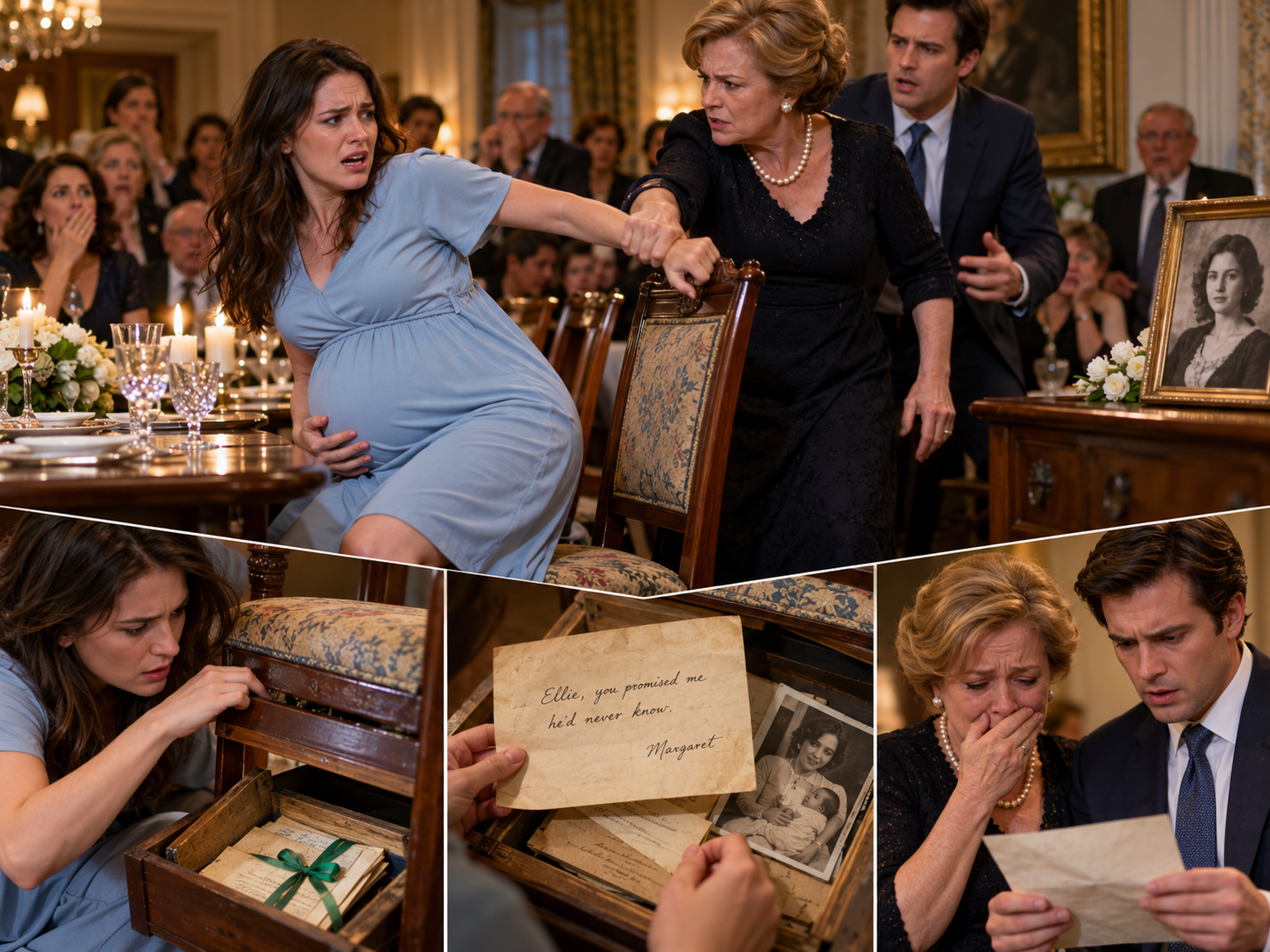
Margaret’s chair was at the table.
Not hidden.
Not isolated.
At the table.
There was no place card in front of it.
I looked at Eleanor.
She followed my gaze.
“I didn't know what to do with it.”
I walked toward the chair.
The compartment underneath had been repaired so it closed properly.
But it was empty now.
The original letters were preserved in archival sleeves upstairs.
“You could put it away,” I said.
“I thought about it.”
“Why didn’t you?”
She touched the back.
“Because hiding the chair started to feel too much like hiding Margaret again.”
I nodded.
We sat down for lunch.
I chose a different chair.
Not out of fear.
Because I wanted Eleanor to see that choice mattered.
Halfway through lunch, the phone rang.
Eleanor glanced toward the kitchen.
Robert started to stand.
“I’ll get it.”
“No.”
Eleanor rose.
Something in her face had changed.
She seemed to know.
We heard her answer.
“Hello?”
Silence.
Then:
“Yes. This is Eleanor Bennett.”
Daniel stopped chewing.
Robert lowered his fork.
My heartbeat quickened.
Eleanor walked back into the dining room with the cordless phone pressed to her ear.
Her face had gone white.
She looked at us.
Then sat in Margaret’s chair.
“Yes,” she whispered into the phone.
A pause.
Tears filled her eyes.
“No, I understand.”
Another pause.
“I’m glad you called.”
Daniel’s hand found mine beneath the table.
I squeezed it.
Eleanor listened for almost a minute.
Then she said something I would remember for the rest of my life.
“Your mother loved you.”
Her voice broke.
“But I think you deserve to hear that story from the beginning, not from the middle where I entered it.”
She closed her eyes.
“Yes.”
Another pause.
“My name is Eleanor.”
She smiled through her tears.
“I was Margaret’s sister.”
We stayed silent.
This was hers to do.
Not ours.
Not yet.
She listened again.
Then her entire face changed.
Forty-six years of fear seemed to leave it at once.
“He asked about her,” she whispered to us, covering the phone.
Robert nodded.
“Tell him.”
So Eleanor did.
She talked for almost an hour.
We left the room halfway through.
Privacy, I had learned, was not the same thing as secrecy.
One respected another person's boundaries.
The other imprisoned them.
Daniel and I sat on the back porch.
Autumn had begun turning the trees orange.
Our daughter kicked hard beneath my ribs.
Daniel put his hand against my stomach.
“There.”
He smiled when he felt it.
“Strong.”
“She’s angry because lunch was interrupted.”
“Definitely a Bennett.”
I gave him a look.
He laughed.
Then his expression turned serious.
“Do you think he’ll want to meet us?”
“Samuel?”
“Yeah.”
“I don't know.”
It felt good to say that.
To leave room for someone else’s decision.
“He might.”
Daniel nodded.
“He might not.”
“I know.”
“And either is okay.”
He looked toward the house.
“Yeah.”
After a moment he said, “I keep thinking about Aunt Margaret.”
“So do I.”
“I barely remember her.”
“What do you remember?”
He looked down.
“Her perfume.”
“What did it smell like?”
“Something floral. Too strong.”
I smiled.
“She would pick me up even when I was getting too big for it.”
He paused.
“And she used to give me butterscotch candy when Mom wasn't looking.”
I pictured the woman from the letters.
Pregnant in secret.
Angry.
Funny.
Afraid.
Still carrying candy for her nephew.
“I think she would like that you remember.”
Daniel looked at me.
“You talk about her like you knew her.”
“In a strange way, I feel like I do.”
“You probably know more about her than I ever did.”
“That's because she left her voice behind.”
He nodded.
After a while, the back door opened.
Eleanor stepped outside.
Her eyes were swollen.
Daniel stood.
“How did it go?”
She held the phone against her chest.
“He wants copies of Margaret’s letters.”
“That sounds fair.”
“I told him we would send them.”
Daniel glanced at me.
I nodded.
“Does he want contact?”
Eleanor breathed in.
“Yes.”
A smile moved across Daniel’s face.
Then he stopped himself.
“What kind?”
“I don't know yet.”
Again, room for choice.
Eleanor sat beside me.
“He has a wife.”
Daniel exhaled.
“And?”
“Two children.”
She laughed and cried at the same time.
“A daughter and a son.”
Robert had come to the doorway behind her.
He covered his mouth.
Eleanor looked at me.
“That means Margaret had grandchildren.”
“Yes.”
She stared across the yard.
“I spent all those years thinking I was protecting the family we had.”
Her voice was quiet.
“I never let myself understand that I was also refusing to know the family we had lost.”
No one answered.
There was nothing to add.
Samuel did not arrive dramatically at the door.
There was no instant reunion.
No embrace that erased four decades.
Real life was slower.
More careful.
He exchanged letters with Eleanor first.
Then emails with Daniel.
He asked for photographs of Margaret.
He sent one photograph of himself.
When Daniel opened it, he began crying before he could speak.
I understood why.
Samuel had Margaret’s eyes.
Not vaguely.
Not sentimentally.
Exactly.
The same eyes from the photograph Eleanor had found.
Daniel printed the two pictures and placed them side by side.
Mother and son.
Separated by decades.
United by a physical resemblance no secret could erase.
Samuel had known from childhood that he was adopted.
He had begun searching in his twenties.
Records were limited.
His adoptive parents had been loving, and he made that clear immediately.
He was not searching because his life had been empty.
He was searching because a full life can still contain unanswered questions.
At twenty-nine, he had registered his willingness to be contacted by biological relatives.
No one came.
At thirty-five, he tried again.
Nothing.
Eventually he stopped expecting anything.
Then, at forty-six, Eleanor’s letter arrived.
He told her he had read it three times before showing his wife.
The hardest part, he wrote, was learning that Margaret had tried to leave him something and that the message had been delayed for nearly forty years.
He did not forgive Eleanor immediately.
She did not ask him to.
That mattered.
“I don't think forgiveness is something I get to schedule,” she told me one afternoon.
I smiled.
“That's progress.”
She rolled her eyes.
And that was progress too.
Samuel eventually agreed to meet Eleanor and Daniel.
I did not go to the first meeting.
Neither did Robert.
Samuel had asked for only the people directly connected to Margaret’s letters.
Again, choice.
Daniel came home five hours later.
I met him at the door.
“Well?”
He wrapped his arms around me.
For a while, he didn't speak.
Then he laughed against my hair.
“He has Mom’s laugh.”
I pulled back.
“Eleanor?”
“No.”
His eyes filled.
“Aunt Margaret.”
Three weeks later, Samuel came to the Bennett house.
By then I was thirty-six weeks pregnant and moving like every room had been designed by an enemy.
When Daniel and I arrived, I saw a dark blue car in the driveway.
My heart pounded.
“This is weird,” I said.
“Very.”
“Are you nervous?”
“Terrified.”
“Good.”
He looked at me.
“Why good?”
“Because I'm tired of being the only nervous person in your family.”
He laughed.
Inside, voices came from the dining room.
I followed Daniel.
Samuel stood when we entered.
He was forty-six.
Tall.
Brown hair threaded with gray.
Margaret’s eyes.
For a moment nobody knew what to do.
Then Daniel extended his hand.
Samuel looked at it.
Then smiled.
“We already did the handshake thing.”
Daniel dropped his hand.
“Right.”
“I'm told we're cousins.”
“Apparently.”
They hugged.
It was awkward.
Then less awkward.
Samuel looked at me.
“You must be Jennifer.”
“I’m afraid so.”
He laughed.
Margaret’s laugh, perhaps.
“You're the one who found the letters.”
The room quieted slightly.
I glanced at Eleanor.
She did not look away.
“I found the compartment.”
Samuel nodded.
“I heard there was a chair involved.”
“There is definitely a chair involved.”
His eyes moved toward it.
Margaret’s chair stood at the table.
He walked over.
Ran one hand along the carved wood.
“This was hers?”
Eleanor answered.
“In a way.”
He looked at her.
She explained what she had told me on the phone.
How Margaret had sat in it during her pregnancy.
How she had hidden letters beneath the seat.
How the chair had eventually become something Eleanor could neither discard nor explain.
Samuel listened.
Then he pulled it away from the table.
For one second, old fear flashed across Eleanor's face.
I saw it.
So did she.
This time she stayed still.
Samuel sat down.
Nothing happened.
Of course nothing happened.
It was a chair.
Wood.
Fabric.
Memory.
That was all.