The criminal case ended four months later.
There was no dramatic trial.
No jury.
No courtroom confession.
Diane accepted a plea agreement to a reduced misdemeanor charge.
She received probation, was ordered to complete an anger-management program, and had to comply with a no-contact provision regarding me for a set period.
She did not admit that I had been right about everything.
She did not suddenly understand me.
She did not apologize in the courthouse hallway.
People like Diane do not become different just because a judge speaks.
But for the first time since I had known her, there was a boundary she could not debate.
A legal one.
She hated it.
I was learning that her hatred did not make a boundary wrong.
Outside the courthouse, Melissa shook my hand.
“How are you feeling?”
I looked toward the parking lot.
Diane had already left with her attorney.
“Like I thought I’d feel more.”
Melissa smiled faintly.
“That’s common.”
“I don’t feel victorious.”
“You weren’t trying to win a championship.”
“No.”
“You wanted the incident taken seriously.”
I nodded.
“It was.”
That was true.
And somehow, that was enough.
The family case was harder.
Because there was no single piece of footage that could decide whether a marriage should survive.
Evan moved into a short-term apartment after I told him I wasn’t ready to return home.
We began co-parenting on a temporary schedule through our attorneys.
Not because either of us wanted an ugly custody battle.
Because after Diane’s pressure and Evan’s brief consideration of emergency custody, I needed structure.
He understood.
Or at least he said he did.
We also started counseling separately.
Later, we attended joint sessions focused on whether reconciliation was even possible.
The counselor asked Evan a question in our third meeting.
“When your mother grabbed Rachel, what were you afraid would happen if you intervened?”
Evan sat very still.
“That my mom would turn on me.”
The counselor waited.
“And what did you believe would happen if you didn’t intervene?”
He looked at me.
“I thought Rachel would forgive me.”
The words hurt.
But they were honest.
The counselor asked, “Why?”
Evan’s eyes filled.
“Because she always had.”
I cried in the car afterward.
Not because he had been cruel.
Because he had finally named the arrangement.
Diane’s anger was dangerous.
My pain was survivable.
So he managed Diane and spent me.
Again and again.
A little at a time.
Until the afternoon on the driveway, when he spent too much.
The Ring camera did not save our marriage.
That would be too simple.
It did something more important.
It removed our ability to lie about why the marriage was broken.
There was no debate over whether Diane had “just reached for me.”
No debate over whether I had been “hysterical.”
No debate over whether Evan had really had enough time to respond.
We could watch it.
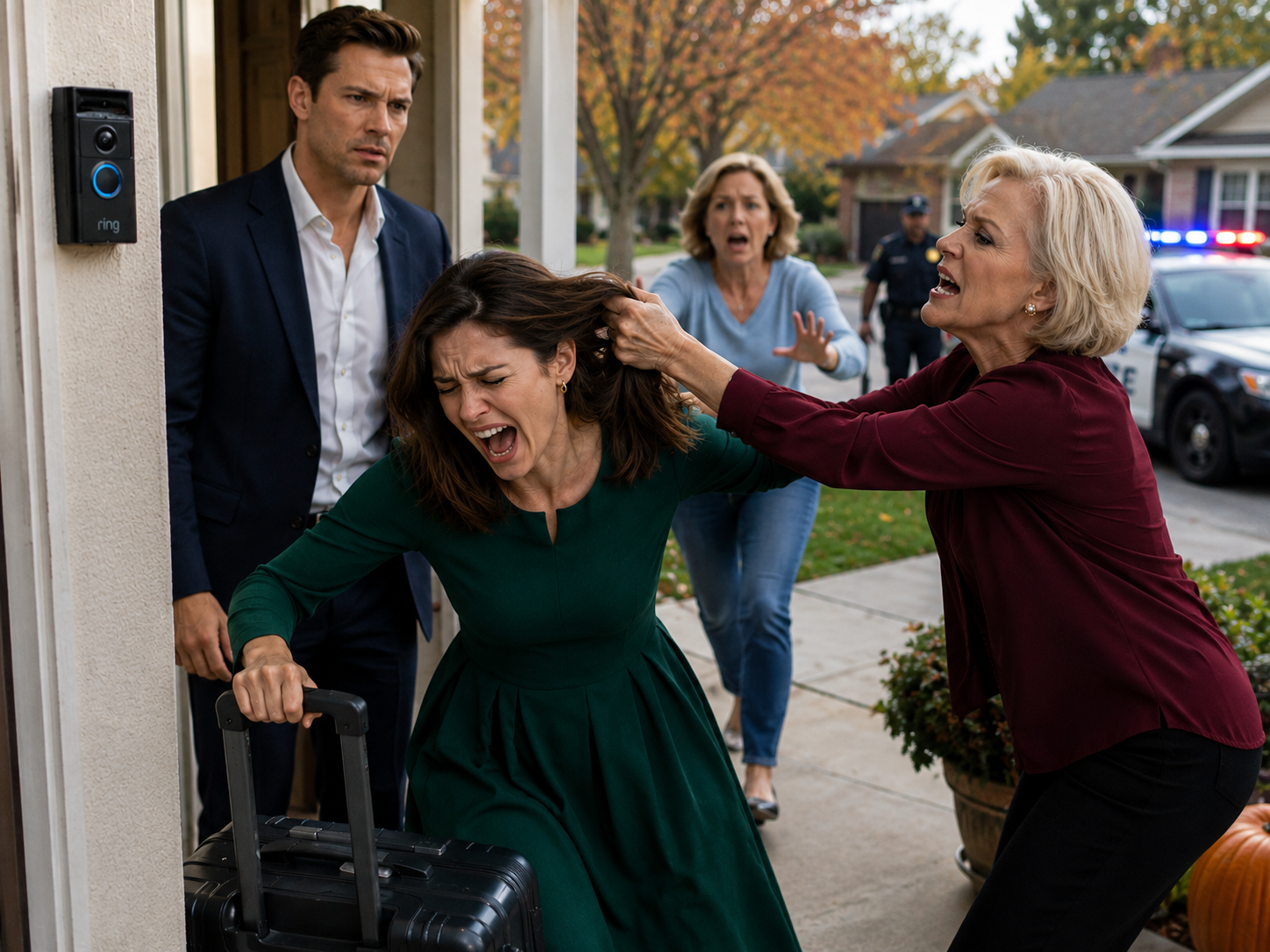
Six seconds after she grabbed my hair, I called his name.
He looked at me.
Eleven seconds later, I tried to move toward the car.
Diane blocked me.
Eighteen seconds later, Mark crossed his lawn.
Twenty-four seconds later, Mark told her to let me go.
Evan still had not moved.
A marriage counselor once asked whether repeatedly watching the footage was helping me heal.
I stopped after that.
Evidence and healing are not the same thing.
Eventually, I no longer needed to see it.
I remembered enough.
Six months after the incident, Evan asked me to meet him at the house.
Not Sarah’s.
Not a coffee shop.
Home.
I had not been inside in months.
When I walked through the front door, the place smelled the same.
Laundry detergent.
Wood polish.
The faint vanilla candle I used to burn near the staircase.
My chest tightened.
Family photos were still on the wall.
Lily at the pumpkin patch.
Our wedding.
A beach trip.
Five years compressed into smiling rectangles.
Evan stood in the living room.
“What’s going on?”
“I’m selling it.”
I stared at him.
“What?”
“The house.”
“Why?”
He looked around.
“I don’t want it anymore.”
“You don’t have to sell because of me.”
“I know.”
“Then why?”
He walked toward the entryway.
Then he pointed to the front door.
“I still see it.”
I knew what he meant.
The driveway.
The suitcase.
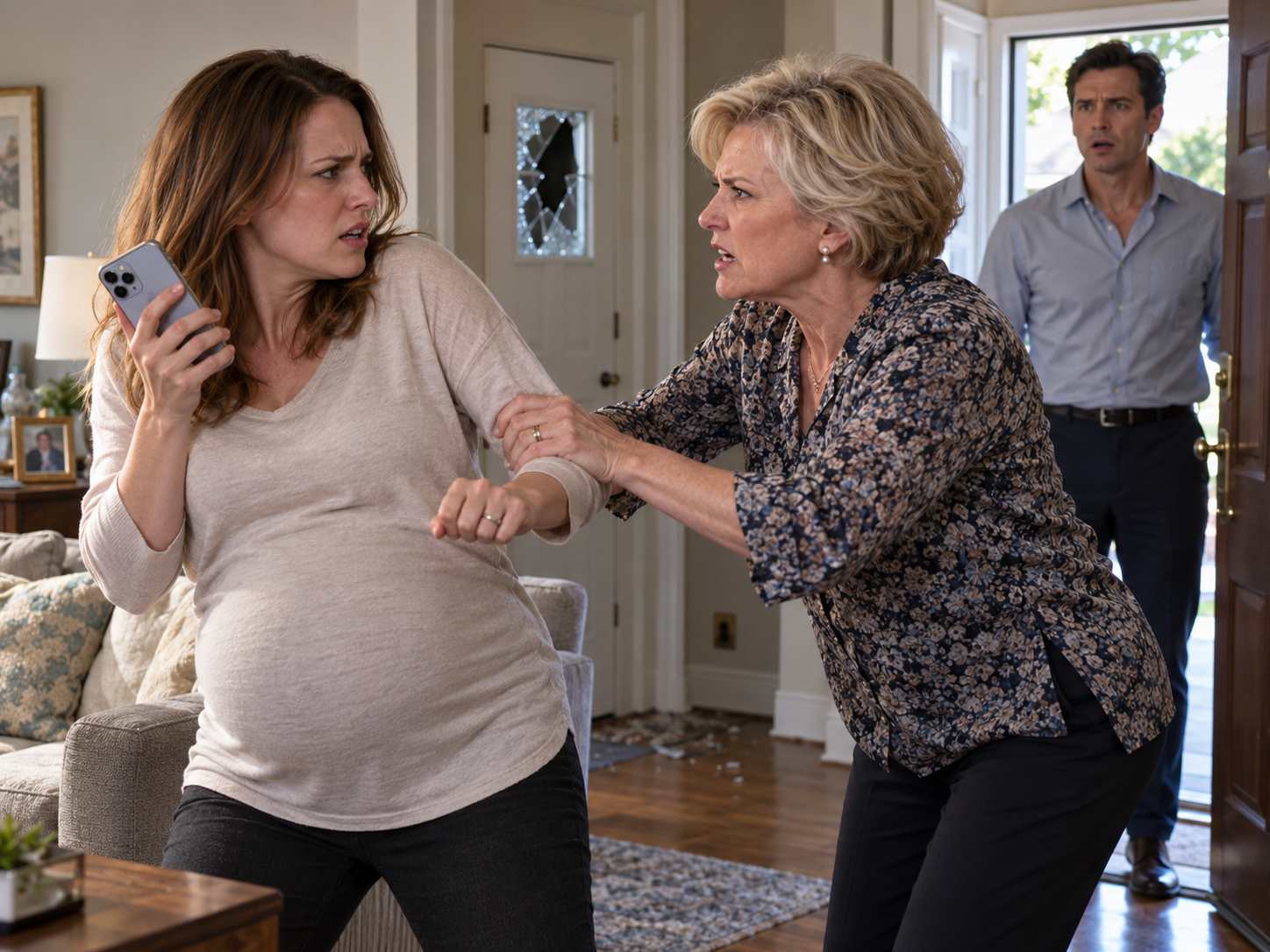
His mother’s hand.
Me looking toward him.
“I thought about taking the camera down,” he said.
I glanced at the Ring.
“Why?”
“Because I hated it.”
I almost smiled.
“So did I.”
“I hated knowing it had recorded the worst thing I’ve ever done.”
I looked at him.
“You didn’t grab me.”
“No.”
His voice was quiet.
“But I watched.”
That mattered.
Not because I wanted him to punish himself forever.
Because accountability begins when people stop minimizing the exact thing they did.
Or failed to do.
He put his hands in his pockets.
“I’ve spent my whole life telling myself Mom is difficult because she cares too much.”
I said nothing.
“She controlled who I dated. Where I went to college. Where we bought this house.”
“She wanted us three streets away from her.”
“I know.”
“She chose our realtor.”
“I know.”
“She tried to name Lily.”
He actually laughed at that.
“Eleanor.”
“She printed monogrammed blankets.”
“She was confident.”
“She always is.”
His smile faded.
“I let her convince me that making her unhappy was the same as doing something wrong.”
I leaned against the wall.
“What changed?”
He looked at the camera.
“That day.”
I followed his eyes.
“I wish it had changed before.”
“So do I.”
“I wish you had stopped her.”
“So do I.”
“I don’t know if wishing matters.”
“It doesn’t.”
That surprised me.
He walked closer.
“Actions matter.”
For several seconds, neither of us spoke.
Then I asked the question I had been avoiding for months.
“Do you expect me to come back?”
He shook his head.
“No.”
“Do you want me to?”
His eyes filled.
“Yes.”
The honesty hurt.
“But I don’t expect it.”
I looked around the room.
Our room.
Our old life.
There had been good years here.
That was something people rarely understood about damaged relationships.
If every day had been terrible, leaving would have been easy.
Evan had made pancakes on Sunday mornings.
He had held my hand through twenty hours of labor.
He had slept on the floor beside Lily’s crib when she had pneumonia.
He knew how I liked my coffee.
He danced badly in the kitchen.
He called me from the grocery store because he could never remember which yogurt I liked even though I had bought the same brand for six years.
He loved me.
I believed that.
But love had existed beside cowardice.
And on the driveway, cowardice won.
“I filed for divorce this morning,” I said.
Evan closed his eyes.
I watched his face fold.
For one terrible second, I almost apologized.
Then he nodded.
“Okay.”
“I’m sorry.”
“I know.”
“I didn’t decide because of the criminal case.”
“I know.”
“I didn’t decide because your mother hates me.”
“I know.”
“I decided because when I imagine being married to you again, part of me is always standing on that driveway waiting for you to move.”
A tear rolled down his cheek.
“I understand.”
“I hope someday you forgive yourself.”
His eyes opened.
“But I can’t stay married to you just to help you do it.”
He nodded.
“No.”
“And I won’t keep Lily from you.”
“Thank you.”
“But Diane is different.”
His expression tightened, but he waited.
“When the legal restriction ends, I want any relationship between Lily and your mother to happen slowly, with clear boundaries. I’m not agreeing to unsupervised time right away.”
He nodded.
“I agree.”
I searched his face for hesitation.
There was none.
“If your mother pushes?”
“I tell her no.”
“If she cries?”
“No.”
“If she says I’m controlling you?”
“No.”
“If she tells you you’re choosing me over family?”
He gave a sad smile.
“You are family.”
I looked away.
Maybe that sentence would have saved us once.
Now it arrived too late.
But late truth is still truth.
Our divorce was finalized the following spring.
It was painful.
Civil.
Far less dramatic than the afternoon that caused it.
We shared custody.
Lily adjusted better than I expected.
Children do not need every adult under one roof.
They need the adults around them to make the world feel predictable.
Evan became better at that.
He stopped using Lily to carry emotional information.
He stopped passing Diane’s complaints to me.
When his mother wanted something that violated our agreement, he told her no without making me the villain.
I noticed.
I never told him how much.
Diane remained angry with me.
I accepted that too.
Eventually, after she completed the requirements of her case and after months of distance, she began seeing Lily again under structured conditions Evan and I both agreed to.
The first time, I was terrified.
I almost canceled.
But boundaries are not the same as permanent punishment.
The goal had never been to erase Diane from Lily’s life.
The goal was to make sure she understood that being a grandmother did not give her ownership.
Over time, things became boring.
That was the best possible outcome.
No screaming.
No surprise visits.
No grabbing.
No police.
Just scheduled afternoons and firm rules.
Diane never apologized to me directly.
Not a real apology.
Once, through Evan, she said she “regretted how things unfolded.”
I told him not to bring me messages like that anymore.
He didn’t.
Two years after the incident, I moved into a small house ten minutes from Sarah.
The front porch was narrow.
The kitchen cabinets were ugly.
The backyard fence leaned slightly to the left.
I loved it.
On move-in day, Sarah arrived carrying pizza.
Lily ran through every empty room shouting that she wanted the bedroom with the “sparkly window,” although there was nothing sparkly about it except the way afternoon light hit the glass.
Mark sent me a housewarming card.
Inside he wrote:
**Hope your new neighbors are boring.**
I laughed for five full minutes.
Then Sarah pointed toward a box on the kitchen counter.
“What’s that?”
I looked.
A Ring Doorbell.
She raised one eyebrow.
“You bought one?”
“I did.”
“I thought you hated those.”
“I changed my mind.”
That evening, after Lily fell asleep, I installed it beside the front door.
When the little blue light came on, I stood on my porch and looked out at the street.
For a moment, I was back there.
Suitcase rolling behind me.
My scalp burning.
Diane’s voice tearing through the afternoon.
**You are NOT taking my son’s child!**
My own scream.
**Let go of me!**
Mark running across the lawn.
Evan standing still.
The memory no longer swallowed me.
That surprised me.
For so long, I thought the important part of that day was the camera.
The proof.
The fact that police could see what happened.
The fact that Diane couldn’t rewrite it.
But standing outside my new house, I understood something else.
The Ring footage mattered because other people needed evidence.
The officers needed it.
The prosecutor needed it.
The lawyers needed it.
Maybe even Evan needed it.
But I didn’t.
I had always known what happened.
I knew when fingers closed around my hair.
I knew when my husband watched.
I knew when someone told me my fear was an overreaction.
I knew when a family that constantly demanded my understanding offered me none in return.
The camera did not create the truth.
It only preserved it.
And maybe that was why the story ended differently than Diane expected.
For years, she had controlled the family by controlling the version of events everyone was allowed to believe.
She would say I misunderstood.
Evan would say she meant well.
I would doubt myself.
Then we would all move on.
That afternoon, the pattern broke.
Not because someone finally argued better.
Because there was nothing left to argue about.
A timestamp.
A driveway.
A woman trying to leave.
A hand reaching out.
A husband standing still.
A neighbor running over.
The truth, recorded from beginning to end.
I looked through the front window of my new house.
Lily was asleep on the couch, surrounded by unopened moving boxes, her stuffed rabbit tucked under one arm.
Safe.
Mine to protect.
Not mine to own.
There was a difference.
I understood that now better than anyone.
My phone buzzed.
A message from Evan.
**Lily left her purple sneakers at my apartment. I’ll bring them to school tomorrow.**
Nothing else.
No message from Diane attached.
No guilt.
No pressure.
No hidden accusation.
Just purple sneakers.
I smiled.
Then I typed:
**Thanks. She’ll need them for gym.**
I sent it.
Simple.
Boring.
Healthy.
I locked the front door.
The Ring camera chimed softly as I stepped back inside.
Once, a camera had recorded the moment my marriage finally became impossible to lie about.
Now another one watched over a home where I no longer needed permission to leave.
And no one standing on my porch would ever again get to tell me that love gave them the right to hold me there.