Stories worth slowing down for — new every evening
Family & Legacy

Her Family Planned Three Weeks in Her Florida Home Without Asking

Her Family Planned Three Weeks in Her Florida Home Without Asking

The first warning arrived as a grocery list.

Margaret Ellis was standing barefoot in her kitchen when her phone buzzed.

She had been slicing a peach.

The knife stopped halfway through the fruit.

Her daughter-in-law, Jenna, had sent the message.

**SUMMER FLORIDA HOUSE — WEEK ONE GROCERIES.**

Margaret stared at the words.

Below them were forty-three items.

Milk.

Juice boxes.

Hamburger buns.

Two cases of bottled water.

Frozen waffles.

Four dozen eggs.

And something called dinosaur chicken nuggets.

Margaret read the list twice.

Then she reached the final line.

**We’ll probably need to use your garage refrigerator too.**

Her garage refrigerator.

Her kitchen.

Her house.

Nobody had asked.

Margaret set the knife down.

Outside, a sprinkler clicked across the hibiscus.

The Gulf air pressed against the windows.

It was June in Dunedin, Florida.

Hot already.

Quiet too.

Usually Margaret liked quiet.

At seventy-one, she had finally learned its value.

Then another message appeared.

This one came from Jenna directly.

**I ordered everything for July 6. Delivery window is 2–4.**

Margaret typed three words.

**For what exactly?**

The dots appeared immediately.

Then vanished.

Then appeared again.

Finally Jenna answered.

**For our three weeks with you!**

Margaret remained very still.

Three weeks.

Not three days.

Three weeks.

She opened the family group chat.

There it was.

A conversation she had somehow missed.

Jenna had posted an itinerary.

July 6 through July 27.

Scott and Jenna.

Their three children.

Jenna's sister, Molly.

Molly's husband.

Their little boy.

Eight people.

Margaret counted again.

Eight.

Her house had three bedrooms.

One belonged to her.

One served as a guest room.

The third had become her sewing room.

Apparently, that no longer mattered.

Jenna had already solved everything.

The teenagers would use air mattresses.

Molly and Ben would take the guest room.

Scott and Jenna would sleep in Margaret's sewing room.

The younger children would rotate between sofas.

Margaret's dining table would become a work station.

Her screened porch would become a play area.

Her driveway would hold three vehicles.

And Margaret would apparently remain somewhere inside all of it.

That part was never discussed.

Her phone rang.

Jenna.

Margaret watched it for two rings.

Normally, she answered immediately.

She answered on the third.

“Hi, Margaret.”

Jenna sounded cheerful.

Too cheerful.

“I figured you saw the list.”

“I saw it.”

“Great.”

A pause followed.

Margaret heard children in the background.

Then cabinet doors.

Then Jenna continued.

“I know it looks like a lot.”

“It does.”

“But feeding everyone in Florida gets expensive.”

Margaret looked at her peach.

Juice had gathered on the cutting board.

“I imagine it does.”

“Exactly.”

Jenna laughed lightly.

“So I thought planning ahead would help you.”

Help her.

Margaret looked around her kitchen.

Nothing there needed help.

Not until July 6, apparently.

“Jenna.”

“Yes?”

“When did we agree to this?”

Silence.

Not long.

Maybe two seconds.

Still, Margaret noticed it.

“Well, Scott said summers are always open.”

Margaret's fingers tightened around the phone.

“He said that?”

“He said you love having everyone.”

Margaret looked toward the refrigerator.

A photograph hung beneath a Florida magnet.

Scott at forty-three.

Jenna beside him.

Three grandchildren between them.

Margaret loved every face.

That was precisely the problem.

“I enjoy visits,” Margaret said.

“Right.”

Jenna sounded relieved.

“So we're good.”

Margaret almost corrected her.

The words reached her throat.

Then another thought arrived first.

If she said no, what happened?

Would Jenna call her difficult?

Would Scott sound disappointed?

Would the children hear about it?

Would sixteen-year-old Ava think Grandma did not want them?

Margaret knew that fear.

She had lived beside it for years.

So she said the sentence she always said.

“I'll look at everything.”

Jenna laughed again.

“Perfect.”

The call ended.

Margaret remained beside the counter.

The house looked exactly the same.

She did not.

Not quite.

She picked up the peach.

Then put it down again.

Three weeks.

Eight people.

Her house.

Their plan.

Margaret walked to the hallway.

The guest room door stood open.

Fresh white sheets covered the bed.

A small watercolor hung above it.

Her late husband, David, had bought it.

A blue heron stood in shallow water.

David had liked birds.

Margaret had teased him about it.

Then he died six years earlier.

Afterward, the house became unbearably quiet.

For a while.

That silence had frightened her then.

So she welcomed interruption.

Scott visited more often.

Then Jenna came.

Then the grandchildren.

Every arrival felt like rescue.

Margaret cooked too much.

She made pancakes.

She changed sheets.

She bought beach towels.

She filled the refrigerator before anyone arrived.

She never let them carry groceries.

She refused money for gas.

She babysat whenever asked.

She made herself useful.

Especially useful.

Somewhere along the way, usefulness became her invitation.

Margaret returned to the kitchen.

Her phone buzzed again.

Jenna had added another message.

**Also, can we clear the sewing room beforehand?**

Margaret read it slowly.

Her sewing room.

She entered it almost every morning.

David's old desk stood beneath the window.

Her machine sat near it.

Fabric filled two wooden cabinets.

A half-finished quilt rested across a chair.

Margaret had started it for herself.

That fact still felt strange.

For herself.

Not a grandchild.

Not a wedding.

Not a birthday.

Hers.

She had chosen soft green and cream squares.

Colors David would have called boring.

Margaret smiled despite herself.

Then she remembered Jenna's message.

Clear the sewing room.

Beforehand.

As though Margaret had received an assignment.

She did not answer.

That was unusual.

Jenna noticed.

Twenty minutes later, another message came.

**We can help move stuff when we arrive.**

Margaret still did not answer.

She finished the peach instead.

That evening, Scott called.

His voice carried the gentle caution Margaret recognized immediately.

“Mom.”

There it was.

The voice he used before asking something.

“Hello, sweetheart.”

“Jenna said you seemed surprised.”

“I was.”

He exhaled.

“I thought we talked about July.”

“We talked about you visiting.”

“Right.”

“You said maybe a week.”

Another pause.

“Plans grew.”

Margaret almost laughed.

Plans did not grow.

People grew them.

“I can see that.”

Scott continued carefully.

“Molly's family couldn't afford a hotel.”

Margaret waited.

“So Jenna thought it made sense.”

Again, Margaret waited.

Scott was used to her filling silence.

She usually offered solutions.

This time she didn't.

“Mom?”

“Yes?”

“You have the space.”

Margaret looked toward the sewing room.

“I have rooms.”

“That's what I mean.”

No.

It wasn't.

Space was empty.

Rooms belonged to lives.

She almost said that.

Instead, she asked, “Did you tell Jenna I agreed?”

Scott hesitated.

That hesitation mattered.

“I told her you'd probably be fine.”

Probably.

Margaret sat at the kitchen table.

Years earlier, she would have protected him.

She might have said he misunderstood.

She might have blamed scheduling.

She might have made the answer easier.

Not tonight.

“You shouldn't have done that.”

Scott grew quiet.

“I didn't think it was a big deal.”

Margaret looked at David's empty chair.

“It became one.”

Another silence.

This one lasted longer.

Then Scott said, “The kids are excited.”

There it was.

The sentence Margaret feared most.

The children.

Not accusation.

Not exactly.

But pressure could wear a sweet face.

“I love the kids.”

“I know.”

“That's separate.”

Scott seemed startled.

Margaret heard it in his breath.

“Separate from what?”

“From deciding who stays in my house.”

He did not answer immediately.

Margaret's heart beat faster.

Strangely, her voice did not.

Finally Scott said, “Okay.”

Then, softer, “I guess we'll talk later.”

After they hung up, Margaret sat alone.

She expected guilt.

It came.

Fast.

Familiar.

Maybe she was overreacting.

Maybe three weeks wasn't terrible.

Maybe families did this.

Maybe she should feel lucky.

Plenty of widows complained their children never visited.

Margaret had heard that often.

At church.

At book club.

At the grocery store.

“You're so lucky Scott stays close.”

She was.

She knew that.

But luck could still require a guest room key.

And apparently several air mattresses.

Margaret stood and carried her plate away.

The dishwasher was empty.

The counters were clean.

No toys lay beneath the table.

No towels hung over chairs.

No one had opened her pantry.

No one had moved her coffee.

The quiet no longer felt lonely.

That surprised her most.

She remembered the first Christmas after David died.

Scott had brought everyone for ten days.

Margaret had begged them to stay longer.

She meant it then.

She had been afraid of January.

Afraid of waking alone.

Afraid of hearing nothing.

Jenna had washed dishes beside her.

Ava had been ten.

The twins had been five.

Laughter filled every room.

Margaret slept badly.

She loved every minute.

When they left, Jenna cried.

“So next year again?”

Margaret had said yes immediately.

The next year became twelve days.

Then sixteen.

Then spring break too.

The first extra visit felt like a gift.

The second felt busy.

The third required preparation.

By the fourth, nobody asked what Margaret had planned.

They asked whether the sheets were clean.

Small changes.

Easy to miss.

One summer, Jenna mailed beach toys ahead.

Margaret thought it was efficient.

Another year, Scott gave his college friend Margaret's address.

The man stayed two nights during a fishing trip.

Margaret barely knew him.

Scott apologized afterward.

She told him not to worry.

Then there was Thanksgiving.

Jenna invited her parents.

Margaret found out eleven days before dinner.

“Your table seats ten,” Jenna had said.

Margaret's table seated eight.

She borrowed chairs.

She bought another turkey.

Nobody intended harm.

That made everything harder to name.

No one yelled.

No one threatened.

They simply assumed.

And Margaret adjusted.

Again.

And again.

And again.

Each adjustment seemed too small to challenge.

Together, they had become a life.

The following morning, Margaret attended water aerobics.

She almost canceled.

Her mind felt crowded.

Instead, she drove to the community pool.

Her friend Ruth Alvarez noticed immediately.

Ruth was seventy-four.

She had silver hair and blunt opinions.

“You're kicking like you're mad at somebody.”

Margaret laughed.

“Maybe the water deserves it.”

“Water's innocent.”

They continued exercising.

Margaret said nothing else.

Ruth did not push.

Afterward, they sat beneath a blue umbrella.

Ruth drank iced tea.

Margaret checked her phone.

Seven family messages waited.

Jenna had posted sleeping arrangements.

Molly had replied with heart emojis.

Ava wanted to bring a friend for five days.

One twin wanted to know about Wi-Fi speed.

The youngest wanted a kayak.

Margaret stared.

Ruth leaned closer.

“Funeral or family chat?”

“Family.”

“Same face.”

Margaret handed her the phone.

Ruth read silently.

Then she returned it.

“Did you invite them?”

“No.”

“Interesting.”

Margaret braced for outrage.

Ruth offered none.

She only asked, “What do you want?”

Margaret opened her mouth.

Nothing came.

The question felt almost rude.

What did she want?

She had spent years asking different questions.

What did Scott need?

What would make Jenna comfortable?

What would the children enjoy?

What kept everyone connected?

What avoided trouble?

Her own preference usually entered last.

If there was room.

“I don't know,” Margaret admitted.

Ruth nodded.

“That's probably your first problem.”

The sentence stayed with her.

Margaret drove home slowly.

At a traffic light, she remembered something else.

Two years earlier, she had planned a weekend in St. Augustine.

Just herself.

Two nights.

She booked a small inn.

She wanted to visit galleries.

David had hated galleries.

She loved them.

The day before leaving, Scott called.

The twins' tournament schedule changed.

Could Margaret keep their dog?

Only four days.

Margaret canceled St. Augustine.

Scott never asked her to.

Not directly.

She volunteered.

That mattered now.

A year later, she planned another trip.

This time to Cedar Key.

Then Ava needed help with an online summer class.

Margaret stayed home.

Again, nobody forced her.

She offered.

That mattered too.

She had begun seeing the pattern differently.

Her family had learned something.

But Margaret had taught it.

Whenever inconvenience appeared, she removed it.

Whenever tension appeared, she softened it.

Whenever Scott hesitated, she said yes.

Her generosity was real.

So was her fear.

The distinction hurt.

Margaret entered her house.

The afternoon light fell across the floor.

Her sewing-room door remained open.

She stepped inside.

The unfinished quilt waited.

She lifted one green square.

Then another.

On David's old desk sat an envelope.

Cream colored.

Unopened.

Margaret touched it.

The envelope had arrived nine days earlier.

She had hidden it beneath a magazine.

Not intentionally.

At least, that was what she told herself.

Inside was a printed confirmation.

Three weeks.

Exactly three weeks.

July 7 through July 28.

Margaret had applied months ago for something Ruth recommended.

A coastal restoration volunteer program.

Not exactly glamorous.

Not exactly a vacation either.

Participants stayed at a small environmental center near Apalachicola.

They helped catalog shorebird nesting sites.

They cleaned protected beaches.

They attended morning lectures.

They ate together.

Margaret had almost forgotten applying.

Then she was accepted.

She had until Friday to confirm.

David would have loved it.

That was why Margaret almost declined.

Birds had belonged to him.

At least, that was how she thought of them.

He had spent twenty years pointing them out.

Roseate spoonbills.

Ospreys.

Herons.

Pelicans.

Margaret mostly smiled and nodded.

After he died, she found his old field guide.

Notes filled every margin.

One page contained a sentence in his handwriting.

**Margaret pretends not to care, then spots them first.**

She had laughed when she read it.

Then cried.

Months later, Ruth showed her the volunteer program.

“You don't need to love birds,” Ruth said.

“You just need to tolerate sunburn.”

Margaret applied that evening.

Then forgot about it.

Or tried to.

When acceptance arrived, she felt foolishly excited.

Then guilty.

Three weeks away.

What if Scott needed her?

What if someone visited?

What if something happened?

So the envelope stayed beneath the magazine.

Now eight people intended to occupy her house.

During the same three weeks.

Margaret sat at David's desk.

She read the confirmation again.

Participants had to confirm by Friday.

Today was Wednesday.

She reached for a pen.

Then stopped.

A photograph stood beside the lamp.

David on Honeymoon Island.

Binoculars around his neck.

Margaret beside him.

Her hair was darker then.

His arm rested across her shoulders.

She remembered the day.

David had spent forty minutes watching an osprey.

Margaret complained about the heat.

Then she spotted another nest.

Before he did.

He had never let her forget it.

Margaret smiled.

She signed the confirmation.

No family meeting.

No permission.

No announcement.

She simply signed.

Then she mailed it.

Her hands trembled afterward.

Not fear exactly.

Something newer.

The next day, Jenna called.

“Did you see the updated plan?”

Margaret was ironing quilt fabric.

“I did.”

“Molly thinks she can bring one folding crib.”

“That sounds useful.”

“And Ava might bring Caroline.”

Margaret kept ironing.

“So nine people?”

“Only for five days.”

Margaret moved the iron carefully.

Jenna laughed.

“I know it sounds crazy.”

“Yes.”

“We'll make it work.”

There it was again.

We.

Margaret set the iron upright.

“Jenna, don't buy anything else yet.”

The laughter disappeared.

“Why?”

“I'll explain soon.”

“Is something wrong?”

“No.”

“Then why wait?”

Margaret looked at the quilt.

“Because I asked you to.”

Silence.

Margaret had never spoken rudely to Jenna.

She had not done so now.

Still, something changed.

Jenna noticed.

“Okay.”

Her voice cooled slightly.

“Sure.”

After the call, Margaret expected panic.

Instead, she finished ironing.

That frightened her almost as much.

The old Margaret would have called back.

She would have explained.

She would have added reassurance.

She would have said nobody was upset.

She would have offered alternatives.

This Margaret let the silence remain.

Friday arrived.

So did two cardboard boxes.

Margaret discovered them beside her front door.

The shipping labels belonged to Jenna.

One contained pool floats.

The other contained children's sunscreen.

Margaret stood over them.

Normally, she would carry them inside.

She didn't.

She dragged both into the garage.

Then she texted Jenna.

**Your boxes arrived. I put them in the garage unopened.**

Jenna replied quickly.

**Perfect!**

Margaret stared at the word.

Then laughed.

Not because anything was funny.

Because the misunderstanding had become almost impressive.

Saturday brought another delivery.

Four beach chairs.

Margaret left them packaged.

Sunday brought inflatable mattresses.

Monday brought a folding high chair.

Her garage slowly became evidence.

Not evidence of cruelty.

Evidence of certainty.

Everyone was certain.

Except the homeowner.

On Tuesday, Margaret drove to the bank.

Then to the pharmacy.

Then to an outdoor store.

She bought walking shoes.

A sun hat.

A lightweight rain jacket.

And a small pair of binoculars.

She almost bought expensive ones.

Then chose the middle-priced pair.

David would have approved.

At home, she placed everything inside a blue suitcase.

She left it open on her bed.

For the first time, the decision felt physical.

Real.

Later that evening, Scott called.

“Mom, are you mad?”

Margaret sat on the porch swing.

“No.”

“Jenna thinks you are.”

“I know.”

“She feels like you're being distant.”

Margaret considered that.

Perhaps she was.

But distance could look enormous when someone expected constant accommodation.

“I've been thinking.”

Scott sighed.

She knew that sigh too.

It belonged to uncomfortable conversations.

“About what?”

“July.”

“Mom.”

The word carried warning now.

Margaret almost backed away.

Old instinct.

Old fear.

Then she looked toward the darkening yard.

A gecko clung to the porch screen.

“I won't be hosting everyone for three weeks.”

Scott did not speak.

Margaret heard a television behind him.

Then Jenna's voice, farther away.

“What?”

Scott moved somewhere quieter.

“Mom, we already made arrangements.”

“Yes.”

“What does that mean?”

“It means exactly what I said.”

“Jenna booked Molly's flights.”

Margaret closed her eyes briefly.

Flights.

Of course.

The plan had gathered weight.

Money.

Expectations.

Children.

That was how assumptions became obligations.

Someone else made enough plans.

Then refusing felt cruel.

“I didn't know about the flights.”

“Well, they're booked.”

“I understand.”

“So what are we supposed to do?”

There it was.

The question Margaret had answered for decades.

What are we supposed to do?

Usually, she solved it.

Her chest tightened.

“I think you'll need to decide that.”

Scott went silent.

Margaret waited.

“That's not like you.”

The words landed softly.

Still, they struck.

Margaret looked at her hands.

“No.”

She spoke carefully.

“It probably isn't.”

Scott exhaled.

“Can we come talk tomorrow?”

Margaret almost said she would drive to them.

They lived near Orlando.

Nearly two hours away.

She had made that drive dozens of times.

Then she stopped herself.

“You can come here.”

Another silence.

“Okay.”

The next afternoon, Jenna arrived with Scott.

Margaret knew the conversation mattered because they came without the children.

Jenna entered carrying a large canvas purse.

Scott carried nothing.

Margaret had made iced tea.

She almost baked banana bread.

Then didn't.

That absence felt absurdly significant.

They sat in the living room.

Margaret remained in her chair.

Scott took the sofa.

Jenna sat beside him.

For several seconds, nobody spoke.

Usually Margaret rescued silence.

Not today.

Jenna finally began.

“I feel embarrassed.”

Margaret nodded.

“I can understand that.”

“I told my sister everything was settled.”

“I know.”

“Because Scott said it was.”

Scott looked down.

There it was.

A crack.

Small.

But visible.

Jenna continued.

“I didn't think I needed a formal invitation.”

Margaret watched her.

That sentence was more honest than anything before it.

“Why?”

Jenna frowned.

“Because we're family.”

Margaret nodded again.

“I know.”

“And you've always loved having us.”

“I do.”

“Then I honestly don't understand.”

Margaret believed her.

That changed something.

Jenna was not pretending.

She genuinely did not understand.

That hurt less than malice.

And more.

Margaret folded her hands.

“Jenna, when you visit for five days, who plans meals?”

Jenna blinked.

“You usually do.”

“Who washes the towels?”

“Margaret—”

“I'm asking.”

Jenna stopped.

“You do.”

“Who buys breakfast food?”

“You.”

“Who changes beds?”

Jenna shifted.

“You do.”

“Who moves her schedule around?”

No answer.

Margaret did not need one.

Scott rubbed his forehead.

Margaret looked at him.

“Who told Jenna July was open?”

Scott lifted his eyes.

“I did.”

“Did you ask me?”

“No.”

“Why not?”

He hesitated.

Then said the worst possible thing.

“Because you've never said no.”

The room became quiet.

Margaret felt something settle inside her.

Not anger.

Recognition.

Scott looked regretful immediately.

“Mom, I didn't mean—”

“No.”

Margaret stopped him gently.

“I think you did.”

Scott stared at her.

“And I think that's important.”

Jenna looked between them.

Something in her expression changed too.

Margaret realized Jenna had entered prepared for battle.

She had expected criticism.

Perhaps humiliation.

Instead, the conversation had moved somewhere else.

Scott leaned forward.

“I should have asked.”

“Yes.”

“I know that now.”

Margaret nodded.

Jenna remained stiff.

“But we're still stuck.”

Margaret looked at her.

“Yes.”

“We have flights.”

“Yes.”

“The kids think we're going.”

“Yes.”

“My sister arranged vacation days.”

“I understand.”

Jenna's frustration finally showed.

“Then what exactly are you asking us to do?”

Margaret did not answer immediately.

She noticed Jenna's purse.

One corner had collapsed inward.

She noticed Scott tapping his thumb.

She noticed her own breathing.

Steady.

Very steady.

“Make another plan.”

Jenna stared.

“That simple?”

“No.”

Margaret shook her head.

“Not simple.”

Then she added, “Just yours to make.”

Nobody spoke.

Outside, a lawn mower started somewhere nearby.

The sound seemed ridiculously ordinary.

Scott eventually asked, “Are you going somewhere?”

Margaret looked at him.

“Why?”

“You keep saying you can't host.”

“I didn't say can't.”

She paused.

“I said won't.”

Jenna looked wounded now.

That was harder.

Margaret had expected anger.

She was less prepared for hurt.

“So you just don't want us here.”

Margaret felt the old instinct rise.

Fix it.

Soften it.

Tell Jenna that wasn't true.

Offer ten days.

Offer one week.

Offer something.

She almost did.

Then she remembered the boxes.

The guest list.

The sewing room.

The flights.

The grocery delivery.

Everything had happened before anyone heard her answer.

“This isn't about wanting you,” Margaret said.

“It is about being asked.”

Jenna looked away.

Margaret continued.

“You planned inside my house before speaking to me.”

Jenna's eyes returned.

“You assigned rooms.”

Silence.

“You invited another family.”

Another silence.

“You scheduled grocery delivery.”

Jenna swallowed.

“You asked me to clear a room I use every day.”

Scott stopped tapping his thumb.

Margaret looked at both of them.

“I don't think you meant to hurt me.”

That was true.

“But you did stop noticing me.”

Jenna's face changed.

Not dramatically.

No tears.

No apology.

Just recognition beginning.
Scott spoke first.

“Mom, what's in July?”

Margaret knew what he meant.

Why now?

Why this boundary?

What had changed?

She stood.

Both watched her.

Margaret walked to the hallway.

Then into her bedroom.

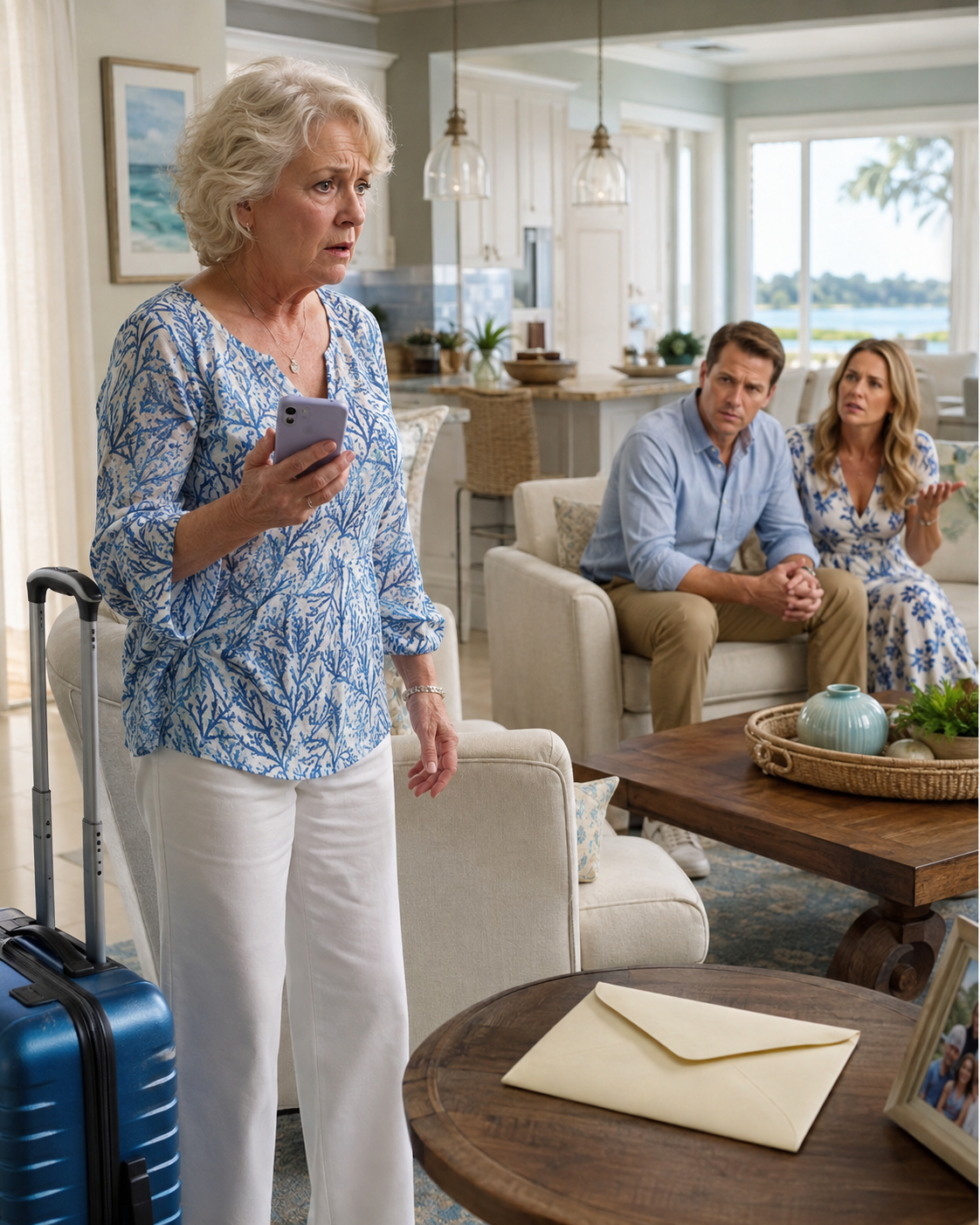
She returned carrying the blue suitcase.

She placed it beside her chair.

Jenna stared at it.

Scott frowned.

“You're traveling?”

“Yes.”

“Where?”

“North Florida.”

“For how long?”

“Three weeks.”

Scott looked genuinely shocked.

Jenna looked almost offended.

“You booked a vacation?”

“Not exactly.”

Margaret sat again.

She told them about the restoration program.

The shorebirds.

The volunteer center.

The acceptance.

The dates.

July 7 through July 28.

Scott looked at the suitcase.

Then at Margaret.

“You knew about this before we planned?”

“The invitation arrived before your grocery list.”

“Why didn't you tell us?”

The question startled her.

Not because it was unfair.

Because she knew the answer.

“I wasn't sure I would go.”

“Because of us?”

Margaret looked at her son.

“Mostly.”

Scott leaned back.

Jenna lowered her eyes.

The room changed again.

Margaret felt it.

For years, she had imagined her sacrifices as invisible expressions of love.

Perhaps they were invisible because she kept making them invisible.

She canceled quietly.

Adjusted quietly.

Paid quietly.

Cleaned quietly.

Agreed quietly.

Then wondered why nobody noticed.

Scott spoke slowly.

“Were there other trips?”

Margaret almost said no.

Protect him.

Old habit.

“Yes.”

“How many?”

“Several.”

His face tightened.

“I didn't know.”

“No.”

“Why didn't you tell me?”

Margaret looked at him.

“Because then you might feel guilty.”

Scott gave a strange, humorless laugh.

“And now?”

“Now I think guilt belongs to the person who feels it.”

Jenna looked up.

Margaret almost apologized for the sentence.

She didn't.

Scott leaned forward again.

“So the house will be empty?”

There it was.

Margaret had expected the question eventually.

“No.”

Jenna's eyebrows lifted.

“What do you mean?”

Margaret reached into the side pocket of her suitcase.

She removed a small yellow envelope.

Inside was a single brass key.

Nothing dramatic.

Just a key.

Jenna stared at it.

Scott did too.

Margaret placed it on the table.

“My friend Ruth will be staying here.”

Scott frowned.

“For three weeks?”

“Yes.”

“Why?”

“Her condominium is being treated for water damage.”

Margaret had learned about it four days earlier.

Ruth planned to stay with her daughter.

The daughter had two toddlers.

Margaret offered her house instead.

Not from guilt.

Not because Ruth asked.

Because it suited Margaret.

Ruth would water the plants.

Collect the mail.

Keep an eye on things.

And Margaret trusted her.

Scott looked stunned.

“So Ruth gets the house?”

Margaret heard the old language immediately.

Gets the house.

As though the house were a prize.

“She gets a place to sleep.”

“Mom.”

“She'll use the guest room.”

“What about the rest?”

“She'll live normally.”

Jenna finally spoke.

“You'd rather let a friend stay here than your own family?”

Margaret studied her.

There it was.

The question underneath everything.

Family versus everyone else.

Blood versus preference.

Obligation versus choice.

Margaret did not answer defensively.

“This isn't a contest.”

“It feels like one.”

“I understand.”

Jenna shook her head.

“I'm trying to.”

Scott stood.

He paced toward the window.

Margaret had watched him pace like that since high school.

He always moved when emotion made him uncomfortable.

Finally he turned around.

“Can't Ruth stay somewhere else?”

Margaret looked at him.

The answer arrived easily.

“Yes.”

Hope appeared on his face.

Then Margaret continued.

“And so can you.”

Silence.

Complete silence.

Scott stared at her.

Jenna slowly leaned back.

Margaret heard the ceiling fan.

A car passed outside.

Somewhere in the kitchen, the refrigerator clicked on.

Margaret touched the brass key.

“The arrangements are already made.”

Her voice remained calm.

“I won't be changing them.”

Nobody argued.

Not immediately.

That was the first time Margaret understood power differently.

Power was not always speaking loudest.

Sometimes it was simply refusing to reopen a decision.

Scott sat again.

Jenna picked up her purse.

For a moment, Margaret thought they would leave angrily.

Instead, Jenna asked one question.

“Can I see the sewing room?”

Margaret blinked.

“What?”

“The room.”

Jenna looked uncomfortable.

“The one I told you to clear.”

Margaret stood.

They walked down the hallway.

Scott followed.

The sewing room was bright.

Afternoon sun covered the floor.

Fabric squares lay across the table.

David's desk remained near the window.

Jenna stopped beside the quilt.

“This is yours?”

“Yes.”

“Who are you making it for?”

Margaret almost smiled.

“Me.”

Jenna touched nothing.

She only looked.

Then she noticed David's photograph.

The binoculars around his neck.

Her expression softened slightly.

“I didn't know you still sewed this much.”

Margaret answered quietly.

“You never asked.”

Jenna flinched.

Margaret regretted the sharpness.

But she did not retract it.

Scott picked up one green fabric square.

He studied it.

“Dad would've hated this color.”

Margaret laughed before she could stop herself.

Scott laughed too.

Even Jenna smiled.

For five seconds, the room felt like family again.

Not perfect.

Not repaired.

Just familiar.

Then Jenna said, “I really didn't think I was taking over.”

Margaret looked at her.

“I know.”

That was perhaps the saddest part.

Jenna sat in the chair near the machine.

“My grandmother's house was different.”

Margaret waited.

Jenna rarely spoke about her grandmother.

“She lived outside Savannah.”

Jenna folded her hands.

“Everybody came whenever they wanted.”

“Did she like that?”

Jenna opened her mouth.

Then stopped.

Margaret watched her think.

“I always assumed she did.”

The answer lingered.

Jenna stared at the quilt.

“She cooked constantly.”

Margaret said nothing.

“Everyone called it Grandma's house.”

Jenna's voice grew quieter.

“But nobody ever asked what she was doing.”

Margaret felt something unexpected.

Not victory.

Certainly not satisfaction.

Recognition.

Jenna had inherited an assumption too.

Different woman.

Different house.

Same language.

Jenna looked toward Margaret.

“I thought this was normal.”

Margaret nodded.

“It probably was.”

Jenna seemed surprised.

Margaret added, “Normal doesn't always mean considerate.”

Nobody argued with that.

When they left, nothing was resolved neatly.

There were no hugs at the door.

No dramatic apology.

Scott kissed Margaret's cheek.

Jenna said goodbye.

Margaret watched their car disappear.

Then she returned inside.

The key remained on the coffee table.

She picked it up.

For years, Margaret had believed family peace required preventing disappointment.

She saw the flaw now.

Disappointment had always existed.

She simply absorbed it first.

Everyone else remained comfortable.

Margaret called Ruth.

“Still need somewhere in July?”

Ruth laughed.

“I thought that was settled.”

“It is.”

“Then why are you asking?”

Margaret looked at the brass key.

“I'm practicing.”

“Practicing what?”

“Remembering people can answer.”

Ruth laughed harder.

Margaret did too.

The next week became awkward.

The family group chat slowed.

Then stopped.

Margaret noticed immediately.

Usually, dozens of messages arrived daily.

Now only Ava posted occasionally.

A photograph of a new haircut.

A complaint about summer school.

A picture of the family dog asleep upside down.

Margaret responded normally.

Nobody mentioned July.

She wondered whether silence was punishment.

Then she wondered whether that assumption was another habit.

Perhaps people sometimes needed time.

Three days later, Ava called.

“Grandma?”

Margaret's stomach tightened.

“Hi, sweetheart.”

“Dad says we're not staying with you.”

Margaret closed her eyes.

Here it was.

The fear beneath every yes.

The grandchildren.

“No.”

“Why?”

Margaret chose her words carefully.

“I made plans too.”

“Oh.”

Nothing else.

Margaret waited.

Ava continued.

“Are you mad at us?”

Margaret's chest hurt.

“No.”

“Mom seems mad.”

“I think she's disappointed.”

“Is that different?”

Margaret smiled despite herself.

“Yes.”

“How?”

Margaret looked at the unfinished quilt.

“You can love someone and dislike their decision.”

Ava considered that.

Then asked, “Where are you going?”

Margaret explained.

Birds.

Beaches.

Volunteering.

Ava became interested immediately.

“Wait, like baby birds?”

“Some.”

“Can you send pictures?”

“I will.”

Then Ava surprised her.

“That sounds cool.”

Margaret swallowed.

“Thank you.”

Another pause.

“Dad found a rental.”

Margaret sat straighter.

“He did?”

“Yeah.”

“Where?”

“Clearwater.”

Margaret almost laughed.

Twenty-five minutes away.

Not disaster.

Not estrangement.

A rental.

A solution they created themselves.

“How nice.”

“It has a pool.”

Margaret smiled.

“Even better.”

Then Ava said something Margaret remembered for days.

“Mom says it's expensive.”

There was no accusation in the girl's voice.

Just information.

Margaret felt the old reflex.

Offer money.

She could afford some.

Maybe half.

Maybe more.

The thought arrived instantly.

Then another followed.

No.

Margaret said, “Vacations can be.”

Ava changed subjects.

Just like that.

The world continued.

No catastrophe.

No banishment.

No grandchildren lost forever.

Margaret hung up stunned.

For years, she had behaved as though every boundary stood beside a cliff.

One wrong step.

Then everything disappeared.

Yet the family had simply rented a house.

Margaret went into the sewing room.

She finished another row.

Two days later, Scott called.

“We found somewhere.”

“Ava told me.”

“Of course she did.”

He sounded tired.

Margaret waited.

“The rental's not cheap.”

“I heard.”

Another pause.

She knew he expected something.

Maybe an offer.

Maybe reassurance.

Maybe apology.

Margaret gave neither.

Scott finally chuckled.

“You're really making me handle this.”

Margaret smiled.

“Apparently.”

“I'm not sure I like the new you.”

“I haven't decided either.”

He laughed.

A real laugh this time.

Then he grew serious.

“Jenna's still upset.”

“I know.”

“She feels rejected.”

Margaret looked toward the backyard.

“I don't want her to.”

“But?”

“But I can't control that feeling for her.”

Scott remained quiet.

“Dad would be proud of you.”

Margaret's throat tightened.

Then she smiled.

“Your father would have offered everyone our house and complained privately for three weeks.”

Scott laughed loudly.

“That is absolutely true.”

Margaret laughed too.

The tension eased.

Not vanished.

Eased.

Then Scott said, “I told Jenna something.”

Margaret waited.

“I told her I was the one who said you'd be fine.”

Margaret said nothing.

“I kept saying it was your house.”

He paused.

“But I was acting like I could give permission.”

The words surprised her.

Scott continued.

“I think I put her in a bad position.”

Margaret sat down.

This was the twist she had not expected.

Not Jenna apologizing.

Scott taking responsibility.

He had always been the bridge between them.

Margaret had assumed bridges were neutral.

Perhaps they were not.

“You did,” she said gently.

“I know.”

“She shouldn't have planned everything.”

“No.”

“But you told her she could.”

“Yeah.”

Margaret remembered Jenna's certainty.

The grocery list.

The room assignments.

The flights.

She had thought entitlement entered her house wearing Jenna's face.

It hadn't.

Not entirely.

Scott had opened the door.

And Margaret had spent years showing him the door never closed.

The realization hurt.

But it also clarified everything.

This wasn't a wicked daughter-in-law story.

It wasn't even a selfish son story.

It was a family system built from assumptions.

Jenna assumed family homes were shared.

Scott assumed his mother always agreed.

Margaret assumed saying no endangered love.

Each belief supported the others.

No villain required.

Only one person had to stop.

Margaret happened to be first.

July approached.

The boxes remained in her garage.

One afternoon, Jenna texted.

**Can we pick our stuff up Saturday?**

Margaret replied.

**Of course.**

No apology.

No explanation.

Saturday morning, Jenna arrived alone.

She loaded pool floats first.

Then chairs.

Then mattresses.

Margaret helped with one light box.

Jenna stopped her.

“I've got it.”

Margaret stepped back.

That tiny moment felt strange.

Jenna carried the box herself.

They worked quietly.

Finally only the high chair remained.

Jenna leaned against her SUV.

“I owe you an apology.”

Margaret looked at her.

Jenna continued before she could respond.

“Not for wanting to come.”

“I know.”

“For planning your house like it was mine.”

Margaret nodded.

Jenna stared at the driveway.

“I was angry because you changed the rules.”

Margaret considered that.

“I think that's fair.”

Jenna looked surprised.

“Really?”

“Yes.”

Margaret leaned against the garage frame.

“I changed them without warning.”

Jenna nodded slowly.

Margaret continued.

“But I think the rules needed changing.”

Jenna gave a short laugh.

“Also fair.”

They stood together in the Florida heat.

No music.

No tears.

No cinematic reconciliation.

Just two women reconsidering each other.

Jenna finally said, “Can I tell you something terrible?”

Margaret smiled.

“That depends.”

“I was looking forward to your breakfasts.”

Margaret burst out laughing.

Jenna joined her.

“I know.”

“You weren't even planning to cook?”

“No.”

“I assumed you would.”

“Yes.”

Jenna covered her face briefly.

“This is getting worse.”

Margaret laughed again.

Then Jenna lowered her hands.

“I never thought of it as work.”

Margaret's smile faded gently.

“Because I tried very hard to make sure you didn't.”

That answer stopped them both.

Margaret heard herself clearly.

There it was.

The part she owned.

She had wanted effort to look effortless.

Because effortless love looked purer somehow.

She had cooked before sunrise.

Then smiled at breakfast.

She had washed towels after midnight.

Then said she enjoyed hosting.

She had spent money.

Then refused repayment.

She had canceled plans.

Then told everyone she was free.

She had hidden every cost.

Then quietly resented people for not seeing it.

That wasn't entirely fair either.

Jenna looked at her.

“You could've told me.”

“Yes.”

“Why didn't you?”

Margaret thought about David.

Then Scott.

Then the grandchildren.

“Because I wanted you to want to come back.”

Jenna's expression softened.

“We would've.”

Margaret smiled sadly.

“I didn't know that.”

That was the deeper truth.

Margaret had confused usefulness with belonging.

If she cooked, they came.

If she babysat, they called.

If she offered her house, they stayed.

If she remained convenient, she remained central.

She had never tested whether they would love her without the service.

Now she had.

The family was still there.

Annoyed.

Rearranged.

But there.

Jenna picked up the final box.

Then stopped.

“When we visit next time…”

Margaret waited.

“How many days do you actually like?”

The question felt almost comical.

Nobody had asked before.

Margaret thought carefully.

“Four.”

Jenna laughed.

“Four?”

“Five if everyone behaves.”

“That's brutal.”

“I'm seventy-one.”

Margaret smiled.

“I've earned accuracy.”

Jenna shook her head, laughing.

Then she hugged Margaret.

Briefly.

Not ceremonially.

It happened because it felt natural.

Margaret hugged her back.

On July 5, Margaret packed.

Two shirts too many.

Not enough socks.

A paperback novel.

Her sun hat.

The binoculars.

David's field guide.

And a photograph.

She almost removed the photograph.

Then left it.

Ruth arrived the next morning.

She carried one suitcase.

One grocery bag.

And an alarming number of coffee pods.

“You look nervous.”

Margaret locked the front door.

“I am.”

“About leaving?”

“Yes.”

“About me burning your house down?”

“That too.”

Ruth took the brass key.

Margaret hesitated before releasing it.

Ruth noticed.

“It's still your house.”

Margaret smiled.

“I know.”

That sentence felt new.

Scott's family had already reached Clearwater.

They sent a pool picture.

The children looked delighted.

Jenna stood behind them.

Scott wore ridiculous sunglasses.

Nobody looked devastated.

Margaret stared at the photograph.

Then slipped her phone into her purse.

Ruth drove her to the meeting point.

The volunteer center's shuttle waited there.

Margaret had expected a bus full of energetic college students.

Instead, half the volunteers looked older than she was.

One man used a cane.

A woman from Tennessee carried three cameras.

Another woman had brought knitting.

Margaret relaxed.

The shuttle moved north.

Florida flattened around them.

Strip malls faded.

Then highways.

Then pines.

Hours passed.

Margaret watched clouds build across the sky.

At first she thought about home constantly.

Had Ruth found the thermostat?

Had she locked the garage?

Would the orchids survive?

Had Margaret forgotten medication?

Then the questions slowed.

By evening, the group reached the coast.

The air smelled different there.

Salt.

Grass.

Warm wood.

The next morning started before sunrise.

Margaret hated that.

David would have loved it.

She walked across a protected beach with binoculars.

A volunteer leader pointed toward distant sand.

“Least tern colony.”

Margaret raised the binoculars.

At first she saw nothing.

Then movement.

Tiny birds.

Quick legs.

Nervous wings.

She smiled.

The leader moved on.

Margaret remained three seconds longer.

Not for David.

For herself.

That distinction mattered.

During the second week, Scott called.

Margaret sat outside the volunteer center.

Mosquitoes attacked her ankles.

“You surviving?” he asked.

“Barely.”

“Birds disappointing?”

“Some are very rude.”

Scott laughed.

Then he told her about Clearwater.

The rental was smaller.

The kitchen had terrible knives.

Molly's child spilled juice on the sofa.

Nobody knew how to operate the washing machine.

Margaret listened.

She did not offer solutions.

Scott noticed.

“Do you know how hard it is feeding nine people?”

Margaret smiled.

“I've heard rumors.”

He laughed.

Then stopped.

“Mom.”

“Yes?”

“I get it.”

Margaret's smile faded.

Scott continued.

“I really get it now.”

She could have made a joke.

She didn't.

“Good.”

They remained quiet.

Then Scott said, “We're having fun.”

Margaret felt warmth spread through her.

“I'm glad.”

“And we're exhausted.”

“I'm also glad.”

Scott laughed again.

Before hanging up, he said something simple.

“We'll see you when you're home.”

Not need you.

Not stay with you.

See you.

Margaret liked the difference.

On her final morning, Margaret walked alone.

Sunrise stretched pink across the Gulf.

She carried David's field guide.

The cover had softened with age.

She reached the page with his note.

**Margaret pretends not to care, then spots them first.**

She ran one finger across the handwriting.

For six years, she had treated the house like a memorial to their life together.

Same furniture.

Same desk.

Same guest room.

Same rituals.

But David had never asked her to become furniture too.

That realization arrived quietly.

She laughed at herself.

Then closed the book.

When Margaret returned to Dunedin, Ruth had cleaned everything.

Too thoroughly.

Margaret complained on principle.

The brass key sat on the kitchen counter.

Beside it was a note.

**House survived. So did you.**

Margaret smiled.

The next day, Scott's family visited.

Only for lunch.

They brought food.

All of it.

Jenna entered carrying sandwiches.

Scott carried drinks.

Ava carried fruit.

The twins carried nothing useful.

Some traditions survived.

Nobody brought suitcases.

Nobody asked for beds.

Nobody mentioned the garage refrigerator.

Margaret watched them fill the kitchen.

She felt love.

She also felt relief.

Those feelings were allowed together.

After lunch, Ava followed her into the sewing room.

“Did you finish it?”

Margaret looked at the quilt.

Almost.

“Help me choose the last border?”

Ava nodded enthusiastically.

They spent twenty minutes comparing fabric.

Nobody interrupted.

Later, Scott stood in the doorway.

He did not enter immediately.

That small courtesy nearly made Margaret cry.

“Can I come in?”

She smiled.

“Yes.”

He stepped inside.

His eyes went to David's desk.

Then the new binoculars.

“You keeping those?”

“Absolutely.”

“Dad would approve.”

Margaret touched the quilt.

“I know.”

Scott stood beside her.

“Next summer…”

Margaret raised one eyebrow.

He laughed.

“I was going to ask.”

“Good start.”

“Would you want us for maybe four nights?”

Margaret pretended to consider.

“Who's cooking?”

“Me.”

“Dangerous.”

“Jenna then.”

“Better.”

Scott smiled.

“So?”

Margaret looked toward the hallway.

Her home.

Not a fortress.

Not a family hotel.

Not proof that she loved them.

Simply her home.

“Yes.”

Scott kissed her temple.

Then he walked away.

Margaret returned to the quilt.

That evening, everyone left before eight.

The house became quiet again.

Years earlier, quiet meant absence.

Then it meant grief.

Later, it became something she filled quickly.

Children.

Meals.

Guests.

Tasks.

Anything that proved she remained needed.

Now quiet meant something else.

Room.

Margaret washed one glass.

Only one.

She dried it.

Then she entered the sewing room.

The quilt was finished.

She carried it to her bedroom.

For the first time, she placed it across her own bed.

Green.

Cream.

Simple.

David would still have called it boring.

Margaret smiled.

Her phone buzzed.

A new family message.

Jenna had posted a photograph from lunch.

Everyone crowded around Margaret's table.

Margaret herself stood near the center.

Not cooking.

Not serving.

Not carrying anything.

Just standing there.

Underneath, Jenna had written:

**Thanks for having us today.**

Margaret read the sentence twice.

Such ordinary words.

Yet they felt entirely new.

Having us.

Not housing us.

Not feeding us.

Not rearranging yourself for us.

Having us.

Margaret set the phone down.

She walked to the front door.

The porch light remained on.

For years, she had left it glowing whenever Scott traveled home.

A silly habit.

David used to tease her.

“They have headlights, Maggie.”

She always left it on anyway.

Tonight, she reached for the switch.

Then paused.

Not from fear.

From memory.

She switched it off.

The hallway softened into darkness.

Behind her, the house remained quiet.

Her family still loved her.

Her son would call again.

Her grandchildren would return.

Jenna would probably still assume things sometimes.

Margaret probably would too.

Nothing had become perfect.

That was almost comforting.

She had not won a battle.

She had changed a habit.

More importantly, she understood who had built it.

All of them.

Including her.

Margaret walked toward her bedroom.

The finished quilt waited there.

So did David's field guide.

She left the guest-room door open.

There would be visitors again.

Guests.

Invited ones.

And for the first time in years, Margaret understood that closing her door when she needed to did not push her family away.

It simply reminded everyone—including herself—that love could enter a home without owning every room inside it.

THE END