PART ONE — THE WOMAN IN THE DOORWAY
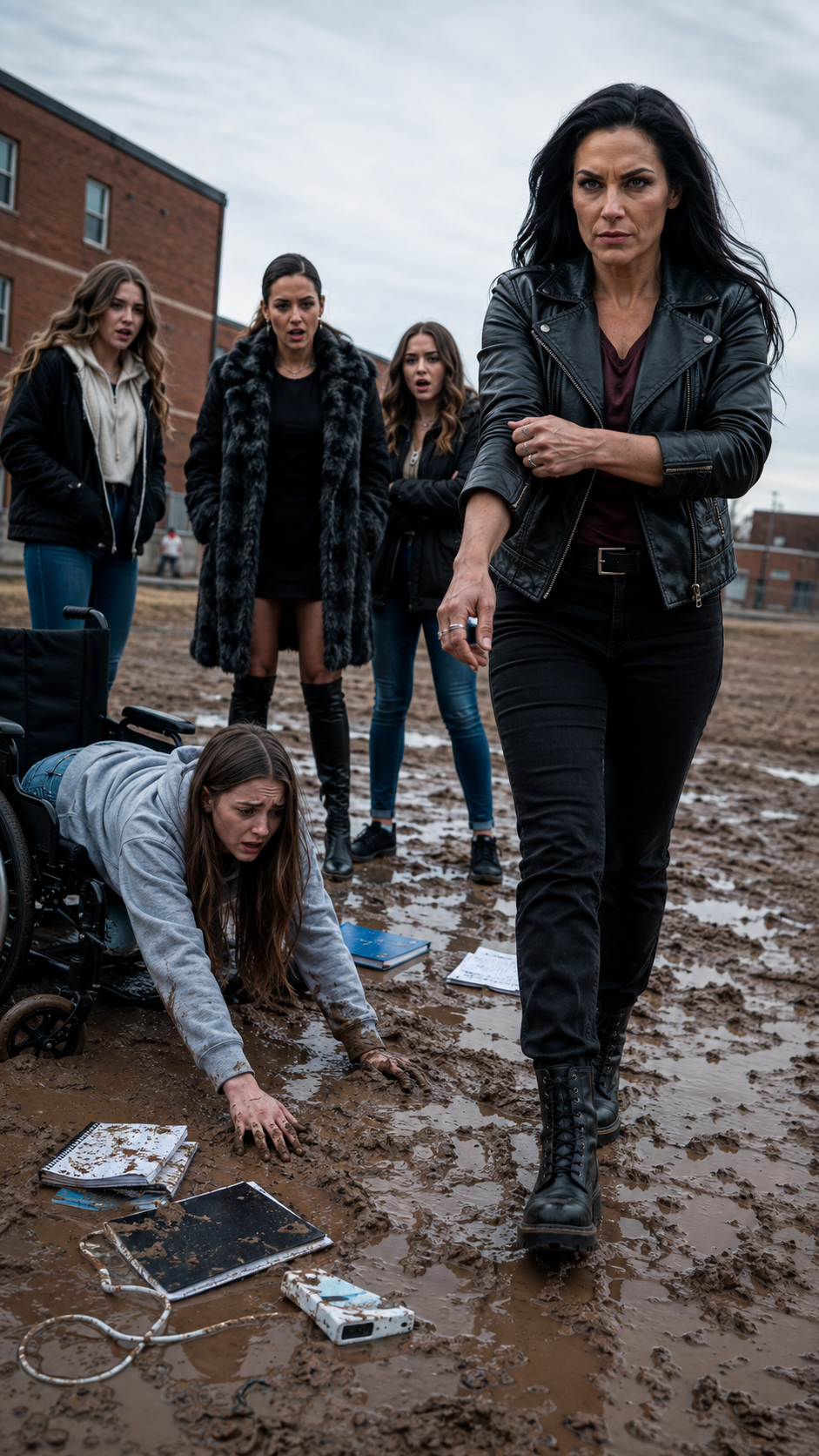
Rachel Donovan heard the plastic crack beneath the black boot before she felt herself begin to cry.
It was a small sound, almost ridiculous compared with the wind sweeping across the muddy courtyard and the distant rumble of traffic beyond the red-brick buildings. Yet to Rachel, kneeling in the mud beside her wheelchair, that crack sounded louder than thunder.
“No,” she whispered.
Cassie Ward looked down at her with a satisfied smile.
The twenty-seven-year-old woman wore a long black faux-fur coat that seemed absurdly expensive for a gray Wednesday afternoon at Ashford Continuing Education Center. Behind her, her friends Brooke and Natalie stood with their hands tucked into their jackets, laughing nervously.
Rachel stared at the small white recorder beneath Cassie’s boot.
“Please,” she said again. “You don’t understand.”
Cassie slowly twisted her heel.
Another crack.
“Oh, I understand perfectly.”
Rachel’s backpack lay upside down in a puddle behind her. Notebooks floated in brown water. Pages covered with months of class notes had already begun to bleed blue ink into the mud.
Only a minute earlier, Rachel had been sitting in her wheelchair beneath the covered walkway, trying to make it across the construction lot before the rain began again.
Then Cassie had stepped in front of her.
“Still collecting evidence?” she had asked.
Rachel had tried to roll around her.
Cassie grabbed the backpack from her lap.
“Give that back.”
“Want it?” Cassie had said, smiling.
Then she turned it upside down.
“Go get it.”
When Rachel reached for the scattered belongings, Cassie shoved the wheelchair.
Rachel hit the mud on her hands and knees.
Now her palms burned, her gray sweatshirt was soaked, and the white recorder she had carried for six months was crushed beneath Cassie’s boot.
“What are you going to do about it?” Cassie asked.
Rachel looked up.
For fourteen months she had been learning to live with people looking down at her.
Doctors.
Insurance adjusters.
Strangers who spoke to whoever happened to be standing beside her instead of speaking directly to her.
People who held doors and expected gratitude large enough to fill a room.
People who assumed that because her legs no longer worked the way they once had, something inside her mind must have broken too.
Cassie’s expression was different.
There was no pity in it.
There was fear.
Rachel had seen it before, though she had never understood why.
“Why do you care so much about what’s on that recorder?” Rachel asked.
Cassie’s smile disappeared.
That was when the laughter behind her stopped.
Brooke was staring across the courtyard.
“Cassie,” she murmured.
Cassie ignored her.
“Cassie.”
“What?”
Brooke swallowed.
“Someone’s coming.”
A woman stood beneath the entrance of the old administration building about fifteen feet away.
She looked to be in her late thirties or early forties, with long black hair moving in the wind and a fitted black leather jacket over a dark burgundy blouse. Heavy black boots disappeared into the mud as she stepped away from the doorway.
There was something about her walk that changed the air.
She did not hurry.
She did not shout.
She simply came toward them with the confidence of someone who had spent much of her life entering rooms where everyone else had reason to be nervous.
Cassie turned.
“Can I help you?”
The stranger removed her sunglasses.
Her eyes were dark and hard.
She looked first at Rachel on the ground.
Then at the wheelchair.
Then at the books scattered in the mud.
Finally, she looked at Cassie’s boot resting on the crushed recorder.
“Take your foot off it,” the woman said.
Cassie laughed.
“Mind your own business.”
The woman continued walking.
Brooke stepped backward.
Natalie whispered, “Oh, God.”
Rachel heard her.
“You know her?” she asked.
Natalie didn’t answer.
The woman stopped several feet from Cassie.
She calmly began rolling up one sleeve of her leather jacket.
“Three against one?” she asked.
Cassie tried to recover her smile.
“This doesn’t concern you.”
The woman looked at Rachel again.
Something changed in her face.
Not pity.
Recognition.
Then she looked back at Cassie.
“Now try it with me.”
Cassie’s color faded.
“You’re Vera Moretti.”
The woman tilted her head.
“So you do know when to be afraid.”
Rachel had heard the name.
Everyone in Bellweather had.
Vera Moretti owned Moretti Freight, three warehouses along the interstate, half a dozen commercial properties, and, according to local gossip, enough secrets to frighten men twice her age.
People said her father had belonged to organized crime.
People said Vera herself had once been involved.
Nobody could prove any of it.
Rachel suddenly wondered which frightened her more—Cassie Ward or the woman who had just made Cassie afraid.
Vera crouched beside Rachel.
“Are you hurt?”
“My hands.”
“Anything else?”
“I don’t think so.”
Vera glanced at the crushed recorder.
“What was on that?”
Rachel hesitated.
Cassie answered for her.
“Nothing.”
Vera looked over her shoulder.
“I didn’t ask you.”
Rachel swallowed.
“Recordings.”
“Of what?”
“People threatening me.”
Vera’s expression tightened.
Cassie started walking away.
Vera stood.
“Stay where you are.”
Cassie stopped.
“You can’t order me around.”
“No,” Vera said. “But the police can.”
Cassie laughed again, though it sounded forced.
“My father owns half the board of this place.”
Vera reached into her jacket.
For one terrifying second Rachel thought she was reaching for a weapon.
Instead, Vera pulled out a phone.
“Then your father can meet us at the police station.”
Cassie stared at her.
Vera’s gaze dropped to the broken recorder.
“And while we wait, we’re going to find out why Malcolm Ward’s daughter was so desperate to destroy that thing.”
For the first time since Rachel had fallen from her wheelchair, she forgot about the mud.
“How do you know her father?”
Vera looked down at her.
A strange sadness crossed her face.
“I know more about the Ward family than I ever wanted to.”
She paused.
“And I knew your father too.”
Rachel stopped breathing.
“My father died twenty-six years ago.”
“I know.”
Vera looked toward Cassie.
Then back at Rachel.
“And if I’m right, what happened to him is the reason they’re afraid of you now.”
PART TWO — THE DEBT
Rachel had been eight years old when her father died.
Samuel Donovan had been an investigative reporter for the Bellweather Chronicle, the kind of old-fashioned newspaperman who kept sharpened pencils behind one ear and believed a city council meeting could be more dangerous than a dark alley if the right question was asked.
He died in a house fire on November 17, 2000.
Rachel remembered very little about that night.
Smoke.
A neighbor carrying her barefoot across wet grass.
Her mother screaming Samuel’s name.
Afterward, Helen Donovan had packed away nearly everything that belonged to him.
“You don’t want to live inside old grief,” she told Rachel whenever questions became too painful.
Rachel had believed her.
Until recently.
Fourteen months before the afternoon in the mud, Rachel had been working as a junior bookkeeper for the Ward Civic Foundation, a respected Bellweather charity that funded senior housing, job-training programs, and scholarships.
Malcolm Ward was its chairman.
Cassie was his daughter.
Rachel had liked the job.
She was good with numbers because numbers, unlike people, generally behaved themselves.
Then she noticed payments that didn’t.
Small transfers moved between foundation projects.
Consulting fees went to companies with no employees.
Invoices appeared twice under different project names.
Rachel asked her supervisor about them.
Three days later, while driving home, a pickup truck ran a red light and struck the driver’s side of her car.
The driver was never found.
Rachel woke up in a hospital unable to move either leg.
Her mother sat beside her for nineteen straight days.
“Forget that job,” Helen told her.
Rachel did.
At least for a while.
Then rehabilitation turned into physical therapy, physical therapy turned into adaptation, and adaptation slowly became a kind of stubborn rebirth.
Rachel enrolled in a paralegal program at Ashford.
She wanted to understand contracts.
Records.
Liability.
Evidence.
She wanted to stop feeling helpless whenever someone in a suit told her there was nothing more to investigate.
Six months earlier, anonymous messages began arriving.
STOP ASKING QUESTIONS.
YOU WERE LUCKY ONCE.
NEXT TIME YOU WON’T BE.
That was why Rachel bought the white recorder.
She carried it everywhere.
Now it sat in pieces on the counter of a tiny electronics shop three blocks from the courthouse.
An elderly man with magnifying glasses perched on his forehead examined the shattered casing.
Vera stood beside him.
“Can you save it, Eli?”
Eli Barnett grunted.
“You always bring me cheerful projects.”
“Can you?”
“Maybe.”
Rachel sat near the window in a borrowed wheelchair because hers was being cleaned and inspected after the fall.
She watched Vera.
“You said you knew my father.”
Vera did not turn around.
“Yes.”
“How?”
Silence.
Rachel’s voice hardened.
“Mrs. Moretti.”
“Vera.”
“Fine. Vera. A woman I’ve never met just walks out of a doorway while I’m being attacked, scares three people half to death, tells me she knew my father, and now refuses to explain herself.”
Vera faced her.
“You sound like Samuel.”
“I wouldn’t know.”
That landed.
Vera pulled out a chair and sat.
“I was sixteen when I met your father.”
Rachel frowned.
“That would make you—”
“Old enough to dislike where this conversation is going.”
Despite herself, Rachel almost smiled.
Vera continued.
“My father, Antonio Moretti, ran transportation businesses. Some were legitimate. Some weren’t. By the time I was sixteen, I understood that certain trucks carried cargo that never appeared on invoices.”
Rachel said nothing.
“Your father was investigating a redevelopment deal involving Malcolm Ward. Ward Construction was buying condemned properties through shell companies. My father’s trucks were moving records and cash.”
“My father was investigating Malcolm?”
“Yes.”
“Then why wasn’t that in the newspaper?”
“Because he died before publication.”
Rachel felt cold.
Vera leaned forward.
“Samuel believed Malcolm Ward was only a middleman. He thought someone else designed the financial structure.”
“Who?”
“I never knew.”
Eli cleared his throat.
Both women turned.
“I’ve got part of the memory.”
Rachel rolled toward him.
“Can you hear anything?”
“Not much.”
He connected a tiny circuit board to a laptop.
Static filled the room.
Then Cassie’s voice emerged.
“She’s coming across the lot now.”
Rachel froze.
The recording had been running inside the backpack before Cassie confronted her.
Another voice answered through Cassie’s phone, faint but unmistakably female.
“Does she have the drive?”
Cassie whispered, “I think so.”
“Then get it.”
Rachel gripped the wheelchair arms.
Vera leaned closer to the speaker.
The female voice continued.
“And Cassie?”
“Yes?”
“Do not let her leave with it.”
The audio dissolved into static.
Rachel stared at the laptop.
“Who was she talking to?”
Vera looked disturbed.
“I don’t know.”
Rachel frowned.
“You recognize the voice.”
“No.”
“You’re lying.”
Vera stood.
“I recognize something else.”
She pointed toward the waveform.
“The woman said drive.”
Rachel’s mouth went dry.
The recorder had never contained the accounting records.
Those were on a thumb drive.
A blue one.
She had found it three weeks earlier inside a box of archived Ward Foundation documents donated to Ashford’s library.
The records showed payments going back twenty-seven years.
Some were connected to the period just before Samuel Donovan died.
Rachel had told only three people about that drive.
Her professor, Daniel Cross.
The elderly librarian who helped her find the archives.
And her mother.
Vera watched Rachel’s face.
“Who knew?”
Rachel whispered the answer before she could stop herself.
“My mother.”
PART THREE — THE BOX IN THE ATTIC
Helen Donovan lived in the same small white house where Rachel had grown up.
When Rachel and Vera arrived that evening, the porch light was already on.
Helen opened the door before they knocked.
She was sixty-four, silver beginning to thread through her carefully cut brown hair. She had spent thirty-eight years working as an accountant for hospitals, charities, and small businesses before retiring.
Her face changed when she saw Vera.
Not surprise.
Recognition.
Rachel noticed.
“You know her.”
Helen gripped the edge of the door.
“Rachel, come inside.”
“Mom.”
“Please.”
Vera said quietly, “Hello, Helen.”
Twenty-six years seemed to pass through the silence.
Rachel’s heart began pounding.
“You told me you’d never met her.”
“I never said that.”
“You told me Dad’s investigation had nothing to do with the Wards.”
Helen looked at Vera.
“What have you told her?”
“The truth,” Vera replied.
Helen laughed bitterly.
“You wouldn’t recognize the truth if it walked into your office carrying a Bible.”
Rachel stared between them.
“What is going on?”
Helen stepped aside.
Inside, everything looked painfully normal.
The yellow lamp beside the sofa.
Her father’s old clock.
A bowl of wrapped peppermints on the table.
Rachel had spent half her life believing safety looked exactly like this room.
Now she noticed that Vera knew where the kitchen was without being told.
“You’ve been here before.”
Vera nodded.
“Once.”
“When?”
“The night your father died.”
Rachel went still.
Helen closed her eyes.
“Vera.”
“No more.”
Vera’s voice was quiet.
“She deserves to know.”
Helen sat down.
For a long time nobody spoke.
Finally she said, “Your father discovered money disappearing from the Bellweather Renewal Fund. Malcolm Ward was involved.”
“I know.”
“No. You know part of it.”
Helen rubbed her hands together.
“Samuel thought the payments were bribes. Some were. Others were protection money connected to Antonio Moretti’s organization.”
Rachel looked at Vera.
“She knows that too.”
Helen’s mouth tightened.
“What she may not have told you is that Vera stole records from her father and gave them to Samuel.”
Vera said nothing.
Rachel turned toward her.
“You were his source.”
“Yes.”
“That’s why you knew him.”
“Yes.”
Helen stood and walked toward the hallway.
“Come with me.”
She led them to the attic stairs.
Rachel had not been upstairs since before her accident.
Vera carried her, carefully and without ceremony, while Helen brought the wheelchair.
At the far end of the attic sat a cedar box.
Rachel recognized it.
Her mother had always said it contained Christmas decorations.
Instead, Helen opened it and removed bundles of newspapers, photographs, and a thick manila envelope.
Samuel Donovan’s handwriting covered the front.
FOR RACHEL — WHEN SHE IS OLD ENOUGH TO DECIDE WHO TO TRUST.
Rachel’s hands shook.
“You had this all these years?”
Helen looked ashamed.
“Yes.”
“Why didn’t you give it to me?”
“Because your father’s truth got him killed.”
Rachel tore open the envelope.
Inside was a letter.
My darling Rachel,
If you are reading this, then something went badly wrong.
There are good people who do bad things because they are afraid, and bad people who become useful because they finally become ashamed.
Do not judge anyone by the name they inherited.
Judge them by what they do when telling the truth costs them something.
Rachel stopped reading.
She looked at Vera.
“My father wrote this about you.”
“I think so.”
There was also a photograph.
Samuel stood outside Bellweather City Hall.
Beside him was a much younger Malcolm Ward.
And beside Malcolm stood Helen.
Rachel stared.
“You worked with him.”
Helen’s answer came slowly.
“Yes.”
Rachel felt as if the room had tilted.
“You never told me.”
“I was Ward Construction’s accounting manager before you were born.”
Vera crossed her arms.
“That’s how Samuel met her.”
Rachel looked at her mother.
“You were part of the investigation.”
Helen nodded.
“I helped your father understand the ledgers.”
“Then you knew exactly what I found.”
“Yes.”
“Why didn’t you tell me?”
“Because I was trying to protect you.”
Rachel heard the phrase differently now.
Protect you.
Forget that job.
Stop asking questions.
Some doors are safer closed.
She reached into the envelope again.
A folded ledger page slipped out.
Four sets of initials appeared beside several transfers.
MW.
AM.
HD.
And SC.
Malcolm Ward.
Antonio Moretti.
Helen Donovan.
Rachel looked up.
“What does HD mean?”
Her mother’s face went white.
Vera stared at the page.
“Helen?”
Helen backed toward the stairs.
Rachel felt something cold move through her chest.
“Mom.”
“It isn’t what you think.”
“What does HD mean?”
Helen whispered, “My initials.”
Rachel could barely hear herself.
“You weren’t helping Dad investigate the money.”
Silence.
“You were moving it.”
Helen suddenly looked twenty years older.
“Yes.”
Rachel stared at the woman who had held her hand through surgery.
The woman who had washed her hair when she could not sit upright.
The woman who had built birthday cakes and sewn Halloween costumes and kept every school photograph in labeled albums.
“How much?”
“I don’t know.”
“Don’t lie to me.”
“Millions.”
Rachel recoiled.
Vera looked stunned too.
Helen began crying.
“It started small. Malcolm said everyone did it. Transfers. Consulting invoices. Then Antonio got involved. By the time your father realized what was happening, I couldn’t just walk away.”