PART ONE — THE PILLS IN THE GUTTER
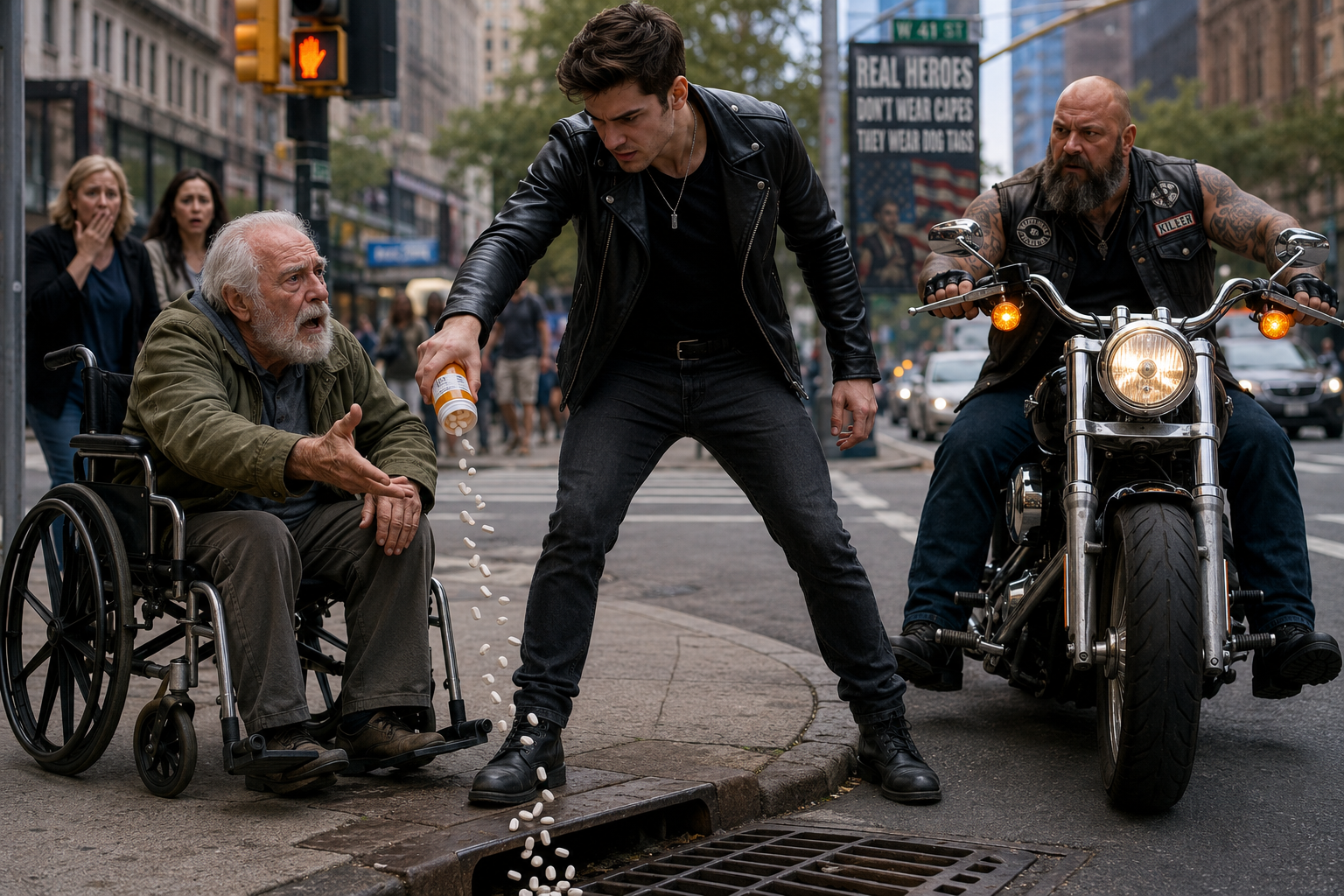
By the time the first white pill struck the concrete and vanished into the storm drain, seventy-six-year-old Walter Hayes already knew that the young man standing over him had mistaken weakness for helplessness.
It was a mistake Walter had seen many times in his life.
His hands shook now. His knees no longer obeyed him the way they once had. The muscles that had carried ammunition through jungle mud, lifted wounded men onto helicopters, and built a house with his own hands had thinned beneath loose fabric.
But there were things age had not taken from him.
Memory was one of them.
Pride was another.
And as he watched the medicine disappear into darkness, he felt an old, bitter anger waking somewhere deep inside his chest.
“Please,” Walter said.
The young man smiled.
His name, Walter would later learn, was Derek Cole.
At twenty-three, Derek had the polished arrogance of someone who had rarely been forced to live with the consequences of his own behavior. His dark hair was carefully styled, his leather jacket looked expensive, and a thin gold chain rested against the collar of his black shirt.
Walter had noticed him approaching only moments earlier.
He had assumed the young man wanted directions.
Instead, Derek had stopped in front of the wheelchair and stared at the small orange prescription bottle in Walter’s hand.
“What’s that?” Derek asked.
“My medication.”
“For what?”
Walter frowned.
“That’s none of your business.”
Derek laughed.
“Oh, tough guy.”
Walter turned his wheelchair slightly toward the corner.
He had no interest in arguing.
That was when Derek reached down and snatched the bottle from his hand.
Walter’s reaction was immediate.
“Give that back.”
Derek held it above his head.
“You need these?”
“Yes.”
“How bad?”
Walter stared at him.
There had been a time when that stare alone could silence a room.
Derek only grinned.
“Bad enough to beg?”
The intersection around them remained busy. Cars crawled beneath the gray afternoon sky. A delivery truck hissed to a stop at the red light. Pedestrians moved along the sidewalk, some glancing over, most continuing on.
Walter felt something colder than anger.
Humiliation.
Not because he was sitting in a wheelchair.
Not because a stranger was mocking him.
But because he realized Derek was enjoying the imbalance between them.
Derek knew Walter could not simply stand up and take the bottle back.
That was the game.
Walter lowered his voice.
“Son, whatever point you think you’re proving, you’ve made it.”
“Don’t call me son.”
“Then give me my medication.”
Derek looked at the bottle.
Then at the open storm drain beside the curb.
Walter saw the thought enter his mind.
“No.”
Derek twisted off the cap.
Walter reached forward.
“Don’t do that.”
The first pill fell.
Then another.
Then the rest.
They rattled against the concrete lip of the drain before vanishing through the opening.
Walter stopped breathing.
The bottle contained nitroglycerin tablets prescribed for his heart.
His refill appointment was not until the next morning.
Without them, a bad episode could become dangerous very quickly.
Derek shook the empty bottle and smiled.
“There.”
Walter stared at him.
“You think that’s funny?”
“A little.”
“You could kill somebody doing something like that.”
Derek shrugged.
“Then maybe you shouldn’t leave your drugs lying around.”
“I was holding them.”
“Same difference.”
Walter looked down into the drain.
Several tablets had landed on a narrow concrete shelf below the opening.
He might be able to reach them.
His doctors had told him not to attempt getting out of the wheelchair alone.
Walter ignored their voices.
He locked the wheels.
Placed both hands on the armrests.
And pushed.
Pain shot through his hips.
His left knee folded almost immediately.
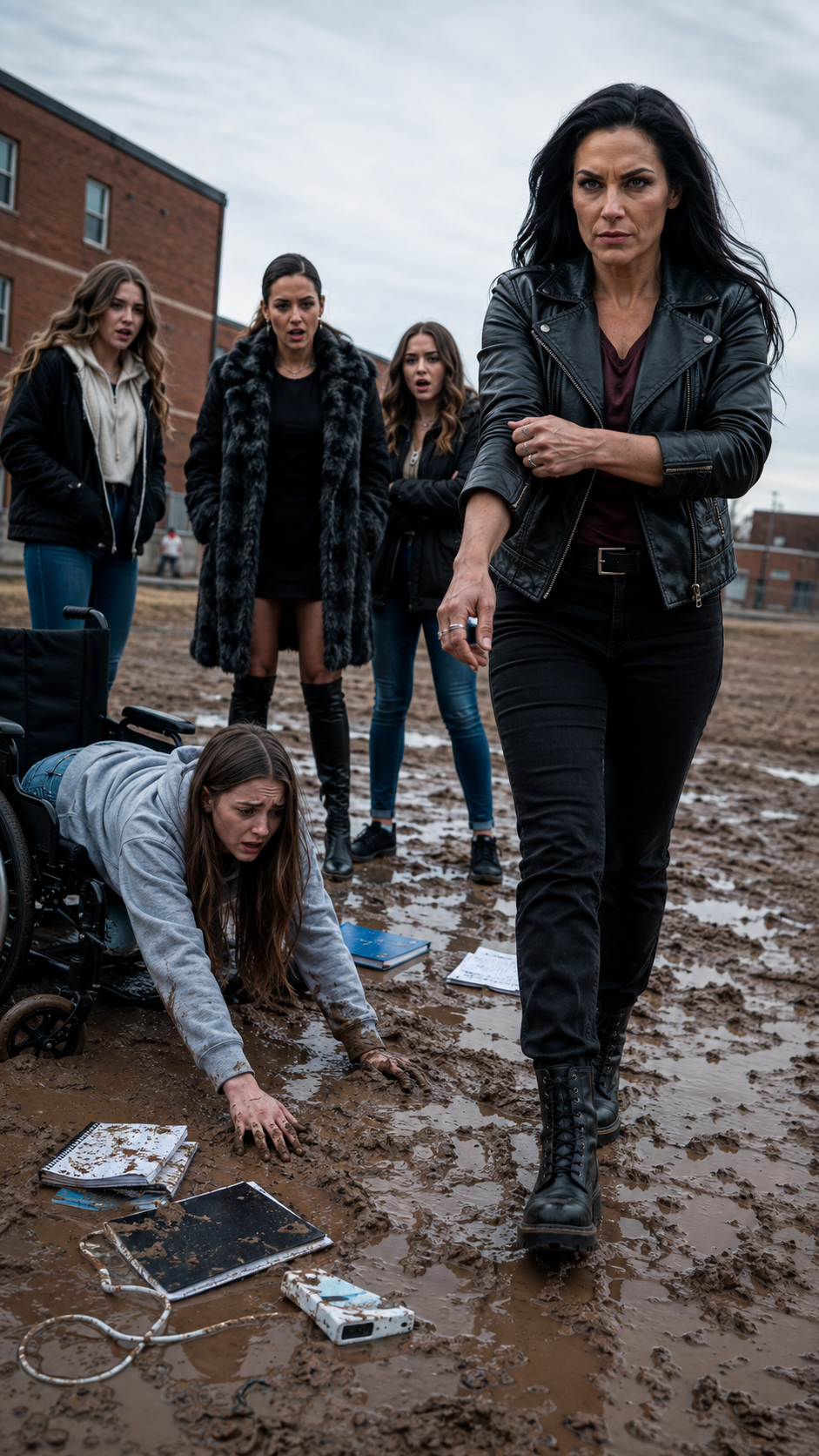
He fell forward onto the sidewalk.
Someone gasped nearby.
Derek laughed.
Walter remained on his hands and knees.
He could hear that laughter behind him.
For one strange moment, the sound took him somewhere else entirely.
Vietnam.
1971.
Rain hammering leaves.
A nineteen-year-old boy crying for his mother.
Walter crawling beneath gunfire because leaving another man behind had never been an option.
He blinked.
The memory disappeared.
He dragged himself toward the drain.
“Sir?” a woman called. “Are you all right?”
Walter ignored her.
He reached down into the opening.
His fingertips brushed damp concrete.
Too far.
Derek folded his arms.
“Need help?”
Walter looked up.
“If you have any decency left, yes.”
Derek bent forward.
For one brief second Walter thought the young man might actually help.
Instead, Derek whispered, “Try harder.”
Then he laughed again.
A low engine growled somewhere behind them.
At first Walter assumed it was traffic.
Then the sound deepened.
A motorcycle.
Large.
Close.
Derek turned.
A black-and-chrome cruiser rolled toward the curb.
The rider was enormous.
Broad shoulders.
Tattooed arms.
Bald head.
Thick gray-black beard.
He wore a black leather vest covered in old patches and road dust.
The motorcycle stopped.
The rider looked at Walter on the ground.
Then at the empty wheelchair.
Then at Derek.
Something in his expression changed.
He killed the engine.
The sudden silence felt louder than the motorcycle had.
Derek straightened.
“What are you looking at?”
The biker stepped off the machine.
Walter saw his face clearly.
And for reasons he could not explain, his heart seemed to miss a beat.
The biker stared at him too.
Not with recognition exactly.
Something closer to disbelief.
Then his eyes returned to Derek.
“What happened?” he asked.
“Nothing,” Derek said.
One of the women nearby pointed toward the drain.
“He dumped that old man’s medicine down there.”
The biker slowly looked at Derek.
“Did you?”
Derek gave an impatient laugh.
“Mind your business.”
The biker walked forward.
Derek’s smile vanished.
“What?”
The biker didn’t answer.
Three steps.
That was all it took.
He seized the back of Derek’s leather jacket.
Derek yelped as he was jerked backward.
“Get off me!”
The biker turned him toward the open drain.
“You thought it was funny when he was down there?”
Derek struggled.
“I didn’t do anything!”
“You want to see how funny it looks from his angle?”
And suddenly Derek was being dragged toward the very same gutter.
Walter should have felt satisfaction.
Instead, as he stared at the biker’s face, an impossible memory began scratching at the locked door of his past.
PART TWO — THE MAN ON THE MOTORCYCLE
“Enough.”
Walter’s voice was weak, but the biker heard him.
He stopped.
Derek was on his knees beside the drain now, breathing hard, terror replacing every trace of arrogance.
The biker still had one fist twisted in the back of his jacket.
Walter pulled himself upright against the curb.
“Don’t hurt him.”
The biker looked almost offended.
“He could’ve killed you.”
“I know.”
“And you want me to let him go?”
“I want him to understand.”
The biker looked down at Derek.
“You understanding yet?”
Derek nodded quickly.
“Yes.”
“Say it like you mean it.”
“Yes!”
The biker released him.
Derek scrambled backward.
One of the women had already called the police.
Walter could hear her explaining the situation.
Derek glanced around as though calculating his chances of running.
The biker saw it.
“Wouldn’t.”
Derek stayed where he was.
The biker crouched beside Walter.
“You hurt?”
“Mostly my dignity.”
“That heals slower.”
Walter looked at him.
The man’s face was weathered by sun and years. A pale scar crossed his left eyebrow. Another ran along his jaw.
Walter stared at the second scar.
His breath caught.
The biker noticed.
“What?”
“Nothing.”
“You sure?”
Walter nodded.
But he was not sure.
The scar reminded him of someone.
Someone young.
Someone bleeding.
Someone Walter had carried through mud while helicopters circled overhead.
Impossible.
That had been more than fifty years ago.
The biker extended his hand.
“Name’s Sam.”
Walter froze.
Sam.
“Sam what?”
“Mercer.”
The world seemed to narrow around them.
Walter’s voice became almost inaudible.
“What did you say?”
“Samuel Mercer.”
Walter closed his eyes.
No.
There had to be thousands of Samuel Mercers.
Millions, perhaps.
He forced himself to breathe.
“You from around here?”
“Originally? Missouri.”
Walter opened his eyes again.
“Where in Missouri?”
Sam’s expression changed.
“Little town called Fairhaven. Why?”
Walter stared at him.
A helicopter rotor thundered somewhere inside his memory.
Rain.
Blood.
A young soldier whispering, Tell my boy I tried to come home.
Walter shook his head.
“Nothing.”
But Sam was watching him more carefully now.
Before either man could say more, two police officers approached.
They separated everyone.
Witnesses spoke.
Derek protested.
Walter sat back in his wheelchair, exhausted.
The officers recovered the empty medicine bottle from the sidewalk.
One of them crouched beside Walter.
“Sir, what medication was in here?”
“Nitroglycerin.”
The officer’s face hardened.
“You need medical attention?”
“I’ll manage.”
“No, sir. We’re calling paramedics.”
Derek overheard.
His face changed.
For the first time, he seemed to understand that what he had done was not a prank.
It was not a social-media stunt.
It was not something that disappeared when everyone went home.
“I didn’t know,” Derek said.
Walter looked at him.
“You didn’t ask.”
Derek swallowed.
“I thought they were just pills.”
Walter almost smiled.
“At my age, son, most pills aren’t decorative.”
Derek lowered his eyes.
The police took him aside.
Sam remained.
When the paramedics arrived, they checked Walter’s heart rhythm and gave him replacement medication.
One paramedic recommended transport to the hospital.
Walter refused.
“You’re stubborn,” Sam said.
“I’ve been told.”
“You got family I can call?”
Walter looked toward the intersection.
“No.”
“No wife?”
“Gone eleven years.”
“Kids?”
Walter hesitated.
“One daughter.”
“Call her.”
“We don’t speak much.”
Sam nodded slowly.
“Life’s too short for that.”
Walter gave him a tired look.
“You always give advice to strangers?”
“Only stubborn ones.”
Walter smiled despite himself.
Then his gaze fell on Sam’s vest.
Among the patches was a small faded emblem.
A red horse beneath three black stars.
Walter’s fingers tightened around the armrest.
He knew that emblem.
Not from a motorcycle club.
From an old photograph.
“Where did you get that?”
Sam touched the patch.
“This?”
“Yes.”
“My father’s.”
Walter felt the blood drain from his face.
“What was his name?”
Sam looked at him strangely.
“Daniel.”
Walter could barely form the next question.
“Daniel Mercer?”
Sam stood perfectly still.
“Yes.”
For more than half a century, Walter had carried Daniel Mercer’s final words inside him.
And now Daniel’s son was standing on a sidewalk three feet away.
PART THREE — THE DEBT
They sat in a diner two blocks away after the police finished taking statements.
Derek had been taken into custody pending further questioning. One of the officers told Walter that prosecutors would decide what charges were appropriate.
Walter barely heard him.
His mind was somewhere else entirely.
Sam sat across from him in a cracked vinyl booth.
Two cups of coffee cooled between them.
Neither man touched his.
“You knew my father,” Sam said.
It was not a question.
Walter stared through the diner window.
“Yes.”
“How?”
“We served together.”
Sam leaned back.
“My mother always said Dad died before I was old enough to remember him.”
“He did.”
“You were there?”
Walter nodded.
Sam’s jaw tightened.
“How?”
Walter took a long breath.
“Daniel was twenty-two. Younger than you are now, probably, in the ways that mattered.”
“I’m forty-seven.”
Walter smiled faintly.
“Exactly.”
Sam did not.
“Tell me.”
Walter stared at his hands.
“In August of 1971, our unit was moving through a valley near the Cambodian border. We walked into an ambush.”
Sam’s expression became unreadable.
Walter continued.
“Daniel was hit badly. Leg and abdomen. We couldn’t move the whole unit back for him.”
“You left him?”
“No.”
The answer came sharper than Walter intended.
“No.”
Sam studied him.
Walter lowered his voice.
“I went back.”
Rain had begun tapping the diner windows.
Walter heard it and almost hated the coincidence.
“I carried him about two hundred yards. Maybe more. Hard to remember.”
Sam looked at Walter’s wheelchair.
“You carried him?”
“I could carry a refrigerator in those days.”
That earned the smallest smile.
Walter continued.
“We reached the extraction point, but Daniel knew he wasn’t making it.”
Sam’s eyes dropped.
“What did he say?”
Walter had replayed the words thousands of times.
“He said he had a boy.”
Sam looked up.
“He told me your name.”
Silence.
“He gave me a photograph. Your mother was holding you. You were maybe nine months old.”
Sam swallowed.
“And?”
“He asked me to tell you something if I ever got home.”
Sam’s voice cracked despite his attempt to control it.
“What?”
Walter looked directly into his eyes.
“He said, ‘Tell Sammy I wasn’t brave because I wasn’t scared. Tell him I was scared every day. I just kept moving anyway.’”
Sam leaned back.
For several seconds he said nothing.
Then he turned his face toward the window.
Walter gave him time.
Finally Sam whispered, “My mother told me he died instantly.”
“She probably thought that was kinder.”
“Did he suffer?”
Walter could have lied.
Instead he said, “Yes.”
Sam closed his eyes.
“But he wasn’t alone.”
Sam nodded once.
Walter reached into his jacket.
From an inside pocket, he removed an old leather wallet.
Inside was a photograph sealed in plastic.
Sam stared at it.
His mother.
Young.
Smiling.
Holding a baby.
On the back, faded blue ink read:
LUCY & SAMMY — CHRISTMAS 1970.
Sam’s hand shook as he took it.
“You kept this?”
“For fifty-five years.”
“Why didn’t you find us?”
Walter looked down.
“I tried.”
“When?”
“1972. Then again in 1974. Your mother had moved.”
“She remarried.”
“I learned that eventually.”
Sam’s face hardened slightly.
“You could’ve kept looking.”
“I did for a while.”
“For a while?”
Walter accepted the accusation.
“I came home with my own problems.”
Nightmares.
Alcohol.
A marriage nearly destroyed before it began.
A daughter who learned as a child not to wake her father when he shouted in his sleep.
Sam stared at the photograph.
“You know why I’m here?”
Walter shook his head.
“I’ve been looking for you.”
Walter frowned.
“For me?”
“Thirty-seven years.”
Walter laughed once in disbelief.
“Why?”
Sam reached into his vest.
He removed a folded piece of paper.
“My mother gave me this before she died.”
Walter unfolded it.
The handwriting was unfamiliar.
Walter,
If Samuel ever finds you, tell him the truth about Daniel.
Not the military version.
Not mine.
The truth.
— Lucy Mercer
Walter stared at the words.
Sam leaned forward.
“What truth?”
Walter felt suddenly cold.
“I don’t know.”
Sam’s eyes sharpened.
“My mother believed you did.”
“She was wrong.”
“Was she?”
Walter looked toward the window.
The rain was heavier now.
There were memories he had buried so deeply that even he no longer knew whether they were memories or dreams.
Daniel bleeding.
Daniel whispering.
Daniel reaching inside his jacket.
Not just for the photograph.
For something else.
An envelope.
A name.
A warning.
Walter’s heart began beating harder.
Sam noticed.
“What aren’t you telling me?”
Walter whispered, “I need to go home.”
PART FOUR — THE LETTER UNDER THE FLOOR