PART FIVE — THE MAN WHO DIAGNOSED THE DISEASE
Samuel did not run.
He did not shout.
He simply sat down.
The police officers moved closer.
Charles stared at his oldest friend.
“You?”
Samuel looked toward the floor.
Victoria whispered, “Why?”
For several seconds, he said nothing.
Then he began laughing quietly.
Not with amusement.
With exhaustion.
“You still don’t understand,” he said.
Charles stepped toward him.
“Then explain it.”
Samuel looked up.
“You destroyed my family before Richard ever met Elena.”
Charles frowned.
“I barely knew your family.”
“You knew my father.”
Charles went still.
Samuel continued.
“Thomas Morris.”
The name came slowly.
Then memory arrived.
A construction foreman.
Whitmore Construction.
Forty-two years earlier.
A bridge collapse.
Three workers killed.
Charles felt his stomach turn.
Samuel’s voice remained steady.
“My father warned you the supports were defective.”
Charles whispered, “That was investigated.”
“Yes.”
“He signed the inspection.”
“Because you ordered him to.”
“That’s not true.”
Samuel laughed.
“My father kept copies.”
Charles said nothing.
“You threatened his job. His pension. His house.”
Samuel’s eyes sharpened.
“When the bridge collapsed, you blamed him.”
Charles felt the room disappear.
Thomas Morris had died by suicide eighteen months after the accident.
Charles had attended the funeral.
He remembered Samuel standing beside the coffin.
Twenty-eight years old.
Silent.
“You became my doctor,” Charles whispered.
Samuel nodded.
“Eventually.”
“For revenge?”
“Not at first.”
That surprised everyone.
Samuel looked suddenly older.
“For years I actually believed I had forgiven you. I built a career. Married. Had children. You became my patient by accident.”
He smiled bitterly.
“And then Richard got sick.”
Charles stiffened.
Samuel continued.
“I watched you sit in the hospital blaming everyone except yourself. Doctors. God. Richard’s lifestyle. His choices.”
“Don’t talk about my son.”
“I loved your son.”
Charles stared.
Samuel’s eyes filled with tears.
“He knew about my father.”
Anna stepped forward.
“What?”
“Richard found the old bridge files while researching company history. He came to me.”
Charles looked at Anna.
Samuel continued.
“He wanted to expose everything.”
Charles could barely speak.
“Why didn’t he?”
“Because he was dying.”
Samuel looked toward Victoria.
“And because he discovered Anna existed.”
Anna’s breath caught.
“Richard decided he would spend whatever time he had left repairing his own mistakes first.”
Samuel turned back to Charles.
“He begged me to stop living inside my father’s grave.”
Charles whispered, “Apparently you didn’t.”
“For a while, I did.”
Samuel’s expression changed.
“Then Richard died.”
His hands began trembling.
“And six months later, Whitmore Development announced plans to demolish the last neighborhood where families of the bridge workers still lived.”
Charles frowned.
“That was a redevelopment project.”
“It displaced forty-three families.”
“They were compensated.”
“You always have a number, Charles.”
Samuel stood.
“A number for workers. A number for neighborhoods. A number for pregnant women your son loved.”
Anna looked down.
Samuel continued.
“So I decided you should experience something money could not repair.”
“The drugs.”
“Yes.”
“You made me think I was losing my mind.”
“I wanted you dependent.”
Catherine began crying.
Samuel looked at her.
“I knew she would eventually try to protect the company.”
“You manipulated me,” Catherine whispered.
“I left enough evidence for you to become suspicious of Victoria.”
Victoria’s face hardened.
“And you knew I was giving him his prescribed medication.”
“Yes.”
“You let me look like I was poisoning him.”
“Yes.”
Charles stepped forward.
“What was the end?”
Samuel looked at him.
“To make your family destroy itself.”
The answer landed harder than any confession about money.
“I didn’t want your company,” Samuel said. “I didn’t want your estate. I wanted you alive long enough to watch everyone you loved become suspicious of everyone else.”
Charles stared at him.
“And tonight?”
“I knew Victoria would medicate your drink.”
Victoria whispered, “How?”
“Because I told her your missed doses could trigger a stroke.”
She covered her mouth.
“You told me he could die.”
“Yes.”
“You bastard.”
Samuel barely reacted.
“I also knew Anna was coming.”
Anna looked stunned.
“You sent me the invitation?”
“Yes.”
Charles turned sharply.
Samuel nodded.
“I sent Anna Richard’s final letter. I told her tonight was the night Charles intended to erase Richard’s descendants from the trust.”
Anna’s eyes filled with anger.
“You used me too.”
“Yes.”
“Why?”
“To put every secret in the same room.”
Charles looked around.
His daughter.
His daughter-in-law.
His granddaughter.
His friend.
Every lie had collided beneath his roof exactly as Samuel intended.
Police stepped toward Samuel.
Then Anna said something unexpected.
“Wait.”
Everyone turned.
She held Richard’s ring.
“My father wrote more than one letter.”
Samuel froze.
Anna reached inside her uniform and removed a second envelope.
“This one was addressed to you.”
Samuel’s face changed.
“You’re lying.”
“No.”
She opened it.
“I found it among my mother’s belongings after she died. Richard gave it to her because he wasn’t sure he would have the courage to give it to you himself.”
Samuel stared.
Anna unfolded the pages.
“Do you want me to read it?”
He said nothing.
So she did.
“Samuel, if you ever decide my father deserves punishment, I won’t tell you that you’re wrong.”
Charles lowered his eyes.
“But before you punish him, remember something. Hatred is a debt that charges interest to the person carrying it.”
Samuel’s jaw tightened.
Anna continued.
“My father spent his life believing control could prevent pain. Your father spent his final years believing shame could never be repaired. Both men were wrong.”
Samuel whispered, “Stop.”
Anna kept reading.
“If you destroy Charles, you will not bring your father back. You will only become another man whose children inherit his anger.”
Samuel’s face crumpled.
“Stop.”
Anna lowered the letter.
Samuel sank into the chair.
For nearly a minute, nobody spoke.
Then Charles did something no one expected.
He walked toward Samuel.
The officers moved instinctively.
Charles raised his hand.
They stopped.
He stood before the man who had drugged him for months.
“I remember your father,” Charles said.
Samuel looked up.
“I remember what I did.”
His voice broke.
“I told myself that bridge collapse was complicated. That engineers signed things. That managers made decisions. That Thomas had responsibilities too.”
Charles swallowed.
“But the truth is simpler.”
He looked toward Catherine.
Then Victoria.
Then Anna.
“I was afraid of losing everything I had built.”
He turned back to Samuel.
“So I let another man lose everything instead.”
Samuel began crying.
Charles continued.
“I did the same thing to Elena.”
Anna closed her eyes.
“I did it to Richard.”
His voice trembled.
“And perhaps I’ve been doing some version of it my entire life.”
Samuel whispered, “You think apologizing fixes this?”
“No.”
Charles shook his head.
“It doesn’t.”
The police handcuffed Samuel.
As they led him toward the door, Charles called his name.
Samuel turned.
Charles said, “Your father deserved the truth.”
Samuel stared at him.
“So tomorrow, he gets it.”
The following morning, Charles Whitmore did something his attorneys strongly advised against.
He held a press conference.
No prepared statement.
No public-relations consultants.
No carefully negotiated language.
He admitted that forty-two years earlier, Whitmore Construction had concealed evidence related to the bridge collapse.
Company stock in privately traded partnerships plunged.
Two board members resigned.
Several lawsuits were filed before lunch.
Charles did not care.
He established a compensation fund for surviving families.
Then he announced that the redevelopment project would be canceled.
Three days later, he corrected his estate documents.
Catherine received no controlling interest.
Victoria received no additional trust distribution.
The foundation received most of Charles’s wealth.
And Anna?
Charles invited her to breakfast.
Not at the mansion.
At a small diner Richard had loved.
Anna arrived wearing jeans and a blue sweater.
Charles was already sitting in a booth.
Two coffees waited between them.
She looked at his cup.
“Are you sure you should be drinking that?”
Charles smiled.
“Martin watched them pour it.”
Anna laughed despite herself.
It was the first time Charles had heard her laugh.
She sat.
For several minutes, neither spoke.
Then Charles slid an envelope across the table.
Anna did not touch it.
“If that’s money, I don’t want it.”
“It isn’t.”
“What is it?”
“Richard’s shares.”
She stared.
“No.”
“They were always supposed to go to his child.”
“You didn’t know I existed.”
“I should have.”
Anna looked at him for a long time.
“I didn’t come here for an inheritance.”
“I know.”
“Then why?”
Charles folded his hands.
“Because I spent most of my life deciding what other people deserved.”
His eyes filled.
“I’m trying to stop.”
Anna looked down at the envelope.
Then she pushed it back.
Charles frowned.
“I told you—”
“I’m not refusing it.”
He looked confused.
“I’m asking you to hold it.”
“For what?”
“Until we know each other.”
Charles stared.
Anna continued.
“I don’t want my first real relationship with my grandfather to begin with paperwork.”
Something inside Charles broke open.
Not dramatically.
Quietly.
Like ice finally yielding beneath spring sunlight.
He looked out the diner window because he did not want her to see him cry.
Anna pretended not to notice.
After a while she said, “My father told me something about you.”
Charles wiped his eyes.
“I’m almost afraid to ask.”
“He said you were impossible.”
Charles laughed.
“That sounds accurate.”
“He also said you were the bravest man he knew whenever the problem belonged to someone else.”
Charles became quiet.
Anna smiled sadly.
“He always hoped someday you’d become brave enough to face your own.”
Charles looked at Richard’s daughter.
Then he nodded.
“I wish he could see this.”
Anna reached across the table.
For a second she hesitated.
Then she placed her hand over his.
“He can’t.”
Charles looked down.
“No.”
“But I can.”
Months later, doctors confirmed that much of Charles’s confusion had indeed been caused by prolonged sedation. Some memory problems remained, but the terrifying decline everyone had feared slowed considerably once the drugs left his system.
Samuel Morris pleaded guilty to multiple charges.
Catherine cooperated with investigators and voluntarily surrendered every document Charles had signed while impaired.
Victoria apologized to Anna.
The apology was awkward.
Anna accepted it anyway.
Not because the slap no longer mattered.
But because Richard had taught her something Charles was only beginning to understand.
Justice and revenge were not the same thing.
One repaired what had been broken.
The other simply broke something else.
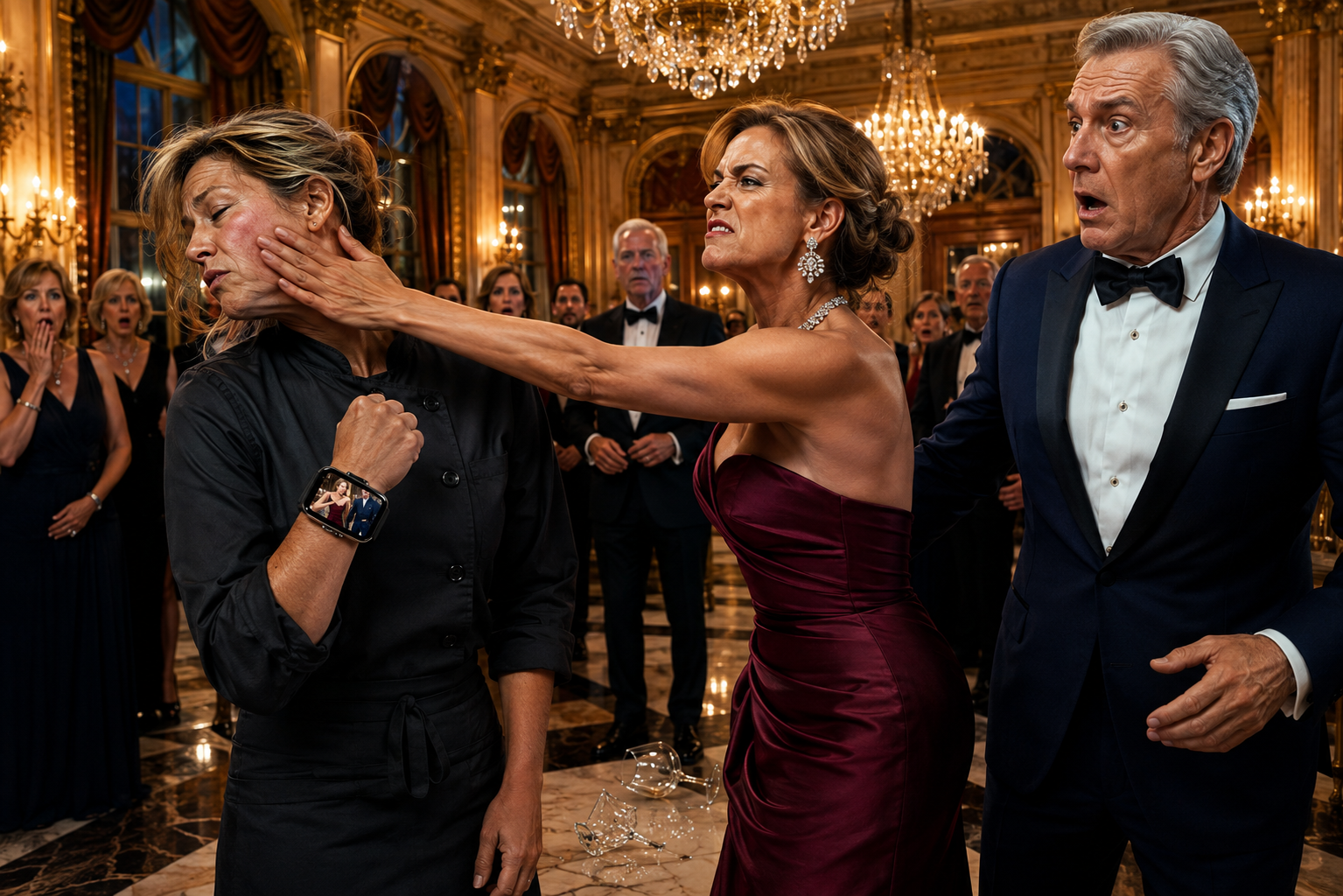
A year after the foundation dinner, Charles stood beneath the same chandelier where Anna had knocked the glass from his hand.
The ballroom was filled again.
But this time there were no society photographers.
No politicians.
No champagne tower.
The guests were families connected to workers killed or displaced by decisions Whitmore Development had made over four decades.
Charles walked to the microphone.
Anna stood beside him.
He glanced at her.
She nodded.
Then Charles looked at the room.
“My entire life,” he began, “I thought legacy meant leaving behind something with your name on it.”
He paused.
“I was wrong.”
The room became silent.
“Legacy is what remains in other people after your name is gone.”
Anna looked toward the back of the ballroom.
For one fleeting second, she imagined Richard standing there.
Not sick.
Not dying.
Young.
Smiling.
Charles continued speaking, but Anna barely heard him.
She touched the silver ring hanging around her neck.
The same ring her father had once given her mother when they were too young, too frightened, and too powerless to build the life they wanted.
Thirty-six years earlier, Charles Whitmore had used his wealth to separate them.
Thirty-six years later, their daughter had walked into his mansion disguised as a waitress and saved his life.
But the strangest part was not that Anna had stopped him from drinking that glass.
It was that by knocking it from his hand, she had shattered something far more dangerous than crystal.
She had shattered the story Charles Whitmore had spent his whole life telling himself about the man he was.
And for the first time, surrounded by the people who had survived his mistakes, he finally had the chance to become someone better.