Four months after my surgery, Kevin called and asked if he could come over.
Not drop by.
Not “be in the neighborhood.”
He asked.
That mattered.
I said yes.
At three on a Sunday afternoon, he stood on my porch holding a paper bag.
I opened the door.
“What’s that?”
“Lemon drops.”
For the first time in months, I almost laughed.
“You finally remembered.”
“I remembered the first day.”
“Then why didn’t you bring them?”
“Because apparently I thought legal documents were a better hospital gift.”
His attempt at humor collapsed under its own weight.
Neither of us laughed.
I stepped aside.
“Come in.”
Kevin looked different.
He had lost weight, but some of the strain was gone from his face.
The expensive watch he usually wore was missing.
So was the polished company truck that used to sit in my driveway.
He had arrived in an older sedan I didn’t recognize.
We sat at the kitchen table.
The same table where I had helped him study spelling words.
The same table where Frank told him he would lend him forty thousand dollars to start Bennett Contracting, provided Kevin gave us a real business plan and not “three pages of dreams and a logo.”
The same table where Kevin later told us he had made his first million dollars in annual revenue.
Now he placed his hands together and looked at me.
“The company is going to survive.”
I blinked.
“It is?”
“Sort of.”
“What does sort of mean?”
“We’re down to seven employees. Smaller shop. No general contracting. We’re going back to custom millwork and installation.”
“How much debt?”
“A lot less.”
“How?”
“Sold equipment. Settled two contracts. The restructuring lawyer renegotiated the line. I sold my house.”
I had known the house was listed.
I had not known it had sold.
“Where are you living?”
“Apartment.”
“Are you all right?”
He gave me a tired smile.
“I hate the apartment.”
“That wasn’t my question.”
His smile disappeared.
“I think I’m getting there.”
I nodded.
He reached into his jacket.
My body reacted before my mind did.
I stiffened.
Kevin noticed.
Pain crossed his face.
Slowly, he brought out a folded sheet of paper and placed it on the table.
“Not legal paperwork.”
I did not touch it.
“What is it?”
“Something I wrote.”
“I’m not signing it.”
This time he actually laughed.
A small one.
“You don’t have to sign anything.”
I opened the page.
Mom,
I have apologized in my head about a hundred different ways, and every version sounded like I was trying to explain why I did what I did.
I don’t want to explain it anymore.
I lied to you.
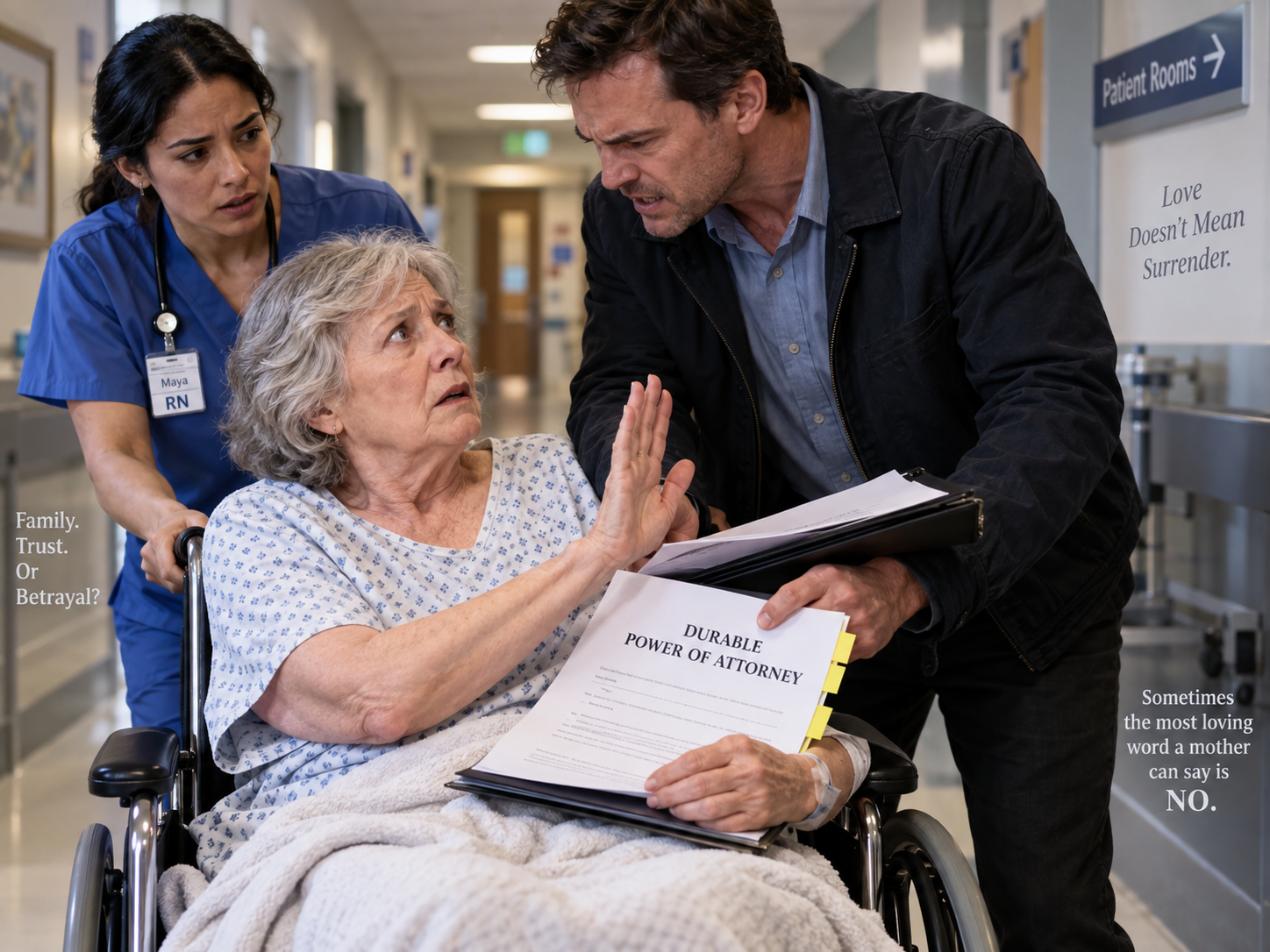
I tried to make you sign documents without telling you what they were.
When you refused, I treated your refusal like proof that you were confused instead of proof that you had a right to say no.
I took you out of your hospital room when you told me not to.
I told the nurse you were disoriented.
I came back looking for your ID and took papers from your drawer.
I did those things.
Being afraid does not change that.
Losing the company would not have justified it.
Trying to protect employees did not justify it.
Dad did not justify it.
Nothing justified it.
I read the paragraph twice.
Kevin watched the table.
The letter continued.
I thought if I could solve the money problem, none of the other things would matter.
I thought if I could save the company before anyone knew how bad things were, Melissa might come back, my employees would be okay, you would never have to know, and Dad would still be proud of me.
I know how stupid that sounds.
What I did to you was worse than losing the company.
I don’t know if you can trust me again.
I am going to stop asking you to.
I folded the letter.
Kevin still would not look at me.
“Did someone tell you to write this?”
“No.”
“Therapist?”
His head came up.
“How did you know I’m seeing a therapist?”
“I’m your mother.”
“That apparently gives you supernatural powers.”
“No. Melissa mentioned once that you thought therapy was for people who enjoyed paying strangers to blame their parents.”
He grimaced.
“I may have been wrong about several things.”
“Several?”
“Okay. Many.”
I put the letter down.
“Are you and Melissa talking?”
“Yes.”
“Coming back together?”
“I don’t know.”
“That means it’s none of my business.”
“Probably.”
We sat quietly.
Then Kevin said, “I’m sorry.”
I had heard those words from him before.
In the hospital.
On the phone.
After security walked him out.
But this time he did not add because.
Because I was stressed.
Because the company was failing.
Because you wouldn’t listen.
Because Dad.
Because employees.
Because lenders.
Because fear.
There was no because.
Just responsibility.
I looked at the man sitting across from me.
My son had frightened me.
Betrayed me.
Tried to use my trust in him as a shortcut around my consent.
Nothing could make that unhappen.
But I also knew something else.
If I wanted him to understand that losing a business did not make him worthless, I had to believe that doing something terrible did not make change impossible.
Those were not the same as forgiveness.
And forgiveness was not the same as restored access.
“I love you,” I said.
His eyes filled immediately.
“I love you too.”
“I do not trust you with my finances.”
He nodded.
“I know.”
“You are not on my power of attorney anymore.”
Another nod.
“You do not have a key to this house.”
“I figured.”
“I changed the locks.”
“I deserved that.”
“This is not about what you deserve.”
I leaned forward.
“It is about what I need.”
He swallowed.
“Okay.”
“If we have a relationship again, it happens from there.”
“From where?”
“From you understanding that my boundaries are not punishments.”
He was silent for a while.
Then he said, “I can do that.”
“We’ll find out.”
It was not a movie ending.
There was no hug across the table while music played.
There were no promises that everything would be different.
We ate lemon drops.
He told me about the smaller workshop.
I told him the surgeon had cleared me to garden again as long as I stopped pretending bags of soil weighed less simply because I was stubborn.
He stayed for an hour.
When he stood to leave, he paused beside the pantry.
I knew what he was looking at.
The height marks.
AGE 8.
AGE 11.
AGE 14.
AGE 17.
Kevin touched the highest line.
“Dad really kept everything.”
“Your father was sentimental.”
“He pretended he wasn’t.”
“Most men in this family seem to have that problem.”
Kevin smiled.
Then his hand dropped.
“Do you think he’d hate me?”
The question hurt.
I considered my answer carefully.
“I think he would hate what you did.”
Kevin nodded.
“And then?”
“And then he would probably make you sit at this table until you figured out what you were going to do differently.”
Kevin looked toward the old chair Frank had always used.
His eyes reddened.
“Sounds like him.”
“Yes.”
At the front door, he turned back.
“Mom?”
“Yes?”
“That fake copy.”
“It wasn’t fake. It was obsolete.”
“Whatever. The wrong one.”
“What about it?”
“When did you decide to leave it in the drawer?”
“The afternoon you admitted you wanted my house as collateral.”
He looked wounded all over again.
“You really thought I might come back?”
“I thought you might.”
“And you hoped I wouldn’t.”
More than anything.
“Yes.”
He lowered his eyes.
“That’s the part I keep thinking about.”
“So do I.”
He left.
I watched from the window as his car backed out of the driveway.
For years, I had thought protecting my son meant giving him somewhere soft to land.
Money when he struggled.
A room if he needed one.
An excuse when pride made him cruel.
A version of his father that always approved of him.
I understand protection differently now.
Sometimes protecting someone means refusing to become the thing they destroy in order to avoid facing themselves.
Sometimes love is a locked door.
Sometimes it is a lawyer’s number.
Sometimes it is a hospital nurse who believes an old woman when her own son calls her confused.
And sometimes love is sitting at a kitchen table months later, knowing exactly what someone is capable of, and allowing them the chance to become capable of something better.
I still have the obsolete power-of-attorney draft.
Not in my bedside drawer.
Not anywhere Kevin could find it.
It sits in a file in Laura’s office beside the valid documents that now make my wishes unmistakable.
For a while, I considered destroying it.
Then I decided not to.
I wanted to remember the lesson written between its useless legal paragraphs.
The dangerous document was never the one Kevin stole from my hospital drawer.
That document could not give him anything.
The dangerous document was the one he had originally placed across my blanket while I was weak, medicated, and trusting.
The one he called insurance paperwork.
The one he believed I would sign because he was my son.
He had counted on love making me obedient.
He had mistaken my age for helplessness.
He had mistaken my surgery for confusion.
And he had mistaken motherhood for permission.
Four months later, I sat alone at my dining table with a different document in front of me.
Laura had sent the final update to my estate plan.
I read every page.
I checked every name.
Every account.
Every authority.
Every restriction.
Then I picked up my pen.
There was no one standing over me.
No one hurrying me.
No one telling me where to sign before I had finished reading.
The house was quiet.
The afternoon sun warmed the table.
Frank’s old fountain pen sat in the drawer beside me, but I used my own.
I signed my name slowly.
Dorothy Elaine Bennett.
My hand did not shake once.
And that was the signature that mattered.
Not because it controlled my money.
Not because it protected my house.
Because it was mine to give.
And for the first time since Kevin wheeled me into that empty hospital hallway, I understood exactly how powerful that was.