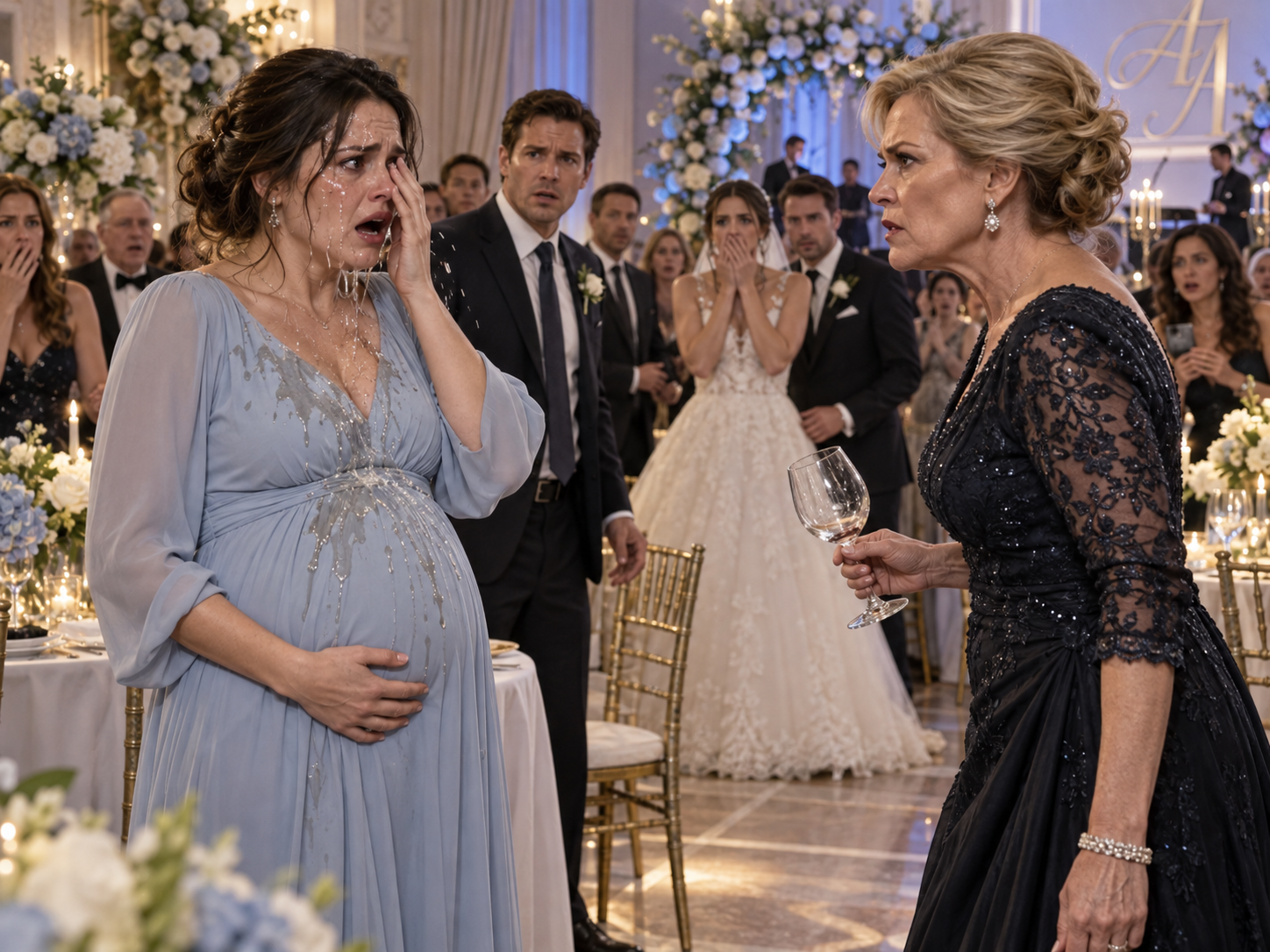
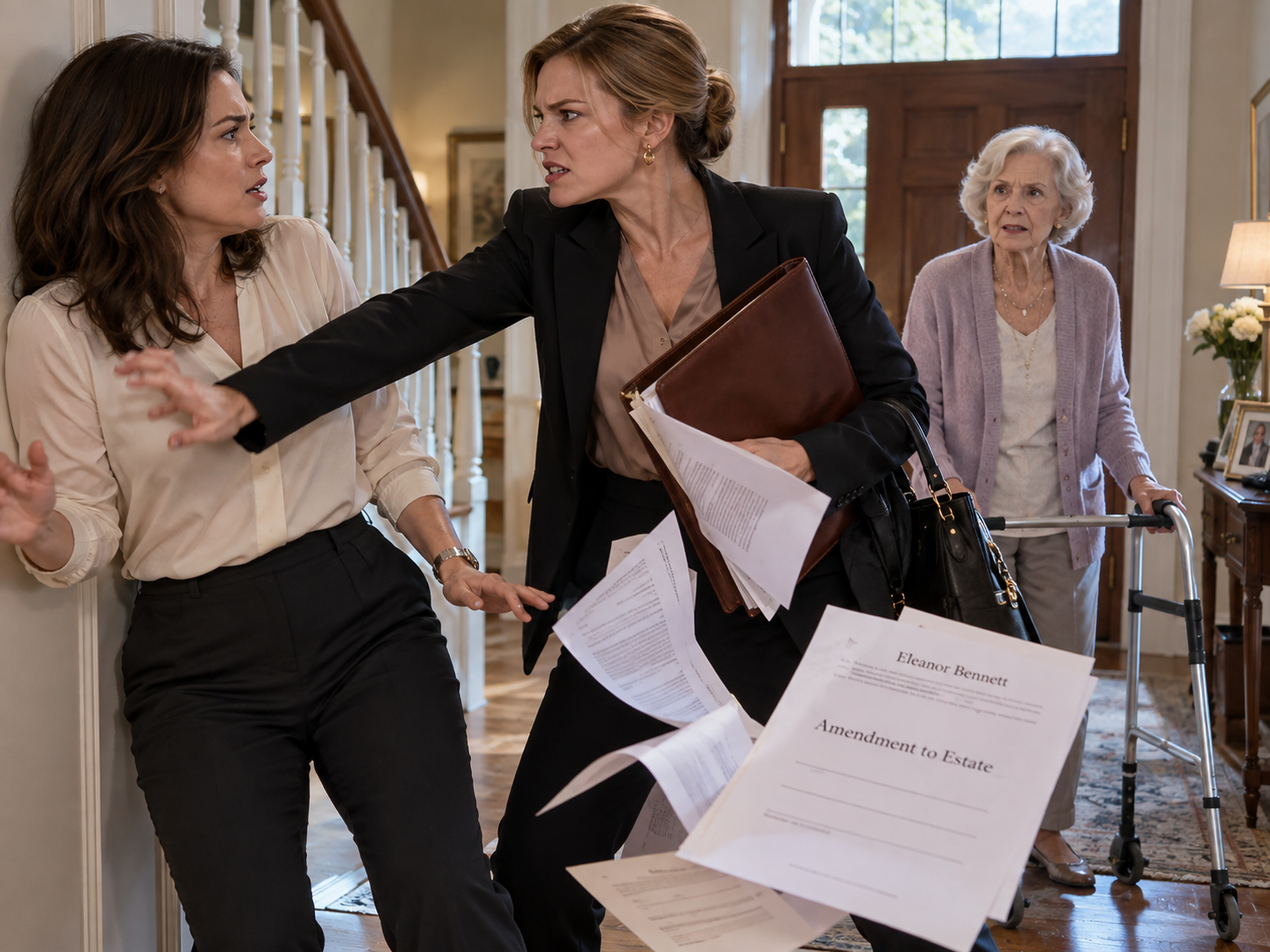
Kimberly didn't come back.
Not that day.
Not the next.
For two weeks, Daniel stayed with his friend Marcus.
He found temporary work with an engineering supplier while continuing interviews.
The salary was lower than the job he'd lost.
His pride suffered.
I considered that part of the recovery.
A month later, he started meeting with a nonprofit debt counselor.
He sold his motorcycle.
Then his expensive watch.
Then the second car he and Kimberly had financed during better years.
Every sale hurt him.
Every payment looked tiny against what he owed.
But tiny numbers move too.
Robert used to say that.
Mountains are just small pieces stacked for a long time.
Kimberly hated the plan.
Daniel told me their marriage had become "complicated."
I did not ask him to choose between his wife and me.
That is another kind of pressure, and I had learned enough about pressure.
I told him only this:
"Your marriage is yours to decide. My house is mine."
He nodded.
"I know."
Three months passed before he came to dinner again.
Alone.
He stood on my porch holding a small cardboard box.
"What's that?"
He handed it to me.
Inside was a ceramic bird.
Not exactly like Robert's.
But close.
Round body.
Tilted head.
Ridiculous expression.
I stared at it.
"I know it's not the same," Daniel said.
"No."
"I tried to find the same one."
"You won't."
"Yeah."
I lifted the bird.
"Where did you get it?"
"A little shop near Burlington."
I looked up sharply.
"You went to Vermont?"
"For an interview."
My heart squeezed.
"And?"
"I got the job."
I smiled.
"For real?"
He laughed.
"For real."
I hugged him.
This time I didn't hesitate.
He held onto me longer than usual.
When we pulled apart, his eyes were wet.
"I won't be taking it."
My smile disappeared.
"Why?"
"Because it would mean moving."
"So?"
He looked surprised.
"So I'd be three hours away."
"Daniel."
"What?"
"Take the job."
"But—"
"You need work."
"I can find something here."
"Maybe."
I put the bird back in its box.
"But don't make decisions around the assumption that I need you twenty minutes away."
He stared at me.
"Mom, you're sixty-eight."
"Not ninety-eight."
He laughed.
I pointed at him.
"And even if I were ninety-eight, I'd still be allowed an opinion."
"Okay."
He became serious.
"You're sure?"
"Take the job."
He did.
He moved to Vermont two months later.
Kimberly went with him.
That surprised me.
I learned later that she'd wanted to leave anyway.
Too many people locally knew about their financial problems.
Too many friends had stopped inviting them to expensive weekends when they began declining.
She had spent years building a life that looked prosperous.
Perhaps Vermont offered her another beginning.
I hoped she would use it better.
We never became close.
There are endings where everyone apologizes, embraces and becomes wiser.
This isn't one of them.
Kimberly sent me a Christmas card.
I sent one back.
She called on my birthday.
I thanked her.
We learned civility.
Sometimes civility is the most honest peace available.
Daniel changed more.
Slowly.
Which made me trust the change.
The first year after moving, he called every Sunday.
Not because I demanded it.
Because he wanted to.
He told me about work.
Debt payments.
His new apartment.
Arguments with Kimberly.
Small victories.
He paid off one credit card.
Then another.
Eighteen months after the realtor stood in my living room, Daniel called.
"Remember the investment?"
Of course I remembered.
"Yes."
"It collapsed."
I sat down.
"What do you mean?"
"The development stalled. Financing disappeared. The people who put money in are stuck. Some might lose almost everything."
I closed my eyes.
"Does Kimberly know?"
"Yeah."
"How is she?"
"Quiet."
That told me enough.
After we hung up, I went into Robert's room.
I still called it that.
Not because the entire room belonged to a dead man.
Because love leaves geography.
A chair becomes his chair.
A window becomes the window where he watched snow.
A room becomes his because memory needs somewhere to sit.
The new ceramic bird stood beside the broken original.
I had eventually stopped trying to hide the crack.
I glued the final piece in place, but the fracture remained visible.
At first, I hated it.
Then one morning, I realized something.
The bird had broken.
That didn't make it useless.
I understood that better now.
Two years after the afternoon Kimberly brought the realtor into my house, I replaced the roof.
I chose new shingles myself.
The contractor tried to explain the colors as though I had never seen a roof.
I told him I had survived one husband, one adult son, a daughter-in-law and forty years of homeownership.
I could handle gray.
He laughed.
The next spring, I removed half of Robert's old vegetable garden.
That surprised Daniel when he visited.
"Dad loved this garden."
"So did I."
"Then why remove it?"
"Because I hate weeding."
He laughed.
"But you kept it all these years."
"I wasn't ready."
That became one of the greatest discoveries of my late sixties.
Keeping something because you love it and keeping something because you're afraid to change it are not the same.
Kimberly had been wrong to decide I was stuck.
But part of her accusation had touched a place I eventually needed to examine.
Not for her.
For me.
I donated Robert's old suits.
I gave Daniel his father's tools.
I kept the green jacket from the lake photograph.
I turned the guest bedroom into a sewing room.
And one Saturday, I changed Robert's old room.
Not into an office.
Not because Kimberly had wanted it.
Because I wanted it.
I moved the memorial table closer to the window.
I removed the heavy curtains.
I bought a comfortable reading chair.
I kept his photograph.
His watch.
His glasses.
The compass.
The two ceramic birds.
Then I put books on the shelves again.
My books.
Mysteries.
Travel memoirs.
Three embarrassing romance novels I hid behind a gardening encyclopedia when Daniel visited.
The room became something new.
Not a shrine.
Not an office.
Not Robert's room.
Not mine.
Ours, perhaps.
A place where what had been could coexist with what remained.
Tom visited every summer.
We never spoke much about the trust anymore.
We didn't need to.
He signed nothing.
That was the point.
Three years after the confrontation, Daniel came home for Robert's birthday.
We still observed it in a quiet way.
Nothing formal.
I cooked meatloaf because it was Robert's favorite.
Daniel brought chocolate cake.
Kimberly came too.
It was the first time she had been inside the house since the meeting with Tom.
I admit I was nervous.
When she entered, her eyes moved automatically toward the living room.
Toward the memorial table.
The photograph was there.
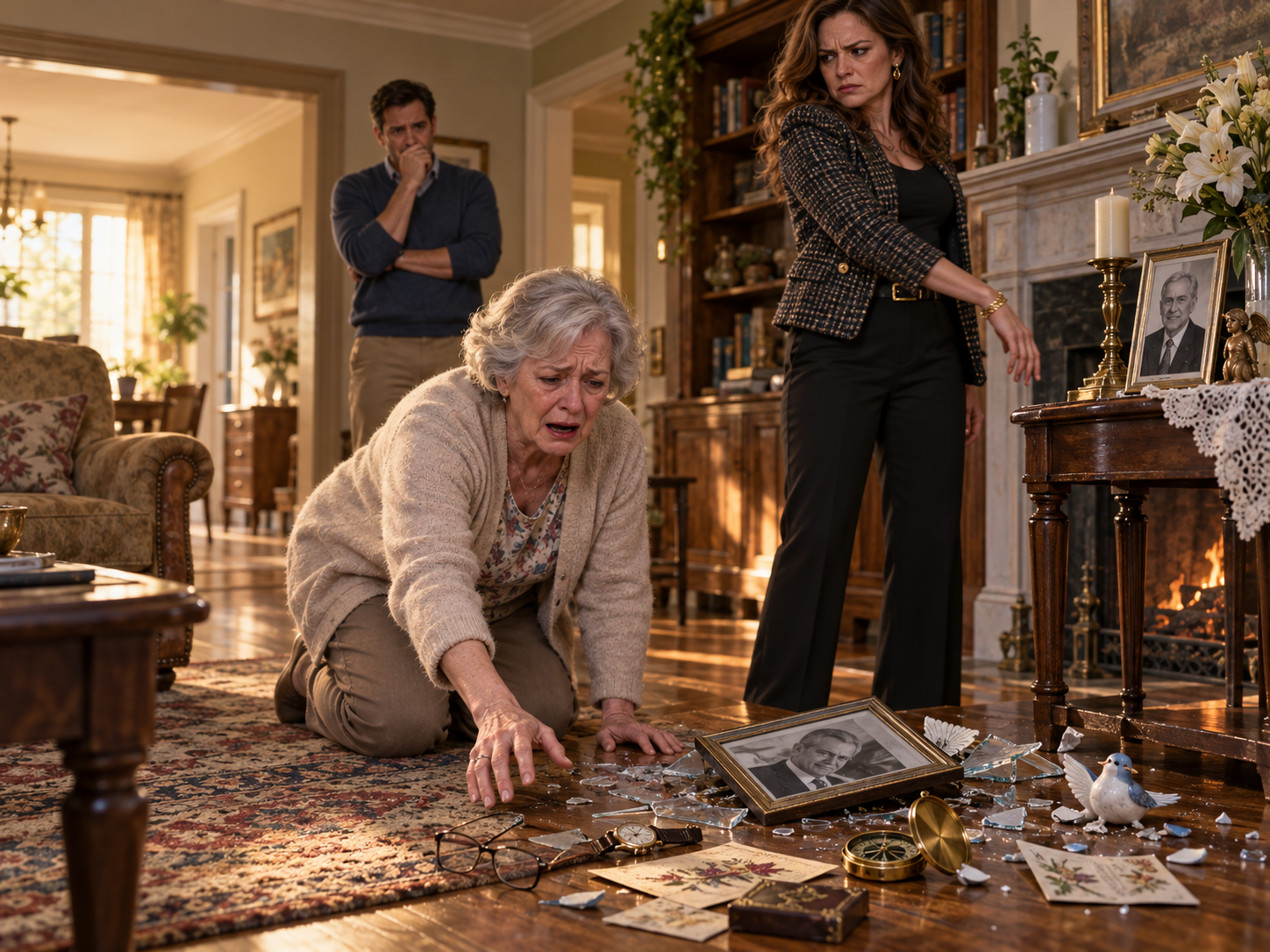
So was the broken bird.
She stopped.
For a second, neither of us spoke.
Then she said:
"You kept it."
I knew which thing she meant.
"The bird?"
She nodded.
"Yes."
"I thought you'd throw it away."
"I almost did."
She looked at the crack.
"I'm sorry."
I waited.
She swallowed.
"For that day."
Her voice was different.
No defense.
No explanation.
No "things got ugly."
"I shouldn't have touched any of it."
"No."
"I shouldn't have pushed you."
"No."
"And I shouldn't have brought the realtor here."
"No."
She almost smiled.
"You're not going to make this easy."
"I don't think apologies are supposed to be easy."
She looked down.
Then said, "I was scared."
I didn't answer.
She continued.
"When Daniel lost his job, I panicked. I kept thinking if I could just fix the money fast enough, no one would know how bad things were."
I understood.
Understanding isn't forgiveness.
But it sometimes opens the same door.
"I had built everything around looking successful," she said.
"The apartment. Cars. Trips. Clothes."
She shook her head.
"I thought if people saw us going backward, they'd know we'd failed."
"And my house looked like a solution."
"Yes."
She looked ashamed.
"For a while, I convinced myself you were being selfish."
"And now?"
"Now I think I was."
Silence.
That was enough.
Not because I needed her humiliation.
Because I needed reality acknowledged.
I stepped aside.
"Come in."
We ate meatloaf.
Daniel told stories about Robert.
Tom called during dessert.
Kimberly asked me about the reading room.
At one point, she stood beside Robert's photograph again.
She didn't touch it.
I appreciated that.
After they left, I washed dishes alone.
The kitchen window reflected my face back at me.
Older.
More lines.
More gray.
Still mine.
I thought about the afternoon when Kimberly's arm swept across the table.
For a long time, I believed that moment was about disrespect for Robert.
It was.
But it was also about something bigger.
They had begun treating my grief as weakness.
Then my age as weakness.
Then my love for my son as weakness.
And I almost participated.
Not by agreeing to sell.
But by doubting whether I had the right to say no without defending it.
Age does something strange to women.
People begin speaking around you.
For you.
About what is practical.
What is safe.
What is too much house.
Too much yard.
Too much driving.
Too much independence.
Sometimes the advice comes from love.
Sometimes it comes from impatience.
Sometimes it comes from people who have already started dividing your life into what will belong to them later.
The hardest lesson I learned was that you can love people deeply and still require them to wait their turn.
My son may inherit this house one day.
Or he may not.
I could sell it tomorrow.
I could leave it to a charity.
I could live here until I'm one hundred and three and haunt the next owner afterward just to irritate Kimberly.
The point is not what I choose.
The point is that I choose.
One summer evening, nearly four years after the broken photograph, I sat in the backyard with a glass of iced tea.
The sun was dropping behind the maple tree Robert planted the year Daniel was born.
The tree had become enormous.
Its roots had lifted part of the stone path.
Robert would have complained about that.
Then refused to cut it down.
I smiled.
On the table beside me lay a letter.
Daniel had mailed it instead of calling.
I had already read it three times.
Mom,
I don't know if I ever properly thanked Dad for what he did.
I hated that trust clause when I first learned about it.
It made me feel like he expected me to fail.
Now I think he expected me to be human.
There is a difference.
If you had sold the house for us, I would have called it help.
Maybe for the rest of my life.
But I think some part of me would have known what it really was.
You paying for the fact that I was afraid to face what I'd done.
I'm glad you said no.
I hated you for it for a little while.
I'm glad you said it anyway.
Love,
Daniel
I folded the letter.
The backyard was quiet.
Somewhere down the street, a dog barked.
A lawn mower started.
Ordinary sounds.
A life continuing.
I looked through the window into the house.
Robert's photograph stood in the room beyond.
The frame no longer had broken glass.
But I kept the old cracked frame in a drawer upstairs.
I don't know why.
Maybe because repaired things shouldn't erase the evidence that they were damaged.
That afternoon had damaged all of us.
Kimberly.
Daniel.
Me.
Even my memory of Robert for a while.
But damage is not ownership.
Pain doesn't get to own everything that comes after it.
I lifted my glass toward the house.
"Well," I said aloud, "you were right again."
In my mind, Robert answered exactly as he always did.
Took you long enough.
I laughed.
Then my phone rang.
Daniel.
I answered.
"Hello?"
"Hey, Mom."
"Hey."
"What are you doing?"
"Sitting in my backyard."
He paused.
Then, with obvious amusement, asked:
"Your backyard?"
I looked at the maple tree.
At Robert's garden.
At the windows glowing gold in the evening light.
At the house that had survived marriage, illness, death, debt, anger, shattered glass and one extremely persistent daughter-in-law.
I smiled.
"Yes," I said.
"My backyard."
And for the first time in years, the word my did not sound lonely.
It sounded free.