Thomas Avery arrived at one-thirty.
He was seventy-one now.
Thinner than I remembered.
White hair.
Wire-frame glasses.
The same calm blue eyes.
When I opened the door, he looked at me for several seconds before smiling.
"Hello, Helen."
I hugged him.
I hadn't planned to.
He hugged me back.
And suddenly I was crying against the coat of a man who smelled faintly of cedar and winter air.
"I'm sorry," I said.
"Don't be."
"I haven't seen you in years."
"I know."
"Robert would've been mad at both of us."
Tom smiled.
"He usually was."
I laughed.
It felt good.
Painful.
But good.
We sat in the living room.
His eyes moved immediately toward Robert's corner.
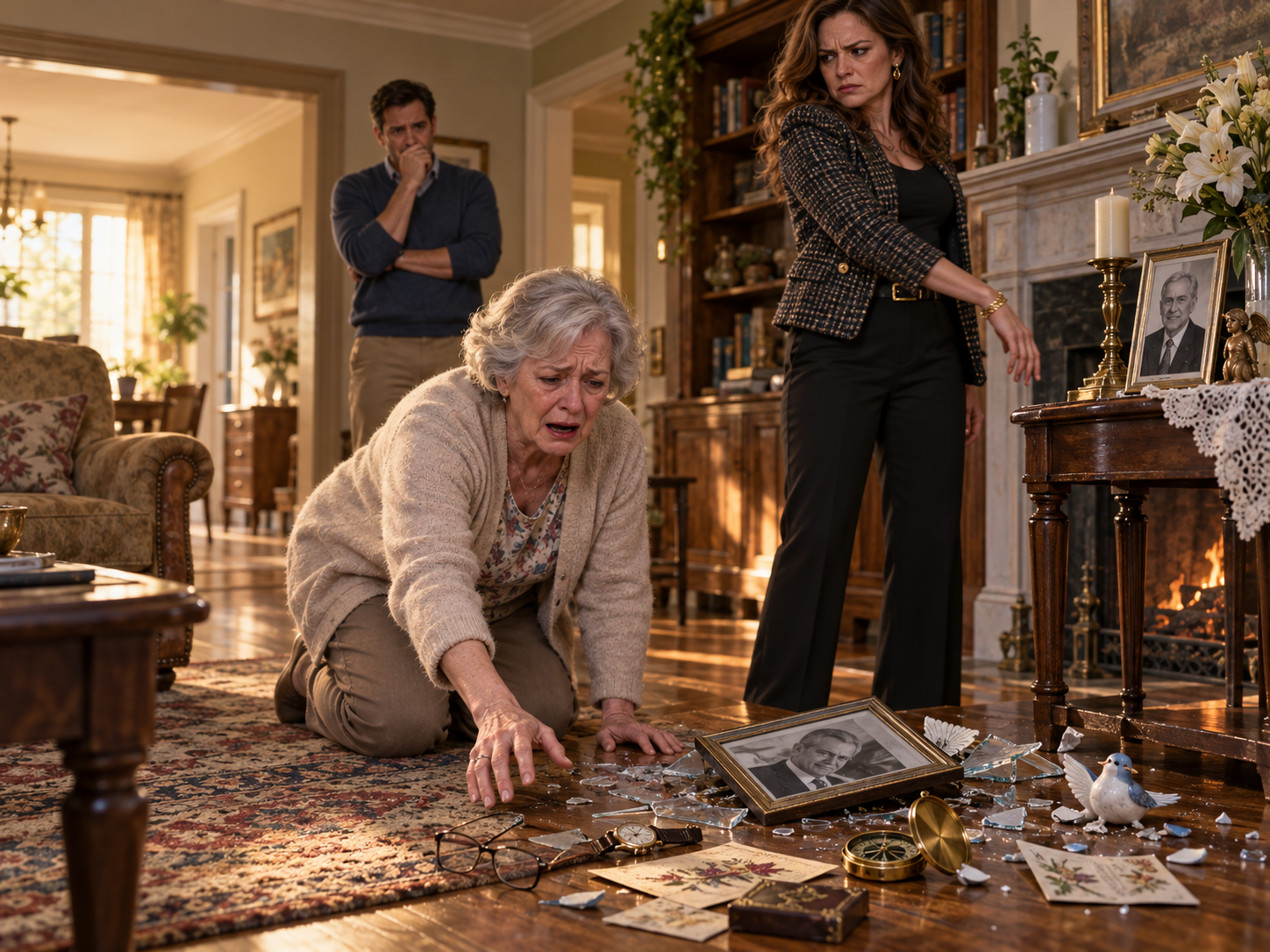
I had repaired what I could.
New frame.
Watch polished.
Glasses set beside the brass compass.
The ceramic bird remained broken.
I had glued two pieces together but couldn't find a way to hide the crack.
Tom walked over.
"He bought that in Vermont."
I stared at him.
"You remember?"
"He made us stop at three shops because he said the first two birds didn't look stubborn enough."
I laughed again.
That had been Robert.
Details like that are the cruelest gift grief gives back to you.
A person is never more alive than when somebody remembers something useless about them.
At two o'clock, Daniel arrived.
At two-ten, Kimberly walked in.
She wore a navy suit.
Not casual clothes.
Not family clothes.
Armor.
She stopped when she saw Tom.
"You're Thomas Avery?"
He stood.
"Yes."
She offered her hand.
"Kimberly Reed."
"I know."
Something about his tone unsettled her.
She sat.
Daniel took the chair beside her, though he left more space between them than usual.
I remained on the sofa across from Tom.
Kimberly opened a folder.
"I brought some information."
Tom nodded.
"I'm sure."
"The house has appreciated significantly."
"So I've been told."
"The estimate is around six hundred forty thousand, possibly higher if marketed properly."
Tom looked toward me.
"Helen, do you want to sell?"
"No."
He looked back at Kimberly.
"Then I don't believe the market value is relevant."
Her face tightened.
"With respect, that's an emotional answer."
"No," Tom said.
"It's an ownership answer."
Kimberly opened the folder wider.
"Actually, the property is held in trust."
"Yes."
"Daniel is a beneficiary."
"A remainder beneficiary."
"He has a financial interest."
"After Helen's death."
Kimberly's mouth tightened.
"Or potentially through an approved transaction during her lifetime."
Tom nodded.
"If the transaction primarily benefits Helen and Helen wants it."
"We found a two-bedroom condominium that would dramatically reduce her maintenance costs."
"I don't want it," I said.
Kimberly ignored me.
"It would leave substantial capital available."
"For whom?" Tom asked.
Kimberly looked at him.
"The family."
"There is no provision authorizing the sale of Helen's residence to fund Daniel's investment."
"We're not asking the trust to fund anything directly."
Tom waited.
Kimberly continued.
"The house could be sold. Helen could purchase a smaller residence. Then she could choose to make a family gift."
Tom smiled faintly.
"You've added an extra step to the same plan."
Her cheeks reddened.
"This could save Daniel financially."
Tom turned to my son.
"Daniel?"
Daniel looked miserable.
"I don't want Mom forced to do anything."
Kimberly twisted toward him.
"Excuse me?"
He swallowed.
"I said I don't want her forced."
"No one is forcing her."
I spoke.
"You brought a realtor here while I was gone."
Kimberly turned back to me.
"Because you refused to even consider the idea."
"That is what no means."
"You refuse everything because you're stuck."
Tom's voice remained calm.
"Mrs. Reed."
She stopped.
"Helen's reasons do not need your approval."
Kimberly stared at him.
Then she leaned back.
I could almost see her changing strategies.
"Mr. Avery, you knew Robert."
"Forty-six years."
"Then you know he cared about Daniel."
"Very much."
"Would he want his son to lose everything?"
Tom did not answer immediately.
Kimberly pressed on.
"The investment we're discussing could produce enough return to clear the debt and restore the money over time."
"Could."
"It is professionally structured."
"By whom?"
She named a development company.
Tom wrote it down.
"What percentage return is guaranteed?"
Kimberly hesitated.
"It's an equity investment. Nothing is guaranteed."
"What percentage of Daniel's available liquid assets would this represent?"
She didn't answer.
Tom looked at Daniel.
Daniel said quietly, "More than we have."
Tom nodded.
"So the plan is to sell Helen's home in order to fund an investment Daniel cannot afford."
Kimberly slammed the folder shut.
"You're twisting this."
"No."
Tom's voice never rose.
"I'm simplifying it."
Silence filled the room.
Kimberly turned to me.
"You called him here because you wanted somebody to tell you you're right."
"No."
I looked at Tom.
"I called him because Robert did."
That landed.
She frowned.
"What does that mean?"
Tom opened his briefcase.
He removed a copy of Schedule C.