Our daughter was born six weeks later.
Her name was Clara.
Seven pounds, four ounces.
Dark hair.
Angry little cry.
Ten perfect fingers.
Ethan sobbed so hard when the nurse placed her on my chest that I started laughing even though I was crying too.
“She’s here,” he kept saying.
As if neither of us could quite believe it.
“She’s really here.”
I touched her cheek.
Clara opened her mouth and screamed.
Ethan laughed through his tears.
“She has your temper.”
“She’s thirty seconds old.”
“I can already tell.”
“Careful. Your mother once made the same mistake with genetics.”
He stared at me.
For one second I worried it was too soon.
Then he laughed.
Really laughed.
The kind I had not heard from him since the laboratory envelope arrived.
I laughed with him until the nurse probably thought we were delirious.
Maybe we were.
Exhaustion can make grief and joy sit strangely close together.
Robert met Clara the next afternoon.
He stood near the hospital door as though waiting for permission to enter.
Ethan hugged him.
Not the old effortless hug.
Something cautious.
But real.
Robert cried when he held his granddaughter.
“Hello, sweetheart.”
Clara slept through the introduction.
Martha did not come.
That was Ethan’s decision.
And, to her credit, she respected it.
Two days later she sent a message.
Not to Ethan.
To me.
For a long time, I stared at her name before opening it.
I know I am not entitled to ask for anything from you. I only want you to know I am sorry. What I said about you was cruel. What I implied about Clara was worse. I made my fear your burden. There is no excuse for that. Please don’t answer unless you want to.
I read it twice.
Then I handed the phone to Ethan.
He read it.
“What are you going to say?”
“I don’t know.”
He nodded.
For once, no one was demanding an immediate answer from me.
So I didn’t give one.
Three weeks passed.
Newborn life swallowed us.
Sleep came in ninety-minute pieces.
My hair existed permanently in a knot.
Ethan learned how to change a diaper at three in the morning without fully opening his eyes.
We argued about bottle temperatures.
We laughed at things that weren’t funny.
I cried once because we ran out of clean burp cloths.
He cried once because Clara wrapped her hand around his finger.
Normal things.
Beautiful things.
Hard things.
Things that had nothing to do with DNA.
One afternoon, I found Ethan sitting in the nursery holding the letter from his biological mother.
Clara slept against his chest.
“You okay?”
He nodded.
Then shook his head.
“I’ve been thinking about finding her.”
I sat in the chair beside him.
“Do you want to?”
“I think so.”
“Then you should.”
“What if Mom thinks—”
He stopped himself.
I smiled.
“What?”
He looked down at Clara.
“I almost did it again.”
“Yes.”
He took a breath.
“What do I want?”
I waited.
“I want to know where I came from.”
“Then that’s your answer.”
He nodded.
“I don’t want another mother.”
“You don’t have to want one.”
“I just want the truth.”
“Then look for it.”
He folded the letter.
“Would that bother you?”
“Why would it?”
“Because everything started with a DNA test.”
“No. Everything started with people believing truth was dangerous.”
He looked at me.
I had not planned the sentence.
But once I said it, I knew it was true.
The truth had hurt us.
Of course it had.
It had exposed Martha.
It had shattered Ethan’s assumptions.
It had forced me to look directly at weaknesses in my marriage I would rather have ignored.
But the lies had done worse.
The lies had created the conditions for the explosion.
A month after Clara was born, Martha came to our house.
This time she texted first.
This time she asked.
Would it be all right if I stopped by for ten minutes? If not, I understand.
Ethan showed me the message.
“What do you think?”
I looked at Clara sleeping in my arms.
“You decide.”
He shook his head.
“No. We decide.”
That mattered.
More than he knew.
“Ten minutes,” I said.
Martha arrived carrying nothing.
No soup.
No toys.
No flowers.
No way to purchase a softer entrance.
She stepped into the living room and looked at Clara.
Her face collapsed.
“Oh.”
Just that.
Oh.
For months she had discussed my child like a disputed claim.
Now the actual child was three feet away.
Small.
Sleepy.
Entirely unconcerned with anyone’s theories about blood.
Martha looked at me.
“May I come closer?”
I nodded.
She approached.
Clara made a small sound.
Martha pressed her lips together.
“She’s beautiful.”
“Thank you.”
She looked at Ethan but did not ask to hold the baby.
I noticed.
So did he.
After a moment, he said, “Do you want to hold her?”
Martha started crying.
“Yes.”
Ethan took Clara carefully from my arms and placed her into his mother’s.
Martha stared down at her granddaughter.
“She has your mouth.”
The room froze.
Martha seemed to realize what she had said.
Her eyes widened.
Then, unexpectedly, she laughed through her tears.
“Or maybe she doesn’t.”
Ethan smiled.
“She does.”
“How do you know?”
“Because I’m her father.”
No anger.
No test.
No percentage.
Just certainty.
Martha nodded.
“You are.”
She sat with Clara for several minutes.
Then she looked at me.
“I owe you something better than a text message.”
I said nothing.
She shifted Clara carefully.
“I accused you because I was afraid.”
“I know.”
“That doesn’t excuse it.”
“No.”
“I humiliated you.”
“Yes.”
“I interfered in your marriage.”
“Yes.”
Her eyes filled.
“I made my son doubt the woman he loved because I taught him all his life that keeping me calm was easier than disagreeing with me.”
Ethan looked at her.
That was the most accurate thing she had ever said about herself.
Martha continued.
“And when the test proved me wrong, my first instinct was to grab the papers because I cared more about keeping my own secret than about what I had just done to you.”
I could feel my throat tightening.
“I’m sorry, Olivia.”
For once, there was nothing after the apology.
No but.
No explanation.
No request that I understand.
I nodded.
“Thank you.”
She looked at me hopefully.
I did not tell her everything was fine.
It wasn’t.
Forgiveness given too quickly can become another kind of lie.
“I’m not there yet,” I said.
Her face fell slightly.
“But I heard you.”
She nodded.
“That’s more than I deserve.”
Clara stretched in her arms.
Martha smiled down at her.
After ten minutes, exactly, she stood.
She handed Clara to Ethan.
Then she left.
No protest.
No attempt to stay longer.
After the door closed, I looked at my husband.
“Well?”
He stared at the door.
“That was weird.”
I laughed.
“It was.”
“Healthy, maybe.”
“Don’t get carried away.”
He smiled.
Over the next several months, things changed slowly.
Not magically.
Slowly.
Martha asked before visiting.
Sometimes we said no.
She learned to survive it.
Ethan stopped telling her details of our arguments.
Robert started seeing a therapist.
Eventually Martha did too, although she announced that fact as if accepting psychological help were a personal insult.
Ethan began the process of accessing additional adoption records.
He had not yet decided whether to contact his biological mother if she was still alive.
That choice belonged to him.
For the first time, his parents seemed to understand that.
The original laboratory report remained in our desk.
One evening, almost a year after everything happened, I found it while searching for our mortgage paperwork.
The torn first copy.
I had forgotten we kept it.
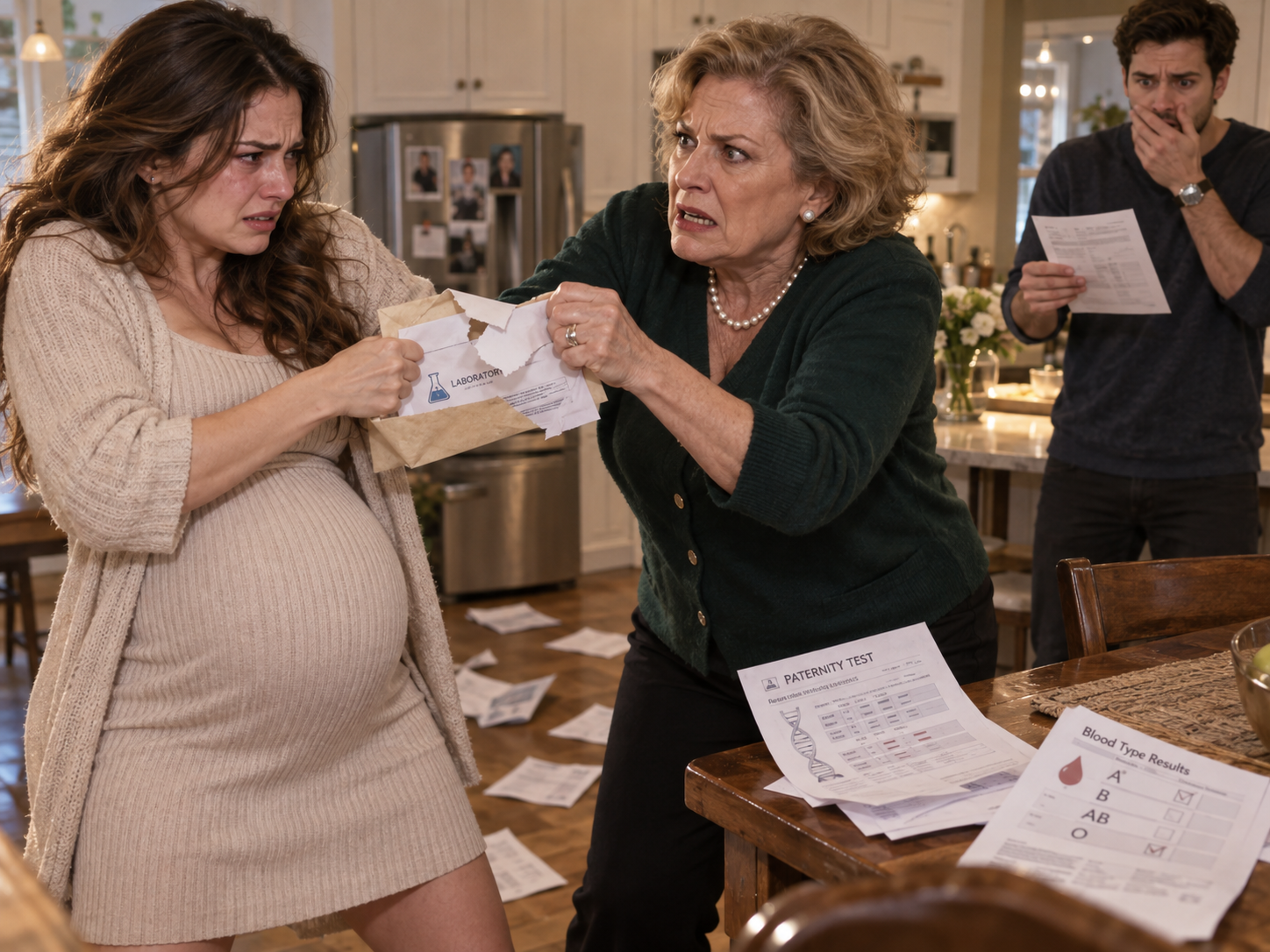
The rip ran diagonally across the envelope where Martha and I had fought over it.
I sat on the floor and pulled out the pages.
There it was.
Probability of Paternity: Greater Than 99.999%.
The number that had once seemed so enormous.
So final.
So important.
Below it, farther into the packet, was the detail that had destroyed thirty-five years of silence.
AB Positive.
Four letters and a symbol.
That was all.
Martha had wanted a laboratory to tell everyone who belonged to whom.
Instead, it had exposed how little belonging had ever depended on blood.
Ethan was not biologically Robert and Martha’s son.
Yet Robert was the man who taught him to ride a bicycle.
The man who sat beside him in the emergency room when he broke his wrist at eleven.
The man who cried at our wedding.
Martha was not his biological mother.
Yet she had stayed awake beside him through fevers.
Packed school lunches.
Fought teachers she thought underestimated him.
Saved every birthday card he ever gave her.
Loved him fiercely.
And hurt him deeply because she feared biology could erase all of that.
Clara was Ethan’s biological daughter.
The laboratory had proved it.
But Ethan became her father every night at two in the morning when he got out of bed before I did.
Every time he strapped her into her car seat twice because the first attempt didn’t feel secure enough.
Every time she cried and reached for him.
Every time he chose patience over the patterns he had inherited from the people who raised him.
Those choices would never appear on a DNA test.
I heard footsteps.
Ethan appeared in the doorway holding eleven-month-old Clara on his hip.
“What are you doing down there?”
“Looking for the mortgage paperwork.”
He glanced at the report.
“Oh.”
Clara reached toward me.
I took her.
She immediately grabbed a fistful of my hair.
“Ow.”
Ethan sat beside us.
For a moment, he looked at the paper.
“Can I see it?”
I handed it to him.
He read the paternity result.
Then the blood group.
He smiled without humor.
“One envelope.”
“One very expensive envelope.”
“It ruined everything.”
I looked at him.
“No.”
He glanced toward me.
“It didn’t.”
“What would you call what happened?”
“It exposed everything.”
He thought about that.
Clara slapped her hand against his knee.
He took her fingers.
“I still wish Mom had never demanded it.”
“So do I.”
“I still wish I had told her no.”
“So do I.”
He smiled.
“You really don’t let me off easy.”
“I love you too much to lie to you.”
That sentence made us both quiet.
Because that was what had been missing from his family for thirty-five years.
They had mistaken love for protection.
Protection for secrecy.
Secrecy for control.
Control for safety.
And somehow one frightened woman had convinced herself that a lie could hold a family together better than truth.
Ethan folded the report.
“I used to think if I found out my parents lied about something this big, it would erase my childhood.”
“Did it?”
“No.”
He looked toward the window.
“It changed it.”
“That’s different.”
“Yeah.”
Clara leaned against his chest.
He kissed the top of her head.
“I remember being six and Mom staying beside my bed all night because I was scared of a thunderstorm.”
I smiled.
“I can picture that.”
“I remember Dad teaching me to throw a baseball.”
“Badly, based on your throwing.”
He bumped my shoulder.
“I remember Mom crying when I left for college. Calling every morning for a month.”
“That part I can definitely picture.”
He laughed.
“Those things are still real.”
“Yes.”
“So is the lie.”
“Yes.”
He nodded.
That was adulthood, I thought.
Not choosing one truth because it was easier.
Holding both.
I looked at the torn envelope again.
For months, Martha had stared at my pregnant stomach and asked herself whether the baby belonged to her family.
She had searched my daughter’s ultrasound for familiar features.
Compared noses.
Chins.
Profiles.
She had demanded DNA because she believed blood would settle the question of belonging once and for all.
And the test had answered her.
Just not in the way she expected.
It told her Ethan was Clara’s biological father.
It told Ethan the people who raised him were not his biological parents.
And it forced all of us to face a truth no laboratory could calculate as a percentage.
Family could be biological.
Family could be chosen.
Family could be built through thirty-five years of breakfast tables, illnesses, school plays, arguments, holidays and ordinary Tuesdays.
Blood could reveal where someone came from.
It could not tell you who had earned the right to remain close to them.
That required something much harder than a test.
Trust.
Martha had broken ours.
Slowly, carefully, she was learning how to rebuild it.
Ethan had broken mine too.
He was rebuilding it every day.
And me?
I had stopped trying to earn my place in anyone else’s definition of family.
I looked at my daughter.
Then at my husband.
“Throw it away,” I said.
Ethan glanced down at the report.
“Really?”
“We know what it says.”
He smiled.
Then he tore it once.
Not angrily.
Not dramatically.
Just once down the middle.
He placed both pieces in the trash.
The first time that report had been torn, two women were fighting over who had the right to control the truth.
This time, nobody was fighting.
Nobody was hiding anything.
Nobody was afraid of what the paper could reveal.
Ethan lifted Clara into the air.
She squealed.
He kissed her belly.
I watched them and thought about that morning in the kitchen almost a year earlier.
Martha clutching the envelope.
Me grabbing for it.
Ethan standing between us.
All of us convinced the most important question in the room was whether my unborn daughter had the right father.
We had been wrong.
The real question was what happened to a family when the truth finally became more powerful than fear.
For thirty-five years, Martha believed silence had kept her son.
In the end, silence nearly cost her him.
And the test she had demanded to expose me had done something she never imagined.
It cleared my name in seconds.
Then it opened a secret she had spent thirty-five years trying to keep closed.
Martha wanted proof of who belonged in her family.
What she got instead was a lesson none of us would ever forget.
Blood can tell you where you came from.
But it is truth—and what people choose to do with it—that decides whether a family survives.