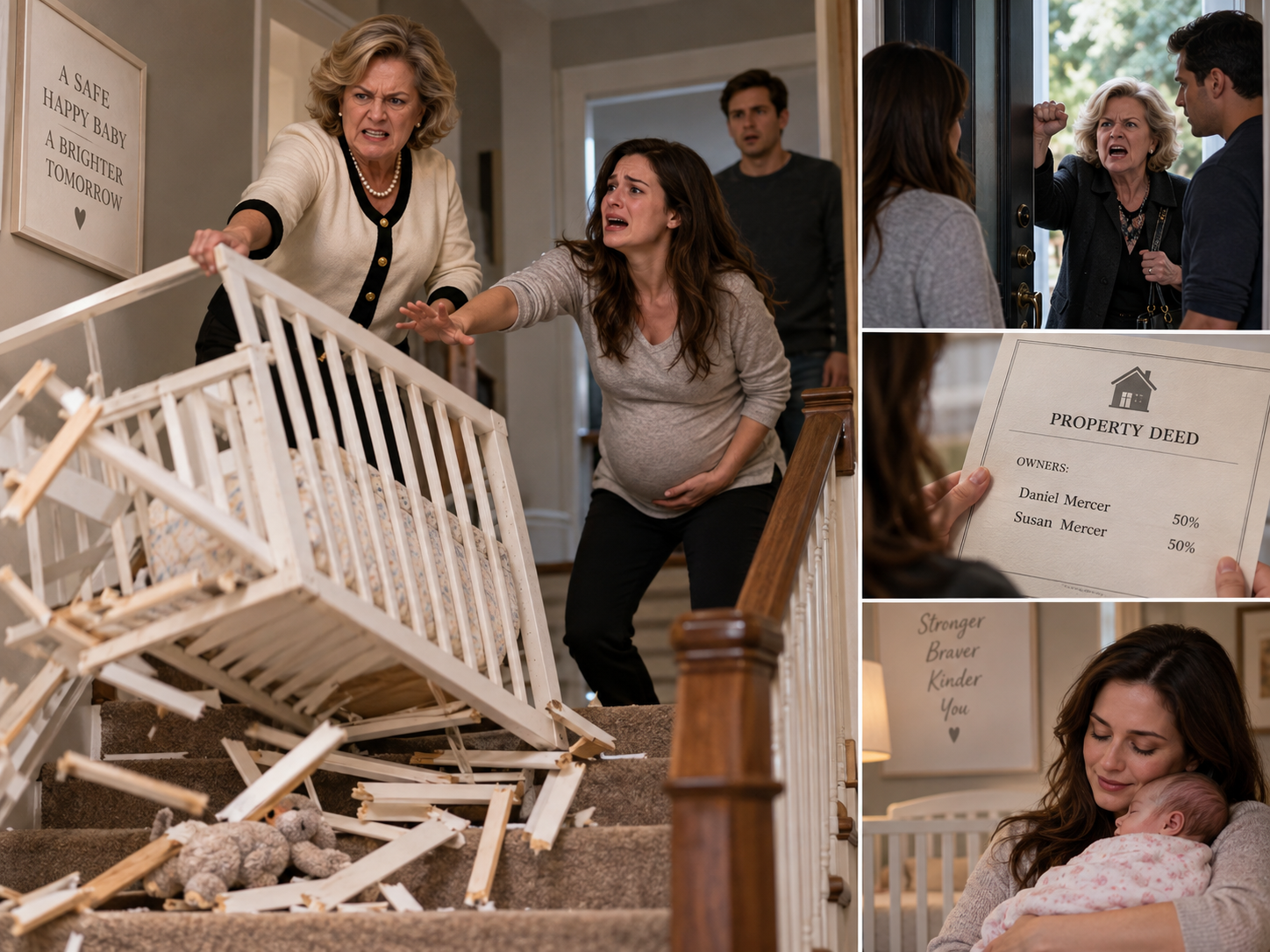
My water broke at 3:14 in the morning.
Not dramatically.
No movie-style flood.
Just enough that I stood beside Natalie’s guest bed thinking:
Either I just lost control of my bladder, or today is the day.
Then the contractions began.
Natalie called Michael.
He arrived in eleven minutes wearing mismatched shoes.
Under any other circumstances, I would have teased him.
Instead, I doubled over against the kitchen island.
“Hospital,” I gasped.
“Yes.”
“Now.”
“Yes.”
He grabbed the hospital bag.
Then stopped.
“Can I touch you?”
Even in labor.
Even terrified.
He asked.
That almost broke me.
I nodded.
He put one arm around me carefully.
Our daughter was born nine hours later.
Seven pounds, three ounces.
Dark hair.
Loud lungs.
Perfect fingers.
When the nurse placed her on my chest, every sound in the room disappeared.
I looked at her face.
Tiny.
Furious.
Alive.
I started sobbing.
Michael stood beside me crying openly.
“She’s here,” he whispered.
I touched our daughter’s cheek.
For months, she had been an idea.
A heartbeat.
A kick under my ribs.
A reason to be afraid.
Now she was a person.
Our person.
Michael kissed my forehead.
“Thank you.”
I looked at him.
“We did this.”
He nodded.
“We did.”
We named her Lily.
A name Eleanor had hated when I suggested it months earlier.
Too plain, she had said.
Too ordinary.
I loved it even more now.
Within hours of Lily’s birth, messages began arriving.
Rachel congratulated us.
Then asked if she could visit whenever we were ready.
No pressure.
No request for pictures.
No assumption.
I noticed.
Eleanor also found out.
Of course she did.
Family news travels through cracks no matter how carefully doors are closed.
She called Michael twelve times.
He did not answer.
Then she sent a message.
Please don’t punish me by keeping my granddaughter away.
Michael showed it to me.
I read it once.
Then handed the phone back.
“What do you want to do?”
He looked at Lily sleeping in the clear hospital bassinet.
“Nothing.”
“You sure?”
“Yes.”
“She’ll tell people I forced you.”
“I know.”
“That bothers you?”
“Yes.”
I appreciated his honesty.
“Are you going to answer?”
“No.”
He deleted the message.
That was the moment I began believing we might survive.
Not because he rejected his mother.
Because he accepted that doing the right thing might still make him uncomfortable.
For years, he had treated discomfort as evidence that something was wrong.
Now he was learning that sometimes discomfort is simply the cost of a boundary.
We stayed at Natalie’s for another week after leaving the hospital.
Then I decided to go home.
Not because Michael asked.
He never did.
I returned because I wanted to.
The broken garage window had been replaced.
The door was reinforced.
There were new security cameras.
New locks.
No hidden keys.
No emergency remotes.
No family access codes.
The house felt different.
So did we.
On our first night home, Michael made dinner while I fed Lily.
He burned the chicken.
I ate it anyway.
At two in the morning, Lily screamed for no reason we could identify.
Michael walked the hallway holding her.
I sat on the couch exhausted, watching him whisper nonsense into her hair.
“Your mother thinks I’m qualified for this,” he told the baby. “She has made a terrible error.”
I laughed.
Then I cried.
Sleep deprivation does strange things.
Michael sat beside me.
Lily finally settled against his chest.
“Sarah.”
“Hmm?”
“I need to tell you something.”
My body tensed automatically.
He noticed.
“It’s not bad.”
“That phrase usually means the next thing is bad.”
He almost smiled.
“Mom came to my office.”
I froze.
“When?”
“Yesterday.”
“What happened?”
“I didn’t let her in.”
I waited.
“She cried in the lobby.”
“Of course.”
“She said she wanted to see the baby.”
“And?”
“I told her no.”
My heart beat faster.
“She asked how long you were going to control me.”
“What did you say?”
Michael looked at Lily.
“I told her you weren’t controlling me.”
He swallowed.
“I told her the reason she thinks I’m controlled is because she can’t imagine me disagreeing with her unless someone else is making me.”
I stared at him.
“What did she say?”
“That I’ve changed.”
“Have you?”
“Yes.”
He looked at me.
“I needed to.”
I leaned back.
Lily made a tiny sound.
Michael adjusted the blanket around her.
Then he said, “Mom asked me to choose.”
My stomach tightened.
“What?”
“She said either I start treating her like my mother again or she won’t be part of my life.”
I felt unexpectedly sad.
Not for Eleanor exactly.
For Michael.
No matter what she had done, she was still his mother.
“What did you say?”
“I told her I hope she gets help.”
“That’s all?”
“And that I love her.”
My eyes filled.
“And then?”
“I left.”
He looked at me.
“I’m not choosing between you.”
I said nothing.
“I’m choosing the kind of husband and father I want to be.”
My tears spilled.
Michael continued.
“If she can be in my life without hurting my family, maybe one day something changes.”
He looked down at Lily.
“But she doesn’t get to define family anymore.”
I reached for his hand.
This time, I did not pull away.
Six months later, the bruise on my hip was long gone.
The scar inside our marriage was not.
But scars are not always proof something died.
Sometimes they prove something survived.
Michael remained in therapy.
So did Rachel.
I saw Rachel occasionally.
Always somewhere neutral at first.
She apologized more than once.
Eventually, I asked her to stop.
Not because I had forgiven everything.
Because repeated apologies can become another demand on the injured person.
Please tell me I’m good again.
I wasn’t ready to do that.
But when Lily was four months old, I let Rachel hold her.
I watched closely.
Rachel knew I was watching.
She did not complain.
She did not say I was punishing her.
She simply sat in the armchair and held her niece carefully.
“Hi,” she whispered.
Lily grabbed a fistful of her hair.
Rachel laughed.
I did too.
That was enough.
Eleanor did not meet Lily.
Not during those first six months.
Maybe someday she would.
Maybe she wouldn’t.
That decision no longer belonged to fear.
It belonged to us.
There were consequences from the break-in.
There were lawyers.
Statements.
Paperwork.
I will not pretend any of it felt triumphant.
Justice in real life often feels more exhausting than satisfying.
Eleanor told relatives she had been misunderstood.
Some believed her.
Some did not.
A few stopped speaking to Michael.
Others apologized to me for staying silent at the party.
I learned something important from all of them:
Being believed by everyone is impossible.
Being believed by the people who matter should not be.
The neighbor’s camera clips remained saved in a folder.
So did Rachel’s video.
I rarely watched either.
I did not need to.
For a while, I had feared that if I stopped looking at the evidence, reality might become unstable again.
As though truth could disappear if I looked away.
Eventually, I understood.
The video had proved what happened to other people.
I never needed it to prove what happened to me.
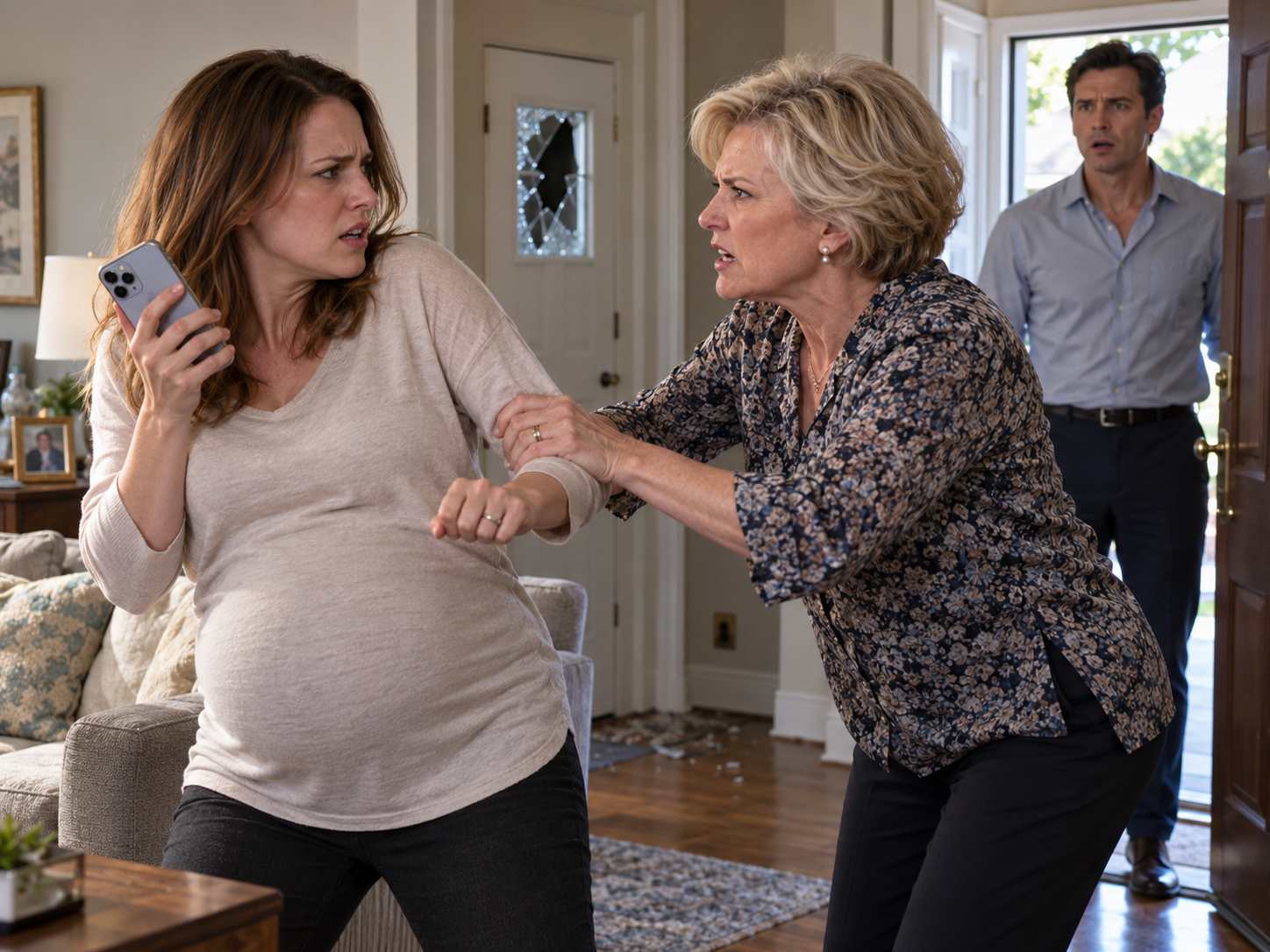
I had known from the moment Eleanor grabbed my wrist.
The deepest wound was never that she lied.
It was that people I loved asked me to distrust myself because her lie was more convenient.
One Sunday morning, almost a year after the fall, I stood at the top of our stairs holding Lily.
She was eleven months old and determined to walk before she had mastered balance.
Michael stood below us.
“Bring her down,” he said.
“You bring her.”
“You’re already there.”
“She likes you better before breakfast.”
“That is scientifically false.”
Lily squealed.
I laughed.
Then I looked down the staircase.
For just a second, my body remembered.
The missing step.
The sensation of falling.
The terrible silence inside me when I could not feel my baby move.
Michael saw my face change.
He did not say, It’s okay.
He did not say, Don’t think about it.
He came upstairs.
He stood beside me.
“Want me to take her?”
I looked at Lily.
Then at him.
“No.”
I adjusted her against my chest.
“I’ve got her.”
And I did.
I held the railing with one hand.
My daughter with the other.
Michael walked one step behind me.
Not pulling.
Not pushing.
Not telling me there was nothing to fear.
Just there.
At the bottom, Lily clapped as if we had completed something extraordinary.
Maybe we had.
I kissed her hair.
Michael smiled.
For a long time, I thought the worst thing Eleanor did was make me fall.
It wasn’t.
The worst thing was what came afterward.
She tried to replace what happened with a version that protected her.
Rachel helped.
Michael almost did too.
And I nearly destroyed myself trying to convince everyone that my memory deserved to exist.
I don’t do that anymore.
I don’t argue with people committed to misunderstanding me.
I don’t leave doors unlocked to prove I’m loving.
I don’t confuse access with affection.
And I no longer believe keeping a family together is automatically virtuous.
Sometimes a family stays together because one person keeps absorbing the damage.
That person used to be me.
Not anymore.
Eleanor once told me I was making Michael choose between his wife and his family.
She was wrong.
I was his family.
So was Lily.
The choice I finally forced him to make was not between two women.
It was between the family he was born into and the cycle he wanted to carry forward.
Between silence and truth.
Between appeasement and protection.
Between pretending nothing happened and becoming the kind of man who would never ask his daughter to doubt herself just to keep somebody else comfortable.
He made his choice.
And I made mine too.
I chose the truth even when I stood alone inside it.
I chose boundaries even when people called them punishment.
I chose to leave a house that no longer felt safe rather than stay because leaving looked dramatic.
I chose not to return until love was backed by action.
Most of all, I chose what kind of home my daughter would grow up in.
A home where closed doors mean something.
Where no one opens her letters because they “care.”
Where no one touches her body because they are family.
Where fear does not become authority.
Where tears do not automatically make the loudest person right.
Where if she ever comes to me and says, “Someone hurt me,” my first question will never be:
Are you sure?
I will ask:
What do you need?
Because I know what it costs when the people closest to you demand evidence before they offer protection.
I know what it feels like to fall.
And I know something else now.
Getting back up is not the moment you stand.
It is the moment you stop letting the people who pushed you explain why you are on the ground.