PART ONE — THE PLATE ON THE FLOOR
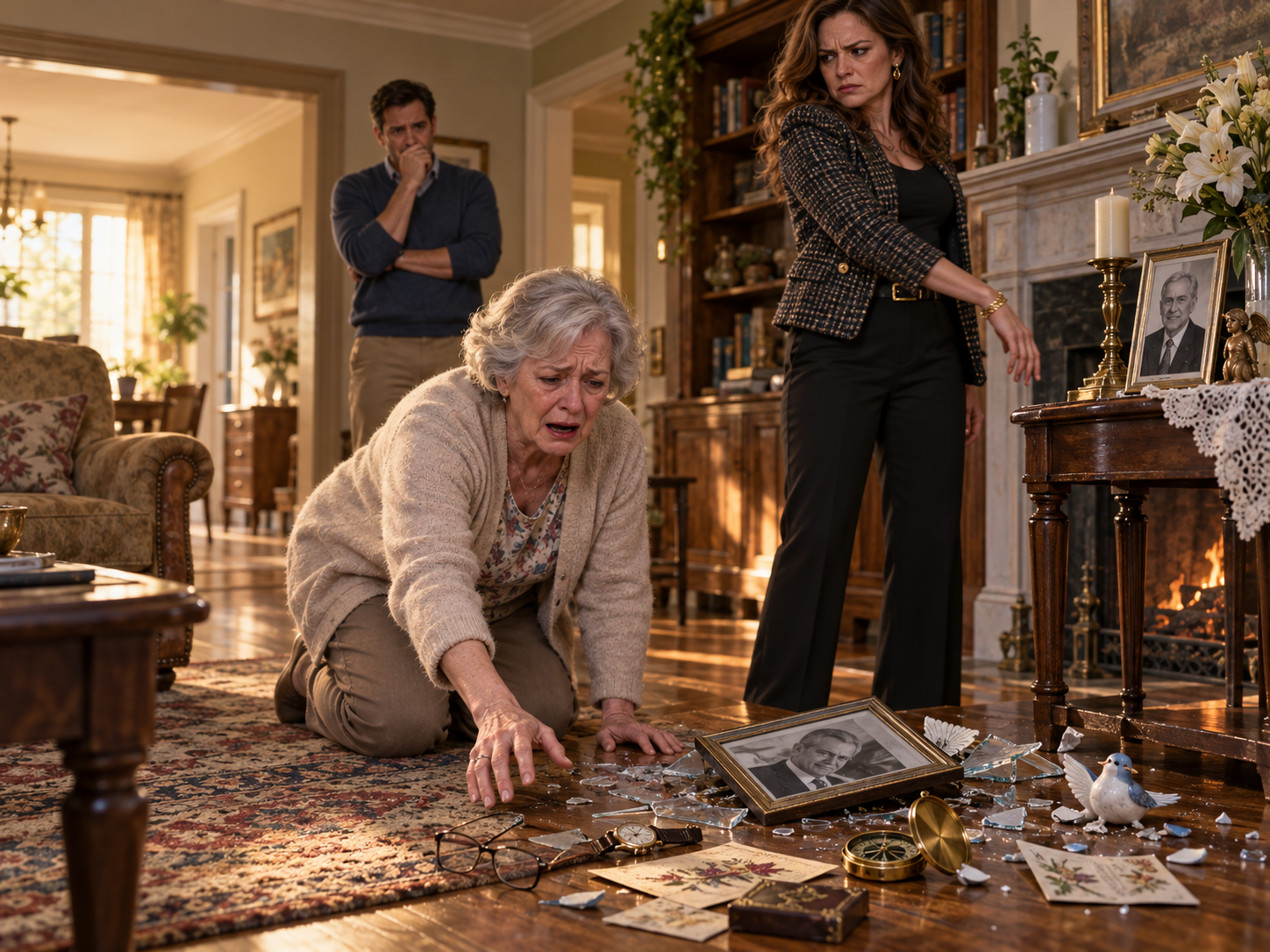
By the time the plate shattered at Emily’s feet, Claire Hale had already spent six months teaching herself not to scream.
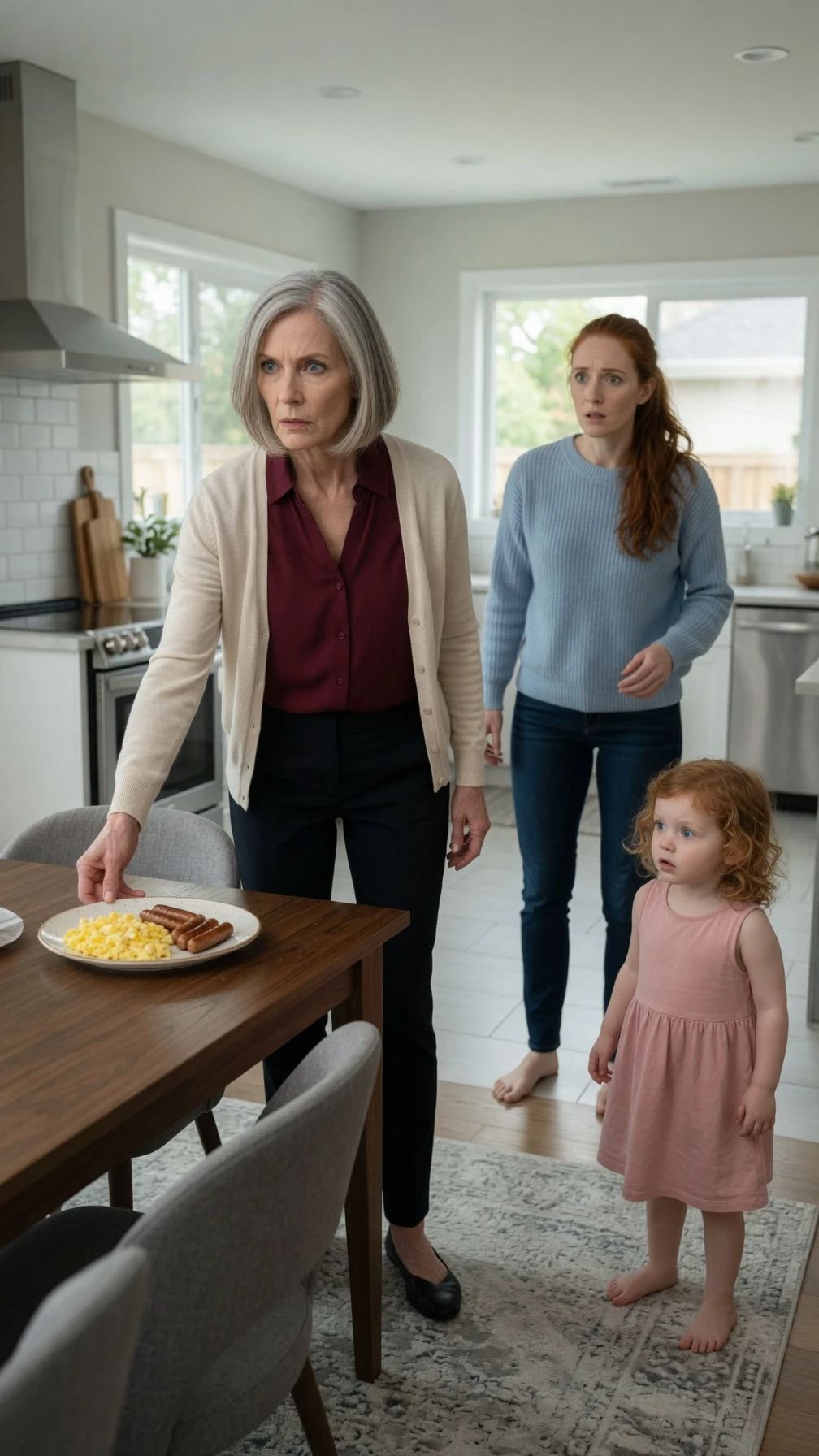
Scrambled eggs struck the pale rug in yellow clumps. Two small sausages rolled beneath the dining table, and a white porcelain plate broke into three jagged pieces less than a foot from the little girl’s bare toes. Emily stared down at the wreckage, too frightened to make a sound until Margaret Hale leaned over her and shouted, “Stop crying! You ruin everything!”
Then the child’s scream filled the house.
Claire stood frozen beside the kitchen island, one hand still wrapped around a dish towel. Morning sunlight poured through the wide windows and shone across the white cabinets, making the room appear peaceful and ordinary. That bright, cheerful light made Margaret’s rage seem even more monstrous.
Emily lifted both arms toward her mother.
“Mama!”
Claire moved before she realized she had dropped the towel. She crossed the kitchen in three strides, fell to her knees, and pulled her daughter against her chest. Emily buried her wet face against Claire’s neck, her little body trembling so violently that Claire could feel each sob against her ribs.
“Don’t move your feet, sweetheart,” Claire whispered. “There’s broken glass. Mama has you.”
She shifted Emily away from the plate and looked up at her mother-in-law.
Margaret stood beside the dining table in a cream cardigan and burgundy blouse, her silver-gray hair arranged in its usual perfect bob. At sixty-seven, she was still elegant enough to make strangers lower their voices around her. Only her eyes betrayed the cruelty beneath the polished surface.
“Don’t you ever speak to my daughter like that again,” Claire said.
Margaret’s expression hardened.
“This is my son’s house,” she replied, pointing one thin finger at Claire. “You will not tell me how to behave in it.”
The sentence fell into the room with the weight of something often repeated and deeply believed.
Claire held Emily tighter. “It is our home, and you just terrified a two-year-old.”
“She threw her breakfast.”
“She dropped her fork.”
“She has no discipline because you indulge every little fit.”
Emily’s crying grew louder.
Claire rose carefully, keeping the child on her hip. “You threw a plate at her feet.”
“I swept it off the table.”
“You knew she was standing there.”
Margaret opened her mouth, but the front door swung inward before she could answer.
A black suitcase rolled across the hardwood floor.
Daniel Hale stepped through the doorway in a light gray travel jacket, his dark hair rumpled from the road. His tired smile vanished the moment he saw the broken plate, the food scattered over the rug, and his daughter sobbing in Claire’s arms.
“What happened?” he asked.
Margaret answered so quickly that Claire almost admired the skill of it.
“Emily had one of her tantrums,” she said, softening her voice. “Claire became overwhelmed. I was trying to calm both of them.”
Claire stared at her.
The transformation was complete. Margaret’s shoulders had lowered, her face had become sorrowful, and the fury of thirty seconds earlier had disappeared beneath the mask of a concerned grandmother.
Daniel looked from his mother to his wife. “Claire?”
For a terrible moment, Claire saw the previous six months stretching before her like a long corridor with no doors.
Margaret criticizing her cooking when Daniel was away.
Margaret whispering that Emily was developmentally delayed.
Margaret rearranging the kitchen and then accusing Claire of forgetting where she had put things.
Margaret smiling warmly whenever Daniel entered the room.
Claire had tried to explain it before. Daniel always listened with the same troubled expression, then told her that his mother was lonely after his father’s death. He said Margaret could be difficult, but she meant well. He said Claire was tired and perhaps taking things too personally.
This time, Claire had proof.
She reached toward the kitchen counter and picked up her black smartphone.
“Good,” she said quietly. “You’re home.”
Margaret’s face lost its color.
Claire opened the recording and held the screen toward Daniel. “I recorded everything.”
Daniel stopped breathing for half a second.
Claire noticed because she knew the rhythm of his body after nine years of marriage. She knew the small twitch beside his mouth when he lied and the way his left hand tightened when he felt cornered. Now both happened at once.
He took the phone.
The video began with Margaret standing beside the table. Her voice burst from the speaker, sharp and unmistakable.
“Stop crying! You ruin everything!”
Daniel watched the plate strike the floor. He watched Emily recoil and Claire rush forward. His face changed gradually, shock giving way to something colder and more complicated.
“Mom,” he whispered. “What did you do?”
Margaret clasped her hands. “Daniel, it looks worse than it was.”
“It looks exactly like what happened,” Claire said.
Daniel did not answer. He dragged the video backward and played the final seconds again.
Claire expected him to focus on the plate.
Instead, his eyes moved toward the upper corner of the screen.
He enlarged the image.
In the video, above the kitchen doorway, a tiny red light blinked from the dark center of what appeared to be an ordinary smoke detector. The light was so faint that Claire had never noticed it.
Daniel looked up from the phone.
His gaze traveled slowly toward the real device mounted above the kitchen entrance.
For the first time since coming through the front door, genuine horror appeared on his face.
Margaret followed his eyes. “What is it?”
Daniel did not answer her.
He crossed the room, climbed onto a dining chair, and reached toward the smoke detector.
Claire stepped forward. “What are you doing?”
“It may be malfunctioning.”
“Then why are you afraid of it?”
“I’m not afraid.”
He twisted the round plastic cover. It came loose too easily, revealing a small black camera lens and a memory unit hidden inside.
The room became silent except for Emily’s uneven breathing.
Claire looked at Daniel. “Why is there a camera in our kitchen?”
Daniel climbed down from the chair, still holding her phone.
“I installed it after the break-in down the street,” he said. “I meant to tell you.”
“There was no break-in down the street.”
“There was an attempted break-in.”
“When?”
“A few months ago.”
“Which house?”
Daniel glanced at his mother.
It lasted less than a second, but Claire saw it.
Margaret saw it too.
Emily lifted her head from Claire’s shoulder and looked toward her father. Her cheeks were wet, and her small voice was hoarse from crying.
“Daddy was here.”
Daniel went still.
Claire kissed the child’s hair. “What did you say, sweetheart?”
Emily pointed toward the kitchen doorway.
“Daddy was there.”
Daniel’s fingers tightened around the phone.
Claire looked at the gray jacket he was wearing, then back toward the stainless-steel oven across the room. In the final seconds of her recording, the oven door had reflected a narrow strip of the kitchen entrance.
And in that reflection, barely visible behind the wall, was the sleeve of a light gray jacket.
Daniel had not just arrived.
He had been standing inside the house while his mother screamed at Emily.
He had watched the plate fall.
Then he had walked outside and entered again through the front door.
Claire felt something inside her break with far less noise than the porcelain plate, but with edges just as sharp.
PART TWO — THE HOUSE OF SMALL LIES
Daniel spent the next hour trying to turn the impossible into something ordinary.
He said he had entered through the garage because he needed to use the bathroom. He claimed he heard raised voices but did not understand what was happening. When Claire asked why he had gone outside and entered again through the front door, he said he had forgotten his suitcase in the car.
“You stood there and watched,” Claire said.
They were in the living room now. Emily had cried herself to sleep against Claire’s chest, one tiny hand still gripping the collar of her sweater. Margaret sat in an armchair with her back straight and her ankles crossed, as though she were waiting for an unpleasant business meeting to end.
“I saw only the last few seconds,” Daniel replied.
“Emily saw you.”
“She is two.”
“She knows her father.”
“She is upset and confused.”
Claire looked at him for a long moment. “You always have an explanation ready.”
Daniel’s face softened in the familiar way that once made her feel safe. He lowered his voice and reached for her arm.
“You’re exhausted,” he said. “Let me put Emily in bed. We can discuss this when everyone is calmer.”
Claire stepped away from his hand.
“How long has that camera been in my kitchen?”
“Our kitchen.”
“How long?”
“A few weeks.”
“Why didn’t you tell me?”
“I forgot.”
Margaret leaned forward. “Daniel has been under enormous pressure at work. You cannot interrogate him while he is standing in his own living room.”
Claire turned toward her. “You nearly put broken porcelain through your granddaughter’s feet.”
“I made a mistake.”
“You called her a burden.”
“I was frustrated.”
“You told her she ruined everything.”
Margaret’s mouth tightened. “You have spent months turning my son against me.”
Claire almost laughed.
It was the elegance of the accusation that struck her. Margaret could take any act of cruelty and rearrange it until she became the injured party. She did not deny what she had done; she merely insisted that Claire’s reaction was the greater offense.
Daniel placed Claire’s phone on the coffee table.
“We need space,” he said. “Mom, perhaps you should go home.”
Margaret stared at him. “You are sending me away?”
“For today.”
“After she secretly recorded me?”
“After you threw a plate beside Emily.”
Margaret’s eyes filled with tears so quickly that Claire wondered whether she had practiced in front of a mirror. She stood, collected her handbag, and paused beside Daniel.
“I hope you remember who stood beside you when no one else did,” she whispered.
Then she left.
Daniel waited until the front door closed before turning to Claire.
“You humiliated her.”
Claire stared at him. “That is what you took from this?”
“I said she was wrong.”
“You also lied about when you entered the house.”
“I panicked.”
“Why?”
“Because I knew how it would look.”
“It looked like you were hiding in the kitchen.”
“I was trying to understand what was happening.”
“You understood enough to leave and perform an entrance.”
Daniel rubbed both hands over his face. “Claire, please. I have been traveling since five this morning.”
She looked at the suitcase near the door. It appeared full, but there was no airline tag attached to the handle. Daniel usually left every tag in place until she cut it off because he complained that the plastic fasteners hurt his fingers.
“Which flight were you on?” she asked.
He lowered his hands. “What?”
“You said your flight was delayed until noon. Which flight brought you home at nine forty?”
“I changed it.”
“When?”
“Last night.”
“Why didn’t you tell me?”
“I wanted to surprise you.”
Claire nodded slowly. “You certainly did.”
That evening, after Daniel fell asleep in the guest room, Claire sat at the kitchen table with every light turned off except the one above the stove.
The hidden camera was gone.
Daniel had removed it and placed it in his locked office, saying he needed to check whether the device had captured anything useful. Claire had not argued because she no longer wanted him to know what she was thinking.
Instead, she opened the home security application on her tablet.
For years, Daniel had handled the passwords because he enjoyed technology and Claire did not. She knew only that their cameras, door sensors, and thermostat were connected through one family account. After three failed attempts, she entered the name of Daniel’s first dog followed by Emily’s birth year.
The account opened.
A list of devices appeared.
FRONT DOOR.
GARAGE.
BACK PATIO.
KITCHEN INTERIOR.
Claire stared at the final entry.
The kitchen camera had been activated four months earlier.
She touched the screen.
A calendar appeared, showing dozens of saved clips. Most were marked for automatic deletion after thirty days, but many had been manually preserved in folders with dates and labels.
KITCHEN MESS.
CLAIRE CRYING.
ARGUMENT WITH MARGARET.
MEDICATION INCIDENT.
Claire’s hands began to shake.
She opened the clip titled MEDICATION INCIDENT.
The recording showed Claire standing at the kitchen counter two months earlier, her face pale and unfocused. She was trying to pour orange juice but missed the glass, spilling it across the counter.
Daniel’s voice came from behind the camera.
“Claire, what are you doing?”
“I don’t know,” she heard herself say. “I feel strange.”
“You took something again, didn’t you?”
“No.”
“Your pills?”
“I don’t take pills.”
“You need help.”
Claire remembered that morning. She had awakened dizzy and confused after drinking tea Margaret had prepared the night before. Daniel had insisted she was suffering from anxiety and scheduled an appointment with a therapist.
The video ended before Daniel helped her to a chair.
Claire opened another clip.
Margaret stood alone in the kitchen, taking a small amber bottle from her handbag. She glanced toward the hallway, removed something from the bottle, and crushed it beneath a spoon.
Then Daniel entered.
“You used too much last time,” he said.
Margaret did not look surprised to see him. “She only slept.”
“She nearly fell down the stairs.”
“That gave you excellent photographs.”
Claire covered her mouth.
On the screen, Daniel opened the refrigerator and removed a pitcher of iced tea.
“She must look unstable,” he said. “Not poisoned.”
Margaret poured the powder into the pitcher and stirred it.
“How much longer?” she asked.
“Until Emily’s birthday.”
“And then?”
“The trust becomes fully accessible.”
Claire’s heart began to pound so hard that the room blurred around her.
Her grandmother had created a trust for Claire when she was young. Most of it had been protected until Claire turned forty or until her first child reached the age of three, whichever came later. Emily’s third birthday was six weeks away.
There was nearly five million dollars in that trust.
Daniel had always claimed the money did not matter to him.
On the recording, Margaret replaced the pitcher in the refrigerator.
“What happens after you have control?” she asked.
Daniel closed the refrigerator door.
“We file for emergency custody,” he replied. “With the videos, the medical records, and your statement, the court will believe she is a danger to Emily.”
“And Claire?”
“She goes somewhere she can get help.”
Margaret smiled faintly. “You mean somewhere she cannot interfere.”
Daniel did not correct her.
Claire watched the clip twice.
Then she downloaded every recording to a storage drive, uploaded copies to a private account Daniel did not know existed, and sent one message to the only person she trusted completely.
Ruth Bennett lived three houses away. She had been Claire’s grandmother’s closest friend and had worked for thirty-two years as a clerk in the county courthouse before retiring. At seventy-four, she had the patient eyes of someone who had spent a lifetime watching people lie under oath.
Claire’s message contained only six words.
I need help. Please come quietly.
Ruth arrived eleven minutes later wearing slippers beneath her raincoat, though there was no rain.
Claire opened the door before she knocked.
“What has happened?” Ruth asked.
Claire led her into the dark kitchen and played the recording.
Ruth did not interrupt. She did not gasp or place a hand over her mouth. She watched Daniel and Margaret discuss the plan, then asked Claire to play it again.
When it ended, Ruth turned toward her.
“Does Daniel know you can access these recordings?”
“No.”
“Does he know you saw the device list?”
“No.”
“Good.”
Claire looked toward the hallway. “I have to take Emily and leave.”
“You may need to,” Ruth said. “But not tonight.”
“They have been drugging me.”
“And they have been preparing to tell the world that you are irrational. If you disappear suddenly with the child, they will use it.”
Claire felt trapped. “Then what do I do?”
Ruth reached across the table and held both of Claire’s hands.
“You do what frightened women have always found hardest to do,” she said. “You stop reacting to the trap, and you let the people who built it believe it is still working.”
PART THREE — WHAT THE CAMERA REMEMBERED
The next morning, Claire made coffee for Daniel.
She smiled when he entered the kitchen, and the effort required more strength than anything she had ever done. He wore a blue shirt she had bought him for their anniversary, and for one disorienting moment, he looked like the man she had married.
“I’m sorry about yesterday,” she said.
Daniel studied her face. “You are?”
“I was frightened.”
“You had every right to be upset.”
“I shouldn’t have accused you of standing there deliberately.”
His shoulders loosened.
Claire understood then how badly he wanted her to doubt herself. Her apology did not trouble him; it comforted him. He walked behind her, placed both hands on her shoulders, and kissed the top of her head.
“I love you,” he whispered.
The words made her stomach turn.
“I love you too,” she replied.
Daniel poured coffee into his cup. “Mom feels terrible.”
“She should.”
“She wants to apologize.”
Claire kept her expression neutral. “Perhaps later.”
“She suggested dinner tomorrow night.”
“Here?”
“Yes. Just the four of us.”
Claire looked toward him. “Emily too?”
“Of course.”
The casual answer chilled her. Emily was not a person in Daniel’s plan. She was evidence, leverage, and the key that would unlock Claire’s inheritance.
“I’ll think about it,” Claire said.
While Daniel went to work, Ruth drove Claire and Emily to meet Sarah Kendall, an attorney who had known Claire’s grandmother. Sarah’s office occupied the second floor of an old brick building across from the courthouse. The furniture was worn, the bookshelves were crowded, and nothing in the room had been selected to impress anyone.
Sarah watched the kitchen recordings with the same disciplined silence Ruth had shown.
When the last clip ended, she removed her glasses.
“You are not going back to that house alone,” she said.
“My daughter’s things are there.”
“Things can be replaced.”
“I need more proof.”
“You already have conspiracy, financial motive, drugging, surveillance, and an attempt to manufacture evidence against you.”
“Will that be enough?”
“It is enough to begin. Whether it is enough to protect you quickly depends on what else they have done.”
Claire placed a folder on the desk. “There is more.”
The previous night, after Ruth left, Claire had entered Daniel’s office using the small emergency key hidden above the doorframe. Inside his locked filing cabinet, she found copies of medical notes, photographs of spilled food, and a draft petition requesting emergency custody of Emily.
The petition described Claire as paranoid, volatile, forgetful, and possibly dependent on prescription medication. It included statements supposedly made by neighbors and relatives, though Claire recognized none of the names.
Sarah turned the pages slowly.
“This was prepared three months ago,” she said.
“Before the worst incidents started.”
“Yes.”
Claire pointed to the final page. “That is not my signature.”
The document authorized Daniel to act on Claire’s behalf regarding the trust if she became medically incapacitated.
Sarah compared it to Claire’s signature on her identification.
“It is a good forgery,” she said. “But not good enough.”
Ruth sat beside Emily on the office rug, helping her arrange wooden blocks into a crooked tower. The little girl laughed when the tower fell, and the sound was so normal that Claire nearly wept.
Sarah closed the folder.
“We can request an emergency protective order today,” she said. “We can also notify the trustee and freeze all attempted transactions.”
“Will Daniel know?”
“Within hours.”
Claire looked out the window toward the courthouse. People crossed the street carrying coffee and briefcases, unaware that her entire marriage had just been reduced to evidence in a folder.
“I want him to believe I know nothing for one more day,” she said.
Sarah’s expression sharpened. “Why?”
“Because the camera recorded more than the clips he saved.”
The security system kept seventy-two hours of continuous backup footage before deleting it. Claire had downloaded everything from the previous three days.
One recording showed Daniel arriving through the garage at 9:12 on the morning of the plate incident. He stood in the kitchen with Margaret for twenty-six minutes before Claire entered.
Another showed Margaret asking, “Are you sure we should involve Emily?”
Daniel answered, “Claire will react faster if she thinks the child is threatened.”