I moved home three months after the kitchen incident.
Not because everything was healed.
Because enough had changed that I wanted to try.
Daniel never asked me to forget.
That mattered.
We changed the locks and kept them changed.
Margaret did not get a key.
She did not stay overnight.
Daniel stopped discussing our finances with her.
When she criticized me, he did not look at me and silently ask me to let it go.
He answered her himself.
Sometimes awkwardly.
Sometimes too late.
But he answered.
The first real test came at Christmas.
We had agreed to spend Christmas Eve with my family and Christmas afternoon with Margaret.
She did not like that.
For three weeks, she sent Daniel messages about tradition.
How Christmas morning had always belonged to them.
How lonely she would be.
How families should make sacrifices.
On December twenty-third, she called and said she had chest pain.
Daniel went white.
I saw the boy in him return instantly.
“Call 911,” I said.
He told her the same.
Margaret refused.
Said it wasn’t that serious.
Said she probably just needed company.
Daniel stood in our kitchen holding the phone.
I knew what she wanted.
So did he.
His hand shook.
“Mom, if you’re having chest pain, you need medical care.”
Pause.
“No, I’m not coming over instead of calling an ambulance.”
Another pause.
His face tightened.
“I love you too.”
Then:
“No.”
Another pause.
“I’m hanging up now. Call 911 if the pain continues.”
He ended the call.
For several seconds, neither of us spoke.
Then Daniel sat down.
“I feel horrible.”
“I know.”
“What if she really is sick?”
“Then she needs a doctor.”
He nodded.
Five minutes later, Margaret texted him that the pain had disappeared.
We both looked at the message.
Daniel laughed once.
It sounded exhausted.
Then he put the phone away.
It was not a triumphant moment.
That’s another thing stories get wrong about boundaries.
They rarely feel powerful when you first make them.
Often they feel cruel.
Especially if you were raised to believe another person's disappointment is an emergency.
But we went to my parents' house the next morning.
And Daniel survived.
So did Margaret.
The months became a year.
Our marriage changed.
Not back.
That version was gone.
At first I mourned it.
Then I realized some things deserve to stay gone.
I no longer wanted the marriage in which I protected Daniel from consequences.
He no longer wanted the marriage in which he made me responsible for keeping his mother calm.
We argued more openly.
Strangely, we trusted each other more.
Because now disagreement did not automatically mean disaster.
Sometimes I said no.
Sometimes Daniel disappointed me.
Sometimes I disappointed him.
And neither of us disappeared.
Margaret remained part of our lives.
Less than before.
More carefully.
She never fully accepted that I had not “taken” Daniel from her.
But over time, she learned that pushing harder made him step back.
So she pushed less.
Not transformation.
Adaptation.
I learned to accept the difference.
Two years after the incident, Margaret and I were alone together for the first time since the café.
It happened at Daniel’s cousin's wedding.
The reception was held at a vineyard outside Charlottesville.
Daniel had gone to help his uncle carry gifts to a car.
I stood near the edge of the patio with a glass of water.
Margaret approached.
For a moment, I considered leaving.
Then I stayed.
She stood beside me.
“You look nice,” she said.
“Thank you.”
Silence.
Music drifted from inside.
A couple laughed near the lawn.
Margaret touched her necklace.
“I've wanted to ask you something.”
I waited.
“Do you still hate me?”
The question surprised me.
“I never hated you.”
She looked skeptical.
“I was furious with you.”
“Were?”
I thought about it.
“I’m not furious anymore.”
Her eyes dropped.
“I think about that night.”
“So do I.”
“I hardly recognize myself.”
I looked at her.
She gave a small, bitter smile.
“I suppose that’s convenient to say.”
“Yes.”
She nodded.
“At least you're honest.”
We stood in silence.
Then she said, “Daniel told me something last month.”
I tensed.
“He said he used to be afraid I would stop loving him if he disappointed me.”
I didn’t respond.
Margaret stared toward the vineyard.
“I never stopped loving him.”
“I believe you.”
Her eyes filled.
“Then why would he think that?”
There were a hundred answers.
None of them belonged to me.
“You should ask Daniel.”
She sighed.
“He says I punished him with silence.”
“Did you?”
She looked down.
“Yes.”
I waited.
“I thought I was giving myself time.”
“Maybe sometimes you were.”
“And sometimes?”
I looked at her.
“Sometimes I think you wanted him to feel what losing your approval was like.”
Margaret closed her eyes.
When she opened them, she did not argue.
That was new.
“I was very alone after his father left,” she said.
“I know.”
“Daniel became everything.”
“I know.”
“That sounds unhealthy when I say it now.”
“It was a lot to put on a child.”
Her face tightened.
“I did the best I could.”
“I believe that too.”
She looked at me sharply.
I meant it.
Doing your best does not mean you did no harm.
Loving someone does not mean you loved them well.
Margaret had taught me that.
Daniel had too.
So had I.
After a moment, Margaret whispered, “I am sorry.”
I did not ask which thing she meant.
Maybe that was why I believed her.
No speech.
No bargain.
No request.
Just sorrow.
I nodded.
“Thank you.”
Daniel returned a few minutes later.
His eyes moved between us.
“Everything okay?”
Margaret looked at him.
Then at me.
“Yes,” she said.
And for once, she did not make me responsible for proving it.
She walked back inside.
Daniel came to stand beside me.
“What was that about?”
“She asked if I hated her.”
He stiffened.
“What did you say?”
“That I don't.”
He studied my face.
“Do you?”
“No.”
“You forgive her?”
I watched Margaret disappear through the reception doors.
“Some days.”
Daniel smiled faintly.
“That sounds familiar.”
I slipped my hand into his.
There was a time when forgiveness meant returning everything to its original place.
Now I understood it differently.
Forgiveness could mean putting down the weight without reopening the door.
It could mean loving someone from farther away.
It could mean refusing to keep punishing them while still remembering what they were capable of.
It could mean staying.
It could mean leaving.
Most of all, it did not mean pretending.
Daniel squeezed my hand.
I looked at him.
There were lines beside his eyes that had not been there when we married.
He had changed.
So had I.
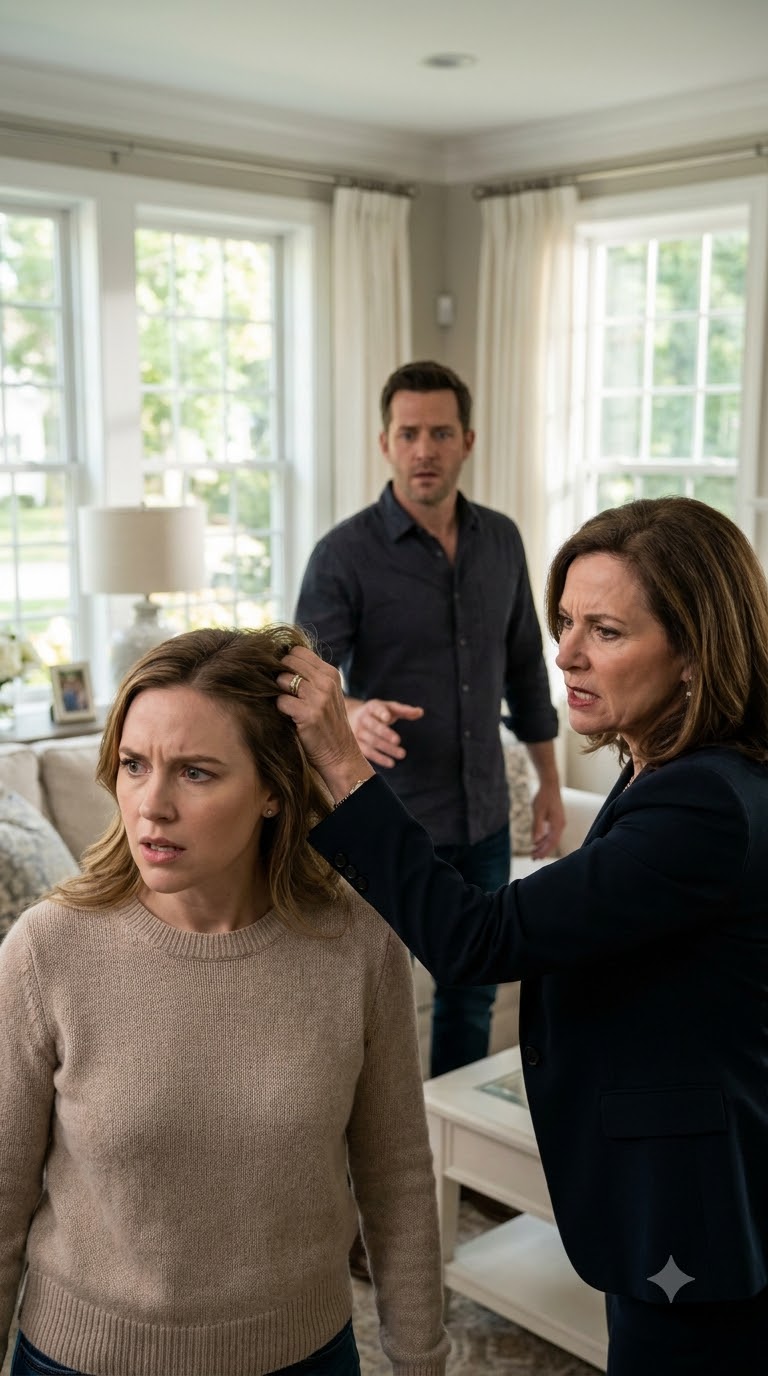
Sometimes I still thought about the seven seconds.
I remembered the pressure against my scalp.
Margaret's face.
Daniel standing across the kitchen.
One.
Two.
Three.
Four.
Five.
Six.
Seven.
For a long time, I believed our marriage had almost ended in those seconds.
Eventually I understood something different.
Those seven seconds had only exposed a marriage that had already been quietly bending around the same problem for years.
I had mistaken silence for peace.
Daniel had mistaken appeasement for love.
Margaret had mistaken access for closeness.
It took one ugly moment to make all three lies impossible to maintain.
People sometimes ask why I stayed with Daniel.
Usually they don’t say it directly.
They ask gentler questions.
“Were you ever able to trust him again?”
“Did you ever get over it?”
“What would you do if it happened now?”
The last one is easiest.
If anyone ever put their hands on me again, Daniel would not wait seven seconds.
I know that not because he promised me.
Promises are easy.
I know because I have watched him practice making the harder choice in a hundred smaller moments.
Every time Margaret says something cruel and he answers instead of looking at me.
Every time she cries and he lets her feelings belong to her.
Every time he disagrees with me and remains present instead of shutting down.
Every time I say, “That hurt me,” and he does not immediately explain why he didn’t mean to.
Trust did not return as one grand gesture.
It returned in seconds.
One at a time.
A year after I came home, Daniel and I were cooking dinner together when he dropped a bowl.
It shattered across the tile.
He cursed.
I laughed.
He looked at me.
“What?”
“You look terrified.”
“I liked that bowl.”
“It was twelve dollars.”
“It was our good bowl.”
“We have six identical bowls.”
“Five now.”
I laughed harder.
Then the doorbell rang.
Daniel froze.
We were not expecting anyone.
He checked the camera on his phone.
His face changed.
“Mom.”
I stopped laughing.
Margaret knew the rule.
No unannounced visits.
“What does she want?”
“No idea.”
He walked toward the door.
Old fear stirred in me.
Not because Margaret might grab me again.
Because I remembered the man who used to open doors simply because his mother stood behind them.
Daniel looked through the glass.
Margaret rang again.
Then knocked.
“Daniel?”
He did not open it.
He called through the door.
“Mom, you need to call before coming over.”
“I was nearby.”
“We’ve talked about this.”
“I only need five minutes.”
“Then call me tomorrow.”
There was silence outside.
“Are you seriously leaving your mother standing on the porch?”
Daniel closed his eyes.
I knew that sentence hurt him.
Maybe it always would.
He took a breath.
“Yes.”
Another silence.
Then footsteps moved away.
A car door slammed.
Daniel remained by the entrance.
I approached.
“You okay?”
“No.”
I took his hand.
“But you did it.”
He looked at me.
“Yes.”
There had been no dramatic confrontation.
No shouting.
No victorious speech.
Just a closed door.
Sometimes healing looks disappointingly ordinary.
That night, after dinner, we sat on the couch watching a terrible movie.
Halfway through, Daniel paused it.
“What?”
He looked at me.
“I’ve been thinking about something.”
“That sounds dangerous.”
He smiled.
Then grew serious.
“The night Mom grabbed you…”
My body tensed automatically.
He noticed.
“Sorry.”
“It’s okay.”
“No, I just—”
He rubbed his thumb along my hand.
“I keep wondering what would have happened if you hadn’t left.”
“What do you mean?”
“If you had stayed that night. If you’d accepted my apology. If we’d all gone to bed and pretended it was one terrible fight.”
I thought about it.
“We would have broken eventually.”
“You think?”
“Yes.”
“Why?”
“Because I would’ve hated you.”
The words surprised both of us.
But they were true.
“Maybe not immediately,” I said. “Maybe I would’ve told myself I understood. Maybe you would’ve been extra kind for a few weeks. Margaret would’ve behaved. Then something else would happen.”
Daniel nodded slowly.
“And eventually I would’ve hated you for all the things I said were fine.”
His eyes filled.
“I’m glad you left.”
I looked at him.
“That’s a strange thing to say.”
“I know.”
He smiled sadly.
“But I am.”
I rested my head against his shoulder.
“I’m glad you came after me.”
“I almost came inside without asking.”
I lifted my head.
“What?”
“At Nora's.”
He laughed softly.
“I got out of the car. Walked halfway to the building. Then I thought, if I walk in because I need to see her, I’m doing the same thing again.”
“Making your feelings my responsibility.”
“Exactly.”
I smiled.
“So I went back to the car.”
“And texted me.”
“Yes.”
“That was smart.”
“Therapy costs me a lot of money. I need to get something from it.”
I laughed.
He kissed my forehead.
The movie remained paused.
Outside, rain tapped against the windows.
The house felt quiet.
Not the silence Margaret used as punishment.
Not the silence Daniel once used to avoid conflict.
A different kind.
Safe.
I realized then that I no longer thought about our home as the place where Margaret grabbed my hair.
It had become the place where Daniel learned to close the door.
That mattered.
Years later, I would still remember every second.
The first, when I thought he hadn’t seen.
The second, when I realized he had.
The third, when his eyes went to his mother.
The fourth, when I saw his fear.
The fifth, when I stopped waiting.
The sixth, when something inside me went quiet.
The seventh, when he finally said, “Mom. Stop.”
But there was an eighth second too.
I hadn't understood its importance then.
The moment after Margaret let go.
The moment I looked at my husband and realized I had a choice.
I could keep explaining away what hurt.
Keep being reasonable.
Keep absorbing other people's fear so they would never have to feel the consequences of it.
Or I could leave the room.
Leave the house.
Risk the marriage.
And force the truth into the open.
So I did.
Margaret’s worst mistake was grabbing my hair.
Daniel’s was waiting seven seconds.
Mine had been believing love meant I had to make both of those things easier to forgive.
I don't believe that anymore.
Love can be patient.
Love can be compassionate.
Love can understand why someone became the person they are.
But love without boundaries becomes permission.
And forgiveness without change becomes an invitation.
Daniel learned that fear was not an excuse.
Margaret learned that motherhood did not guarantee access.
And I learned that being the reasonable one did not mean being the person everyone was allowed to hurt.
Those seven seconds nearly destroyed my marriage.
Instead, they ended the version of it that needed to die.
What came after was harder.
Messier.
Less romantic.
And far more real.
Because the man beside me now is not the man who promises he would protect me if something terrible happened.
He is the man who finally understands that protecting a marriage happens long before anyone raises a hand.
It happens in the small moments.
The uncomfortable ones.
The moments when saying no disappoints someone you love.
The moments when silence would be easier.
The moments when you have only a second to decide who you are going to be.
And now, when those moments come, Daniel does not wait for seven.