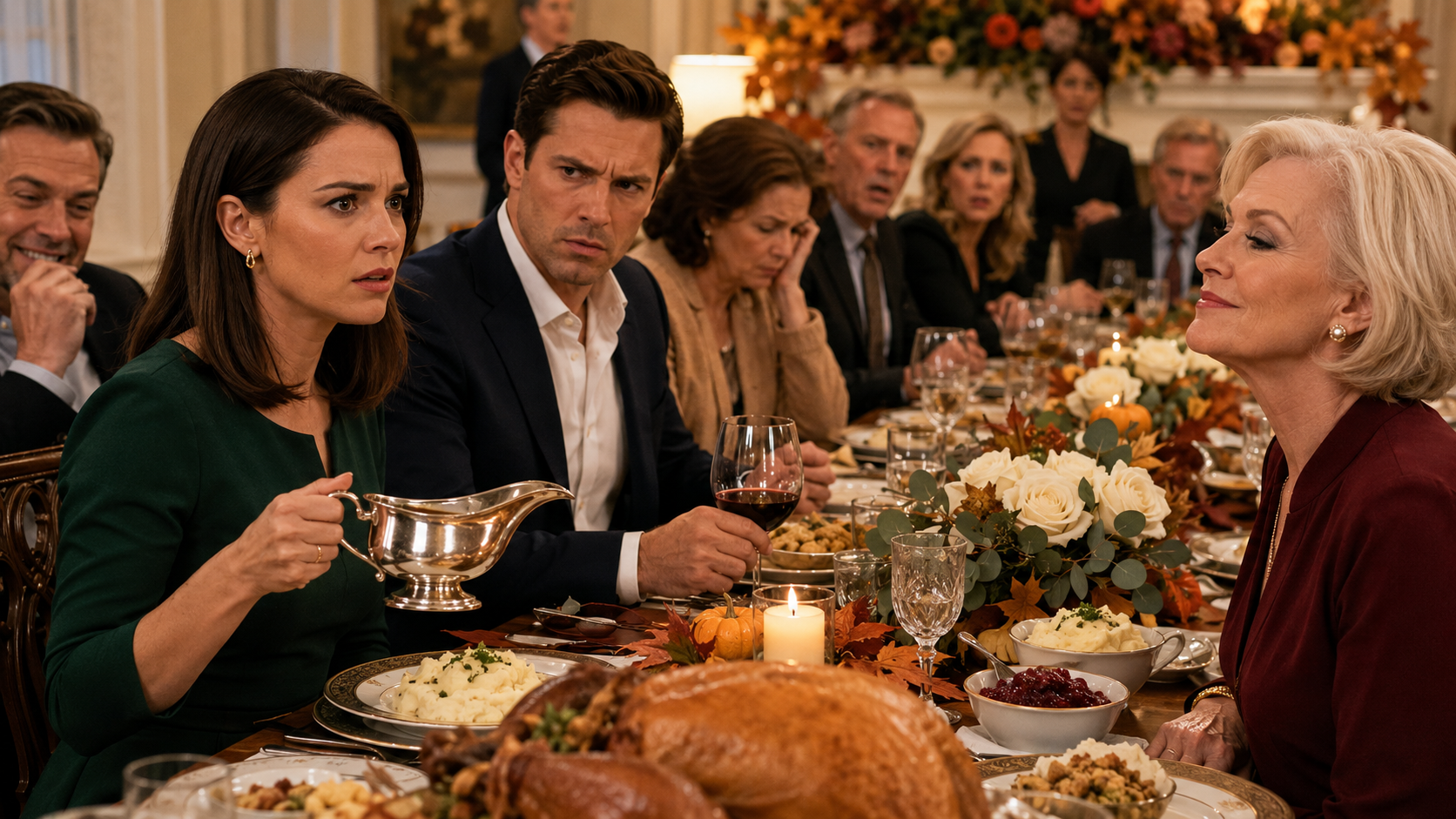
We didn't leave immediately.
Part of me wanted to.
I wanted my coat, my shoes and the cold November air.
I wanted the safety of our car.
I wanted to go home and put on sweatpants and pretend none of it had happened.
But leaving at that moment would have made it too easy for the Whitmores.
They could have waited until the front door closed.
Then rewritten the evening.
Emily overreacted.
Emily embarrassed Lorraine.
Emily made everything about money.
Emily ruined Thanksgiving.
I knew how family stories worked.
The person who left first often lost control of the version told afterward.
So I sat back down.
That surprised everyone more than if I'd stormed out.
Daniel sat beside me.
Lorraine remained standing near the doorway to the kitchen.
I could see a red flush spreading from her neck toward her jaw.
George finally put down the carving knife.
"Maybe we should all take a moment."
"No," I said.
His eyes moved to me.
I kept my voice steady.
"I've taken four years of moments."
That made Melissa look down.
She knew.
Of everyone there, Melissa probably knew best.
She had apologized for her mother more times than I could count.
After Christmas comments.
After birthday comments.
After Lorraine asked whether Daniel and I had a prenup "for his protection."
After she announced at our anniversary dinner that I was "very lucky Daniel wasn't the type of man to expect a wife to contribute equally."
Melissa always found me afterward.
In hallways.
In kitchens.
By the coat closet.
"She doesn't mean it."
"She's from a different generation."
"She gets protective of Daniel."
"I'm sorry."
I had always accepted those apologies.
Now I realized how strange that was.
Melissa wasn't the person who owed them.
She looked at her mother.
"Mom, you need to apologize."
Lorraine stared at her.
"Excuse me?"
"You heard me."
"Do not speak to me like I'm a child."
"Then don't act like one."
"Melissa."
"No."
Melissa pushed her chair back.
Her face was red, but she kept going.
"You've been awful to Emily for years."
Lorraine looked around as if someone would intervene.
Nobody did.
"You've made comments about her clothes, her family, her job. You even told me you thought she married Daniel because she wanted his lifestyle."
I felt a dull ache under my ribs.
Hearing it confirmed was worse than suspecting it.
Daniel turned toward his sister.
"She said that?"
Melissa looked guilty.
"More than once."
Daniel's face went hard.
Lorraine snapped, "Because I was concerned!"
"About what?" I asked.
She turned toward me.
I expected another attack.
Instead, something more complicated came out.
"You came from nowhere."
The sentence landed softly.
Almost gently.
That made it uglier.
My throat tightened.
"Mom," Daniel said.
But I kept my eyes on Lorraine.
"What does that mean?"
She exhaled impatiently.
"You know exactly what I mean. Daniel had built a certain life."
"And I didn't belong in it?"
"I didn't say that."
"You just did."
Lorraine pressed her lips together.
The truth was simple now.
She had looked at me and decided my background was evidence.
My father's grease-stained work shirts.
My mother's modest paycheck.
My state university degree.
My old car.
None of that embarrassed me.
It never had.
My father had fixed cars for thirty years and could diagnose an engine problem by sound.
My mother had raised me after he died and somehow kept us from losing the house.
I had learned more about money from watching her stretch a paycheck than I learned in any economics class.
Lorraine believed I had come from nowhere.
I believed I had come from people who taught me how to survive.
"You never asked," I said.
Her eyebrows drew together.
"Asked what?"
"Anything."
She stared at me.
"You never asked how I built my company. You never asked why I work the hours I do. You never asked what my parents taught me. You never asked what Daniel and I actually wanted from our life."
I swallowed.
"You just looked at what I didn't have when I met your son and filled in the rest."
Lorraine's expression hardened again.
"Well, perhaps if you'd been more forthcoming—"
I laughed.
The sound surprised me.
"I told you."
"What?"
"I told you what I do. At least six times."
"I knew you worked."
"You called it my little business."
Patricia looked down at her plate.
Lorraine said nothing.
"You once asked Daniel whether I planned to get a real job when we had children."
"I didn't mean—"
"You did."
The room felt very still.
My anger wasn't hot anymore.
It was clean.
That was the strange thing.
For years, Lorraine's comments had left me questioning myself.
Was I too sensitive?
Was I misunderstanding her?
Had she meant something else?
Now I could finally see the pattern without trying to make it prettier.
Daniel reached for my hand.
I let him take it.
Then I turned to him.
"And you."
His fingers tightened around mine.
He already knew.
I could see it.
"I should have corrected her," he said.
"Yes."
No softening.
No rescue.
Just yes.
His eyes dropped.
"I was ashamed."
"I know."
"When I lost the job, I felt like everything she'd always said about me suddenly wasn't true."
My anger toward him was different.
It hurt because I understood it.
That didn't make it harmless.
He rubbed his thumb over my knuckles.
"Every time she praised me for taking care of you, I knew I should say something."
I waited.
"But I liked hearing it."
The honesty stunned the table.
He looked at me.
"I hated myself for liking it. But I did."
My eyes burned.
He continued.
"I felt useless at home. You were covering the mortgage. You were working. You were telling me I had time to figure out what I wanted to do next. And then I'd call Mom, and she'd tell me I was this successful son who had everything under control."