PART ONE — THE MEDALS IN THE MUD
The first medal struck the muddy water with such a small splash that Walter Hayes almost laughed at the unfairness of it.
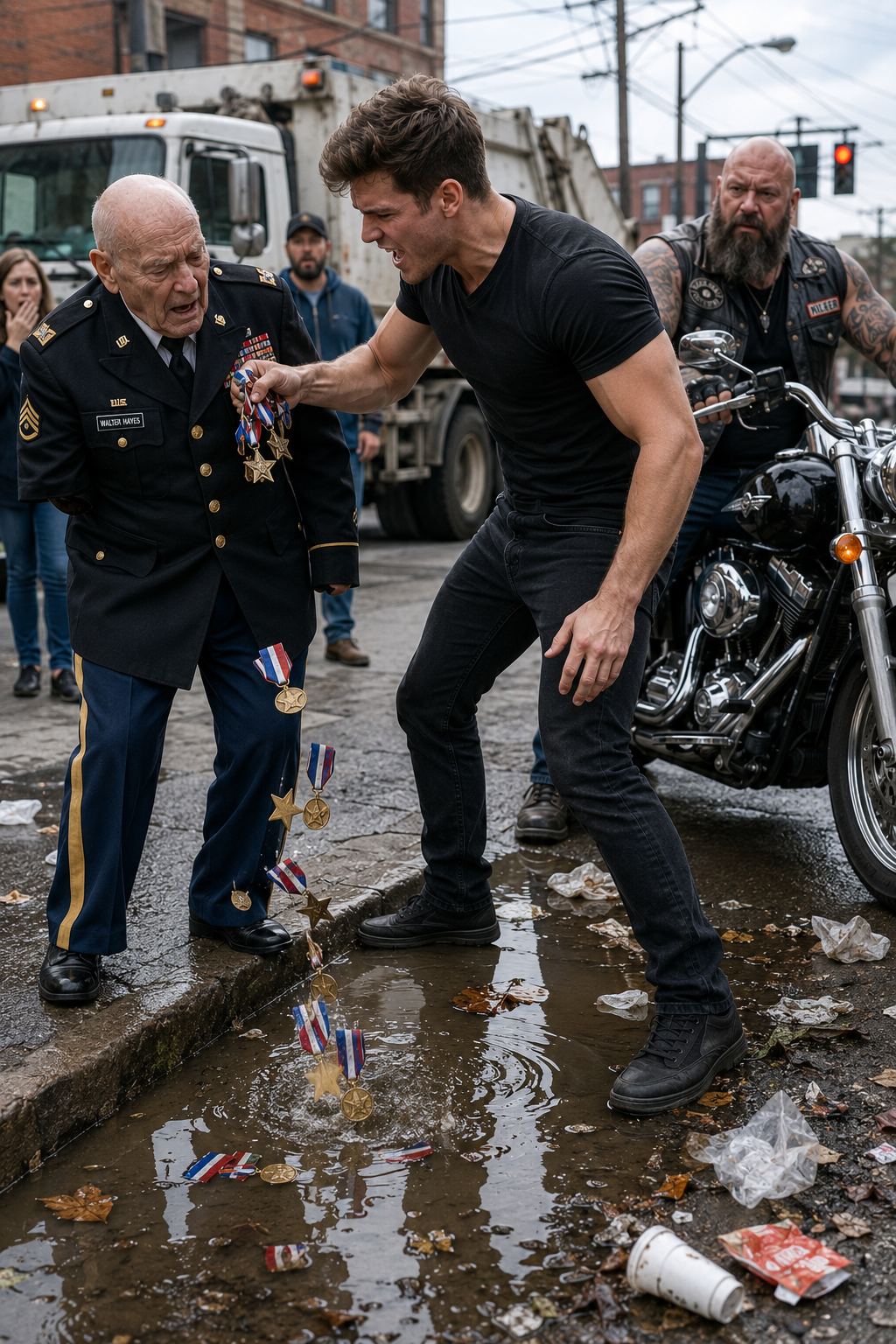
Something that had cost men their blood, their youth, and in some cases their lives disappeared beneath brown street water without ceremony. Around it floated a crushed coffee cup, a cigarette package, three wet leaves, and a plastic grocery bag tangled against the curb.
The young man standing above him laughed loudly enough for everyone at the intersection to hear.
Walter did not.
At eighty-one, Walter had learned that silence could carry more weight than shouting.
He stood beneath the gray afternoon sky in his dark Army dress uniform, one polished shoe inches from the filthy puddle. His back had begun to bend with age, and the empty left sleeve of his jacket had been neatly pinned against his side. Across his chest remained several ribbons and decorations, though three places were now painfully bare.
The young man held another medal between two fingers.
“Want this one too, Grandpa?”
Walter looked at him.
The boy—though he was probably twenty-five—was tall and broad through the shoulders. He wore a tight black T-shirt, dark jeans, and an expression of careless superiority that Walter had seen before in men much more dangerous than this one.
“My name isn’t Grandpa,” Walter said.
The young man smirked.
“What is it?”
“Walter.”
“Walter.” He repeated it mockingly. “Okay, Walter. You really wore all this stuff outside expecting nobody to ask questions?”
“I was going to a ceremony.”
“A costume party?”
A woman near the crosswalk turned.
Walter noticed her expression.
So did the young man.
That seemed to encourage him.
Walter’s nameplate gleamed faintly above his right breast pocket.
W. HAYES.
The young man leaned closer.
“These even real?”
“Every one.”
“What’d you do?”
Walter’s eyes moved briefly toward the medal in his hand.
“I came home.”
“That’s it?”
“No.”
Walter paused.
“Some other men didn’t.”
The smile should have disappeared.
Instead, the young man laughed.
He reached toward Walter’s chest again.
Walter raised his remaining hand.
“Don’t.”
The young man stopped for perhaps half a second.
Then he pulled another medal free.
Walter heard the stitching strain.
The sound hurt more than he expected.
“Give it back.”
“What’s so special about it?”
Walter stared at him.
“Someone better than you died while I was earning it.”
The intersection seemed quieter.
Cars still moved.
A delivery truck still groaned through the light.
But several people were watching now.
The young man glanced toward them, perhaps realizing he had an audience.
He grinned.
Then he looked toward the puddle.
Walter followed his gaze.
“No.”
The young man raised an eyebrow.
For the first time, Walter allowed desperation into his voice.
“Please.”
The medal fell.
It spun once in the air, struck the broken edge of the curb, and dropped into the brown water.
The young man burst out laughing.
Walter stared down.
One of the medals remained visible beneath a thin film of grime.
Another, a small bronze star hanging from a red-white-blue ribbon, rested beside a soaked fast-food wrapper.
His mind left the street.
For an instant he was twenty-six again.
Rain crashed through jungle leaves.
Gunfire cracked from the tree line.
A young soldier screamed his name.
“Hayes!”
Walter smelled smoke.
He felt hot blood running across both hands.
Then a horn sounded at the intersection.
He was eighty-one again.
The young man stood over him.
“You want them?” he said.
Walter looked up.
“Go get them.”
Walter’s jaw tightened.
He had spent decades learning to live with pity.
Strangers opened doors for him.
Children stared at the pinned sleeve.
People lowered their voices when they noticed the medals.
He disliked all of it.
But this was something different.
This was deliberate.
The young man had chosen humiliation because he believed Walter could do nothing about it.
Walter bent toward the puddle.
His right knee protested immediately.
He placed his hand against the curb and lowered himself slowly.
A woman stepped forward.
“Sir, let me help.”
Walter shook his head.
“I’ve got it.”
“You don’t have to—”
“I said I’ve got it.”
His voice was not angry.
Only stubborn.
He lowered one knee to the pavement.
Then the other.
His dress trousers darkened where they touched the wet concrete.
Behind him, the young man laughed.
“Careful, hero.”
Walter reached into the puddle.
His fingers brushed a ribbon.
Not enough.
He leaned farther.
Pain shot through his hip.
Another memory rose.
A boy named Jimmy Donnelly lying beneath a broken tree.
Nineteen years old.
Freckles across his nose.
Wedding ring only three weeks old.
Walter shoved the memory down.
Not here.
Not now.
His fingers finally closed around the ribbon.
Then a deep engine growled behind him.
The sound rolled between the brick buildings.
Walter barely noticed.
The motorcycle slowed.
The young man did.
His laughter faded.
A massive black-and-chrome cruiser pulled toward the curb.
The rider was enormous.
Bald.
Broad as a door.
A thick dark beard streaked with gray covered his jaw, and tattooed arms extended from a sleeveless black leather vest.
He looked like the kind of man strangers moved away from instinctively.
The biker saw Walter.
Then the puddle.
Then the medals.
Finally, he saw the young man.
The motorcycle stopped.
The engine died.
The sudden silence felt unnatural.
The biker stepped down.
“What happened?”
The young man shrugged.
“Nothing.”
The woman by the crosswalk spoke before Walter could.
“He ripped that veteran’s medals off and threw them in the water.”
The biker looked at the young man.
“You do that?”
“Mind your own business.”
The biker’s expression did not change.
He started walking.
The young man’s grin returned, but it was weaker now.
“What? You gonna play tough guy?”
The biker kept coming.
“Hey, man. This has nothing to do with you.”
Three steps.
Then two.
Then one.
The biker’s massive hand closed around the back of the young man’s shirt.
“What the—”
The young man was jerked backward.
His confidence vanished instantly.
“Let go!”
The biker turned him toward the puddle.
“You thought it was funny?”
“I was joking!”
“That old man laughing?”
The young man struggled.
Walter looked up.
“Enough.”
The biker stopped.
For several seconds, no one moved.
Walter slowly pulled himself upright against the curb.
“Don’t hurt him.”
The biker looked at him.
“He threw your medals into sewage.”
“I noticed.”
“You want me to let him go?”
Walter glanced at the frightened young man.
“Yes.”
The biker’s jaw worked.
Then Walter added, “After he picks them up.”
The biker looked down at the young man.
A faint smile appeared beneath his beard.
“You heard him.”
The young man stared at the puddle.
“You’ve got to be kidding.”
The biker tightened his grip.
“Does he look like he’s kidding?”
A minute earlier, the young man had ordered an eighty-one-year-old amputee onto his knees.
Now he lowered himself slowly toward the same dirty water.
His hands touched the pavement.
His jeans darkened at the knees.
“Pick them up,” the biker said.
The young man reached into the puddle.
Walter watched.
He expected satisfaction.
Instead, he felt tired.
Then the biker suddenly crouched beside the water.
Something had caught his attention.
One of the medals lay partly submerged near the curb.
He picked it up carefully.
Mud ran across his fingers.
He wiped the metal with his thumb.
His face changed.
Walter noticed.
“What is it?”
The biker turned the medal over.
On the back were several tiny engraved words.
The biker stared at them.
Then he looked at Walter’s nameplate.
W. HAYES.
His face went pale.
“Your name is Walter Hayes?”
Walter frowned.
“Yes.”
The biker stood slowly.
For the first time, the intimidating man looked almost frightened.
“My God.”
Walter’s stomach tightened.
“What?”
The biker held the medal as though it were something sacred.
“My father spent forty-eight years looking for you.”
PART TWO — THE NAME FROM THE WAR
The biker’s name was Raymond Donnelly.
Walter learned that twenty minutes later while sitting in the back of an ambulance, refusing for the third time to be taken to the hospital.
“You’re eighty-one,” the paramedic told him.
“I know. I was there for most of it.”
“You fell on concrete.”
“I’ve fallen on worse.”
Raymond stood nearby with his arms crossed.
“You’re stubborn.”
Walter looked at him.
“You’ve known me twelve minutes.”
“Long enough.”
The police had arrived quickly.
The young man identified himself as Derek Cole.
He insisted he had been joking.
The witnesses disagreed.
One woman had recorded almost everything.
When an officer asked Walter whether he wanted charges filed, Walter said only, “I want him to understand what he did.”
The officer nodded.
“That’s admirable, sir, but the district attorney may have opinions of his own.”
Derek sat on the curb twenty feet away.
He looked younger now.
Without the grin, he was simply a frightened man who had finally encountered a boundary that did not move for him.
Walter turned back to Raymond.
“You said your father knew me.”
Raymond nodded.
“James Donnelly.”
Walter’s chest tightened.
“Jimmy?”
Raymond stopped breathing for a moment.
“You called him Jimmy?”
Walter stared toward the street.
Gray clouds hung low over the buildings.
“Yes.”
Raymond slowly sat on the ambulance bumper.
“My father was in Vietnam.”
“I know.”
“He never talked about it.”
“Most of us didn’t.”
“He talked about you.”
Walter looked at him sharply.
Raymond reached into his vest and removed an old photograph sealed in plastic.
The image showed four young soldiers standing beside a helicopter.
Walter recognized himself immediately.
Twenty-six years old.
Two arms.
Lean face.
No gray hair.
Beside him stood Jimmy Donnelly.
Freckles.
Crooked smile.
Walter’s throat closed.
“Where did you get this?”
“My father.”
Walter stared.
“That’s impossible.”
“Why?”
Walter looked at Raymond.
“Because Jimmy died.”
Raymond said nothing.
Walter’s voice lowered.
“I watched him die.”
Raymond’s expression changed.
“No.”
“Yes.”
“My father came home.”
Walter shook his head.
“No.”
Raymond handed him the photograph.
On the back were four names.
WALTER HAYES
JAMES DONNELLY
FRANK MORAN
THOMAS VANCE
Walter stared at them.
Thomas Vance.
A name he had spent half a century avoiding.
Raymond spoke carefully.
“My father’s full name was James Patrick Donnelly. He came home in 1972. He died six years ago.”
Walter looked at him as though he had begun speaking another language.
“That can’t be.”
“He had scars across his chest and left leg. Lost most of his hearing in one ear.”
Walter’s hand began trembling.
“Jimmy was hit in the stomach.”
“I know.”
“He stopped breathing.”
Raymond leaned closer.
“He told me you carried him nearly half a mile.”
Walter shut his eyes.
The jungle returned.
Jimmy bleeding against him.
“Don’t leave me, Walt.”
“I’m not leaving you.”
“Tell Marie…”
“You’ll tell her.”
“I can’t feel my legs.”
“You’re going home, Jimmy.”
Walter remembered reaching the evacuation point.
Remembered laying Jimmy beside another wounded soldier.
Remembered an explosion.
Remembered darkness.
Then a hospital.
Doctors telling him Jimmy had died before extraction.
Raymond spoke.
“He didn’t die.”
Walter opened his eyes.
“Then why was I told he did?”
“I was hoping you could tell me.”
Walter had no answer.
Raymond looked at the medal he had recovered from the puddle.
“What is this one?”
Walter took it.
The Distinguished Service Cross.
He had rarely worn it.
“You were awarded that for saving my father?”
Walter swallowed.
“For trying.”
Raymond shook his head.
“He said you succeeded.”
Walter stared at him.
For fifty-five years he had believed Jimmy Donnelly was among the men he had failed.
A ghost he carried.
A name he spoke only in dreams.
“He lived.”
Raymond smiled sadly.
“He had three children. Nine grandchildren. Two great-grandchildren before he died.”
Walter covered his mouth.
People moved around them.
Police radios crackled.
Cars passed.
None of it mattered.
“He lived.”
Raymond nodded.
“He lived because of you.”
Walter began to cry.
There was no dignity in it.
No attempt to hide.
An eighty-one-year-old man sat beneath a gray sky and cried for a nineteen-year-old soldier he had mourned for more than half a century.
Raymond placed one huge hand on his shoulder.
“My father wanted to find you.”
“Why didn’t he?”
“He tried.”
Walter looked at him.
“For how long?”
“Forty-eight years.”
Walter laughed through tears.
“I wasn’t hiding.”
“According to him, you were.”
Walter frowned.
Raymond pulled another item from his vest.
A folded letter.
“He wrote this before he died.”
Walter unfolded it.
Ray—
If you ever find Walter Hayes, don’t just thank him.
Tell him he was lied to.
Tell him I didn’t die that day.
And tell him Thomas Vance knows why he was made to believe I did.
Walter’s body went cold.
PART THREE — THE MAN WHO CAME HOME WRONG
Walter had not spoken the name Thomas Vance aloud in thirty years.
Back then, Captain Thomas Vance had been thirty-two, ambitious, polished, and certain he was destined for stars on his shoulders.
He was also dangerous.
Not because he was reckless.
Because he was careful.
Men like Vance never broke rules where anyone important could see.
They simply arranged circumstances until other men paid for their decisions.
Raymond drove Walter home in his truck while another member of his motorcycle club followed with the bike.
Derek had been taken to the station.
Walter barely noticed.
The incident on the street already felt strangely distant.
At Walter’s small bungalow, Raymond helped him inside.
“You live alone?”
“My wife died twelve years ago.”
“Children?”
Walter hesitated.
“A daughter.”
“Nearby?”
“About thirty miles.”
“You close?”
Walter looked away.
“No.”
Raymond understood enough not to press.
Walter opened a cabinet and removed an old metal box.
Inside were photographs, military papers, ribbons, citations, and letters.
He found Vance in a faded photograph.
“There.”
Raymond studied the man.
Clean-cut.
Handsome.
Confident.
“What happened after my father was wounded?”
Walter sat back.
“Our patrol walked into an ambush outside Dak To.”
“You remember clearly?”
“Some parts.”
Walter touched the empty sleeve.
“I lost this arm twenty minutes later.”
Raymond nodded.
Walter continued.
“Vance ordered us across an exposed field. Jimmy said it was suicide. I agreed.”
“Did Vance know there was enemy fire?”
“We all knew.”
“So why go?”
“Vance wanted a position on the ridge before another unit arrived.”
“For what?”
Walter smiled without humor.
“Credit.”
Raymond’s jaw tightened.
“We crossed anyway.”
Walter looked at his own younger face in the photograph.
“Jimmy went down first. Then Moran. I dragged Jimmy behind a tree. He was bleeding badly.”
“You carried him.”
“Yes.”
“You got him to evacuation.”
“I thought so.”
Raymond sat opposite him.
“My father said he woke up in a field hospital under another man’s name.”
Walter looked up.
“What?”
“He had no dog tags when they found him.”
Walter instinctively touched his chest.
His mind moved backward.
Jimmy’s tags.
He remembered them.
Vance kneeling beside Jimmy.
Walter shouting for a medic.
Then—
Walter stood too quickly.
Pain shot through his hip.
“What?”
“I remember something.”
Raymond waited.
Walter closed his eyes.
“Vance took Jimmy’s tags.”
“Why?”
“I don’t know.”
A memory surfaced slowly.
Vance saying, “He’s gone, Hayes. Move.”
Walter refusing.
Vance pulling the tags from Jimmy’s neck.
Walter screaming at him.
Then incoming fire.
Raymond whispered, “My father woke under the name Frank Moran.”
Walter stared.
“Moran.”
“Yes.”
Walter’s skin prickled.
Frank Moran had died that day.
Or Walter had believed he had.
The pieces began rearranging themselves.
“Vance switched them.”
Raymond nodded.
“My father believed so.”
“But why?”
Raymond opened another letter.
“My father spent years trying to prove that Vance had falsified casualty reports.”
Walter felt sick.
“For what purpose?”
“He didn’t know.”
Walter did.
Or at least he suddenly remembered enough to fear that he did.
“Money.”
Raymond frowned.
“What money?”
“There was a shipment.”
Walter’s voice became quiet.
“South Vietnamese payroll. American cash too. We were escorting it before the ambush.”
“How much?”
“In 1971? Nearly four hundred thousand dollars.”
Raymond whistled softly.
“That would be millions now.”
“Vance claimed it burned.”
“Did it?”
Walter looked at him.
“No.”
The room went silent.
Walter continued.
“I saw him loading cases into a jeep after the attack. I confronted him.”
“What did he say?”
“He told me shock was making me confused.”
Raymond laughed bitterly.
“And then you lost your arm.”
Walter stared.
For fifty-five years he had accepted the official sequence.
Ambush.
Explosion.
Injury.
Hospital.
But now another memory crawled from the dark.
Vance standing near the jeep.
Walter approaching.
Jimmy alive in the distance.
Vance yelling.
A sudden blast.
Not enemy artillery.
A grenade.
Walter whispered, “He tried to kill me.”