My daughter was born six weeks later.
She came three days early during a rainstorm.
I woke at four in the morning with a pain that felt different from everything I had experienced before.
By five thirty, the contractions were regular.
At six twelve, I called Daniel.
We had barely spoken for four days.
Not because we were fighting.
Because we had reached that terrible stage where the truth had already been said and neither person knew what language came next.
He answered on the first ring.
“Laura?”
“I think it’s time.”
He was at my apartment twenty minutes later.
Susan was not with him.
That mattered.
Maybe it should not have mattered so much.
But it did.
Daniel drove me to the hospital.
He carried my bag.
He rubbed my back.
He brought me ice chips.
He did not talk about the house.
He did not talk about his mother.
For eleven hours, we were not a broken marriage.
We were two terrified people waiting to meet our child.
When the nurse placed my daughter against my chest, everything else disappeared.
She was warm.
Red-faced.
Furious.
Perfect.
Her tiny mouth opened in protest against the entire world.
I laughed and cried at the same time.
Daniel stood beside the bed with tears running down his face.
“She’s here,” he whispered.
“Yes.”
“What do you want to name her?”
We had discussed names before everything fell apart.
One had always stayed at the top.
“Emma.”
He nodded.
“Emma.”
Our daughter opened her eyes for less than a second.
Daniel touched one finger to her hand.
She closed her tiny fist around it.
He broke.
Completely.
He bent his head and cried.
I watched him.
I loved him.
I knew that.
Maybe part of me always would.
But love and safety are not the same thing.
Love and trust are not the same thing.
Love and partnership are not the same thing.
That was what the last six weeks had taught me.
Susan came the next afternoon.
Only because I agreed.
Daniel asked first.
He did not say, “Mom is coming.”
He asked.
“Would you be comfortable if my mother visited for fifteen minutes?”
It was such a small thing.
But I noticed.
I said yes.
Susan entered carrying flowers.
No giant gifts.
No family heirlooms.
No opinions.
She stopped beside the hospital bed.
For the first time since I had known her, she seemed uncertain.
Her eyes moved to the baby.
Her face softened.
“She looks like Daniel.”
“Maybe.”
Susan smiled faintly.
“May I?”
She gestured toward Emma.
I hesitated.
Then handed her the baby.
Susan held her carefully.
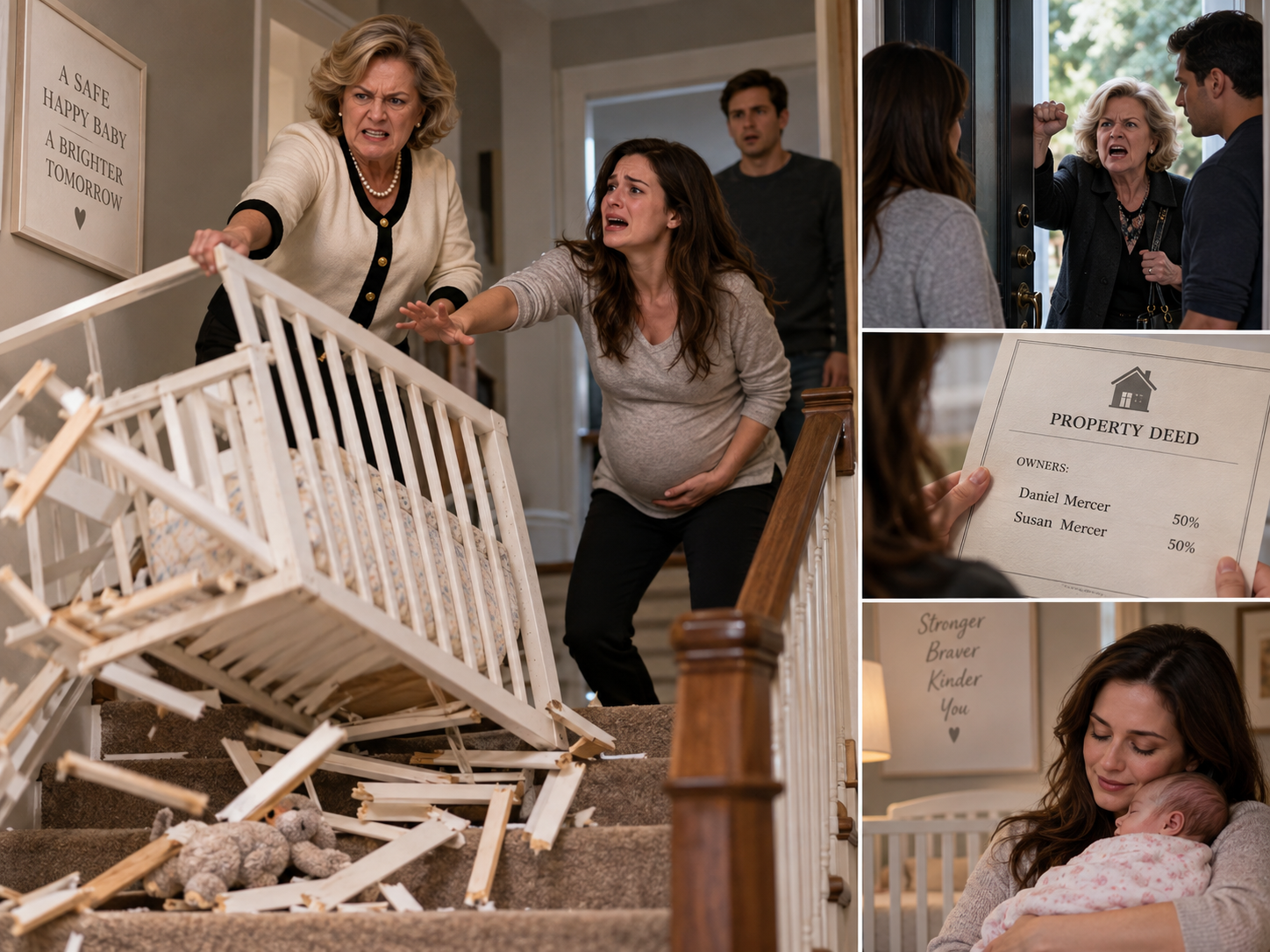
The same woman who had thrown an empty crib down a staircase now held my daughter as if she were made of glass.
The contradiction hurt.
Because people are rarely monsters every minute.
That would make leaving easy.
Susan loved Emma.
I could see that.
She loved Daniel.
I believed that too.
The problem was that Susan had spent years confusing love with authority.
And Daniel had spent years accepting the confusion.
“I’m sorry about the crib,” she said.
I looked at her.
Daniel looked at her too.
Susan kept her eyes on the baby.
“I should not have done that.”
It was not a perfect apology.
But it was the first one.
“Thank you,” I said.
She nodded.
Then added, “I was angry.”
I waited.
I could almost see the explanation forming.
The instinct to justify.
To tell me what I had done to provoke her.
Susan swallowed it.
“I was angry,” she repeated, “and I behaved badly.”
Daniel looked down.
I wondered whether he had talked to her.
Probably.
But the apology still came from her mouth.
That mattered too.
When Susan returned Emma to me, she touched the baby’s blanket.
“I kept the old family crib.”
My body tensed.
Susan noticed.
“She won’t use it,” she said quickly.
Then, almost awkwardly, “I understand that now.”
I nodded.
We did not become friends.
We did not hug.
There was no miracle.
There should not have been.
Some damage can be acknowledged without being erased.
Susan left after thirteen minutes.
At the doorway, she turned.
“Laura?”
“Yes?”
“If you need anything…”
She stopped.
For once, she seemed to understand that the sentence itself was dangerous.
She changed it.
“If you want anything, you can ask.”
“Okay.”
Then she left.
Two days later, I brought Emma home.
My home.
The apartment still smelled slightly like fresh paint.
The living room furniture did not match because half of it came from storage and half was bought secondhand.
The kitchen was narrow.
The bathroom fan rattled.
There was no staircase.
That made me strangely happy.
Daniel carried Emma’s car seat into the nursery.
The room was small.
Sunlight came through cheap white blinds.
Against the far wall stood her crib.
A new one.
White wood.
Simple lines.
I had assembled most of it myself at thirty-six weeks pregnant until my swollen ankles forced me to stop.
A neighbor helped tighten the last few bolts.
Daniel had never seen it.
He stood in the doorway.
His expression changed.
“This is the one?”
“Yes.”
“It’s nice.”
“I like it.”
He stepped closer.
His fingers touched the rail.
I watched his face and knew he was thinking about the first crib.
The sound of it breaking.
The beginning of the end.
Or maybe the beginning of something else.
“I found a place,” he said quietly.
I looked at him.
“What?”
“An apartment.”
I had known he was still living in the house with Susan.
Or rather, Susan was living in the house with him.
It had lasted less peacefully than she expected.
I knew that from his occasional comments.
Susan reorganized the pantry.
Susan complained about his laundry.
Susan wanted him home for dinner.
Susan wanted to know why he spent evenings at my apartment helping with prenatal appointments and assembling baby equipment.
The irony was so obvious neither of us needed to point it out.
“You’re leaving the house?”
He nodded.
“Mom can keep it for now.”
“What about your ownership?”
“I’ll deal with it later.”
I stiffened.
He saw it.
“No.”
He shook his head.
“I don’t mean ignore it.”
He took a breath.
“I mean I’m not waiting until the property problem is solved before I change how I live.”
That sounded different.
He had started therapy three weeks earlier.
His decision.
Not mine.
I had told him I would not promise reconciliation.
He said he understood.
For the first time, I thought maybe he actually did.
“Where is the apartment?” I asked.
“About fifteen minutes from here.”
“For Emma?”
“And me.”
I nodded.
“That’s good.”
He looked at the crib again.
“Laura.”
“Yes?”
“I know saying sorry doesn’t fix what I did.”
“No.”
“I keep thinking about the night you left.”
I waited.
“When you said I loved you but never enough to disappoint my mother.”
His eyes dropped.
“You were right.”
I didn’t respond.
He continued.
“I thought being a good son meant preventing her from feeling abandoned.”
“That’s not your job.”
“I know that now.”
“Knowing and doing are different.”
“I know.”
He gave a sad smile.
“I’m learning that too.”
Emma stirred in my arms.
Daniel reached toward her but stopped.
“Can I?”
I handed her to him.
He held her against his chest.
His face softened.
Watching him with her was almost unbearable.
This was the man I had married.
Not the liar.
Not the coward.
Not the son trapped between two women.
The man underneath all of that.
The problem was that marriage could not survive on the person underneath.
It had to survive on the person who showed up.
“I filed,” I said.
Daniel went still.
He knew what I meant.
The separation paperwork.
Not yet divorce.
But formal.
Real.
He looked at Emma.
Then at me.
“When?”
“Yesterday.”
He nodded slowly.
“Okay.”
I expected an argument.
I almost wanted one.
Instead he said, “I understand.”
Tears burned my eyes.
“Do you?”
“I think so.”
He looked around the nursery.
“I spent years trying to keep from losing my mother.”
His voice broke slightly.
“And I almost lost my wife because of it.”
I looked at him.
“Daniel.”
“I’m not saying that to make you feel guilty.”
“Good.”
“I just need you to know I understand what I did.”
I nodded.
That was all I could give him.
Three months later, the house went on the market.
Susan did not want to sell.
Daniel did.
For the first time in his adult life, he refused to let her anger make his decision for him.
There were arguments.
I heard about them only when they affected Emma’s schedule.
I stayed out of them.
That house was no longer my battlefield.
Eventually Susan agreed.
Not because she suddenly respected boundaries.
Because keeping the property alone was expensive, and buying Daniel out was more than she wanted to spend.
When the sale closed, Daniel returned part of the money I had contributed to major improvements.
He did it voluntarily.
I accepted it.
Not as charity.
Not as reconciliation.
As acknowledgment.
We never pretended the paper had not mattered.
We learned that paper matters precisely because promises sometimes fail.
Susan rented a townhouse twenty minutes away.
She asked before visiting Emma.
Most of the time.
The first time she appeared without calling, I did not open the door.
She stood outside for two minutes.
Then left.
She called later.
“I forgot.”
“No, you didn’t.”
Silence.
Then, “You’re right.”
She never did it again.
That was our relationship now.
Not warm.
Not cruel.
Defined.
Boundaries did not make Susan love me.
They made loving Emma possible without letting Susan control us.
Daniel and I remained separated through Emma’s first year.
He came to pediatrician appointments.
He learned bottles.
Diapers.
Night routines.
He once spent forty minutes walking circles around my living room while Emma screamed from teething pain.
He never called Susan for instructions.
That sounds small.
It wasn’t.
Sometimes I saw the man I had married.
Sometimes I saw the man who had lied to me.
Both were real.
Healing required me to stop pretending one canceled out the other.
On Emma’s first birthday, we had a small party in a local park.
Susan came with a wrapped gift.
She handed it to me instead of opening it herself.
Another small thing.
I opened it beside Emma.
Inside was a hand-sewn quilt.
Not the old crib.
Not a family object I was expected to use.
A new quilt.
On the corner, Susan had stitched Emma’s name and birthday.
“It’s beautiful,” I said.
Susan looked relieved.
“I thought you could decide whether she uses it.”
The sentence was almost funny.
Almost.
“I think she will.”
Susan smiled.
Across the picnic table, Daniel watched us.
Later, when the guests were gone and Emma was asleep against my chest, he helped me carry gifts to my car.
He closed the trunk.
“Do you ever think about coming back?”
I knew he did not mean the house.
The house was gone.
He meant us.
I looked at him.
A year earlier, I would have rushed to give an answer.
To soothe him.
To save him from uncertainty.
I no longer did that.
“Sometimes,” I said.
Hope flashed across his face.
I raised a hand.
“That is not a promise.”
“I know.”
“I don’t know if trust comes back.”
“I know.”
“You don’t get to become better just so I return.”
“I know.”
“You have to become better because you don’t want to live like that anymore.”
He nodded.
“That’s what I’m trying to do.”
For once, I believed him.
Not because he said it.
Because for twelve months, his actions had stopped requiring me to believe words alone.
Maybe our marriage would survive.
Maybe it wouldn’t.
That is not the ending people usually want.
They want a door either slammed shut or thrown open.
They want forgiveness or revenge.
They want the mother-in-law defeated.
The husband redeemed.
The wife victorious.
Real life gave me something less dramatic and more valuable.
Choice.
The house was sold.
Susan had her own place.
Daniel had his.
I had mine.
No secret names on deeds.
No hidden arrangements.
No keys I didn’t know about.
No furniture arriving for people who had decided my future without asking me.
That night, after Emma’s birthday party, I carried her into her nursery.
She was heavy with sleep.
Her cheek rested against my shoulder.
I lowered her into the crib.
The white rails were still clean except for one tiny tooth mark where she had recently started chewing the edge.
I smiled.
I remembered the first crib.
The crash.
The splintering wood.
Susan’s voice from the top of the stairs.
Things in this house are going to be done my way.
For a long time, I thought the worst thing she destroyed that day was the crib.
It wasn’t.
She destroyed the illusion that silence was peace.
She exposed a marriage built partly on things I had never been told.
She showed me that a home could look like mine, feel like mine, contain all my belongings, all my effort, all my love—and still belong to someone else on paper.
It hurt.
It humiliated me.
It nearly broke me.
But once I saw the truth, I could not be pushed back into ignorance.
Emma shifted beneath her blanket.
I touched two fingers lightly to her back.
“Your home,” I whispered, “will never be a place where love means surrender.”
She slept on.
I walked to the nursery door.
Before turning off the light, I looked once more at the crib.
Solid.
Safe.
Chosen by me.
No history attached.
No debt.
No obligation disguised as tradition.
Just a place for my daughter to sleep.
I turned off the light.
Then I closed the door quietly behind me.
And for the first time in a very long while, everything inside my home was exactly where I had chosen to put it.