For two days, Daniel behaved as if normal life could be restored through small acts of usefulness.
He ordered a replacement banister bracket where the crib had struck the wall.
He swept the remaining splinters from the entryway.
He brought home Thai food because I liked the coconut soup from the place near his office.
He touched my shoulder more often.
He asked if the baby had been moving normally.
He avoided every important question.
I let him.
Not because I had forgiven him.
Because I had started paying attention.
There is a difference between suspicion and knowledge.
Suspicion makes you frantic.
Knowledge requires patience.
I had spent most of my marriage assuming Daniel’s silences were kindness.
He hated conflict. That was how I explained it.
When Susan criticized the color we painted the dining room and Daniel changed the subject, I called him diplomatic.
When she invited herself to our anniversary dinner and Daniel said it would be cruel to ask her to leave after she had driven forty minutes, I called him compassionate.
When she reorganized my kitchen because my system was “inefficient,” and Daniel laughed and said at least we got free labor, I told myself he was trying to keep the peace.
I had mistaken avoidance for gentleness.
Now I wondered how much of our marriage had been shaped by that mistake.
On Friday afternoon, I was folding baby clothes in the nursery when the doorbell rang.
For one terrible second, I expected Susan.
Instead, it was a delivery driver.
He had two large cardboard boxes.
“Laura Mercer?”
“Yes.”
“These go upstairs?”
I looked at the shipping label.
The name was Susan Mercer.
The address was ours.
“What are they?”
“Furniture, I think.”
“I didn’t order furniture.”
He checked his tablet.
“Delivery notes say second-floor guest room.”
My skin went cold.
“Leave them here.”
He carried both boxes inside.
After he left, I stood over them.
The first was labeled PORTABLE WARDROBE STORAGE SYSTEM.
The second was a compact writing desk.
I called Daniel.
This time he answered.
“Hey.”
“Why is your mother having furniture delivered here?”
Silence.
Not surprise.
Silence.
“Daniel.”
“I was going to talk to you.”
My fingers tightened around the phone.
“When?”
“Tonight.”
“That phrase is becoming meaningless.”
“I know.”
“No, I don’t think you do. Why is Susan sending a desk and wardrobe to our guest room?”
He exhaled.
“Because she was planning to stay for a while after the baby comes.”
I stared at the boxes.
“A while?”
“Just to help.”
“How long?”
“We hadn’t worked out an exact—”
“How long?”
“Maybe a few months.”
For several seconds I couldn’t speak.
The baby pressed hard against the left side of my stomach.
I lowered myself onto the bottom stair.
“A few months.”
“She wants to help us.”
“She lives forty minutes away.”
“Exactly. It would make things easier.”
“For who?”
“For everybody.”
I laughed.
The sound came out breathless.
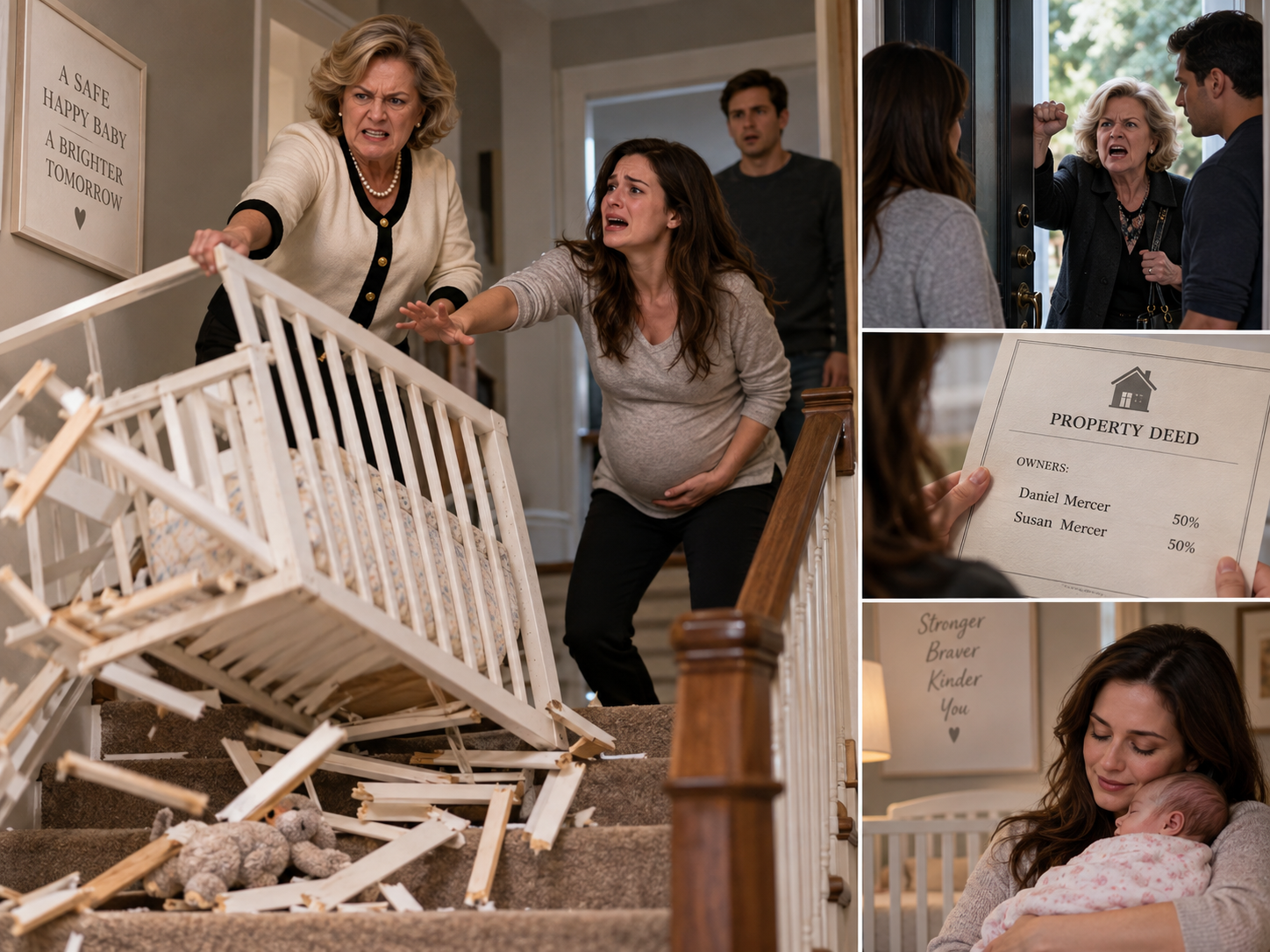
“She destroyed the crib two days ago.”
“That happened after we discussed this.”
I closed my eyes.
“How long have you been discussing it?”
Another silence.
“Daniel.”
“Since July.”
It was October.
“You’ve been planning for your mother to move into our house for three months?”
“Not move in permanently.”
“Without telling me.”
“I was going to.”
“She ordered furniture.”
“I know.”
“She put our address on it.”
“I know.”
“So everybody knew she was coming here except the pregnant woman who actually lives here?”
“That’s not fair.”
My anger sharpened.
“You keep saying that when what you mean is you don’t like hearing it.”
He lowered his voice.
“I didn’t know how to bring it up.”
“You say, ‘Laura, my mother wants to stay with us after the baby is born. What do you think?’”
“She was going to be helpful.”
“That was not your decision to make by yourself.”
“It’s my house too.”
“Then why didn’t you tell me?”
Silence.
I waited.
Finally he said, “Because I knew you would say no.”
There are sentences that change a marriage.
Not because they reveal something new.
Because they confirm something you have been trying not to see.
I stood slowly.
“So you decided my answer didn’t matter.”
“That’s not what I said.”
“It is exactly what you said.”
“Laura, please. We’ll talk tonight.”
“No.”
“What?”
“Your mother is not moving in.”
“We need help.”
“I need peace.”
“She’s still my mother.”
“And I am still your wife.”
“I know.”
“Do you?”
“Of course I do.”
“Then choose to act like it.”
I hung up.
For the next hour, I moved through the house in a strange state of calm.
I dragged the unopened boxes into the garage.
I changed the sheets on the guest bed even though no one had slept there.
I opened the closet.
There were four empty hangers.
Then I noticed a plastic storage tub on the top shelf that I didn’t recognize.